





Paragraph 1: The Fracture of a Quiet Evening
The late-spring evening in the Anne Arundel County neighborhood of Glen Burnie must have started with ordinary intentions—perhaps the fading sunlight casting long shadows across driveways, the distant sound of lawnmowers, and the simple, unremarkable rhythm of a Thursday night. It was a short drive to the intersection of North Crain Highway and 11th Avenue, a stretch of road that likely sees its share of commuters and errand-runners, but on May 7th, it became the flashpoint for a sequence of events that would rapidly unravel into chaos and violence. It began, according to police, as a routine report of a hit-and-run, a common enough occurrence where frazzled drivers tap bumpers and exchange insurance information. But when officers arrived, the situation had already metastasized into something far more darkly personal. A 28-year-old woman named Jasmin L. Cooper had crashed her vehicle, but instead of waiting for the authorities, she made a devastating choice that cut straight to the heart of family loyalty. When a relative—described by police in the initial reports—arrived at the scene to offer help, presumably driven by concern and love, Cooper forcibly commandeered that person’s vehicle, turning a moment of familial support into a terrifying violation. The car she took was not just a mode of transport; it was property that belonged to someone who cared enough to show up amid the wreckage. In that single, desperate act, she severed a bond and ignited a pursuit that would have life-altering consequences for herself, for the officers tasked with stopping her, and for the family members left to process the betrayal.
Paragraph 2: The Lens of the Body Camera and the Futile Negotiation
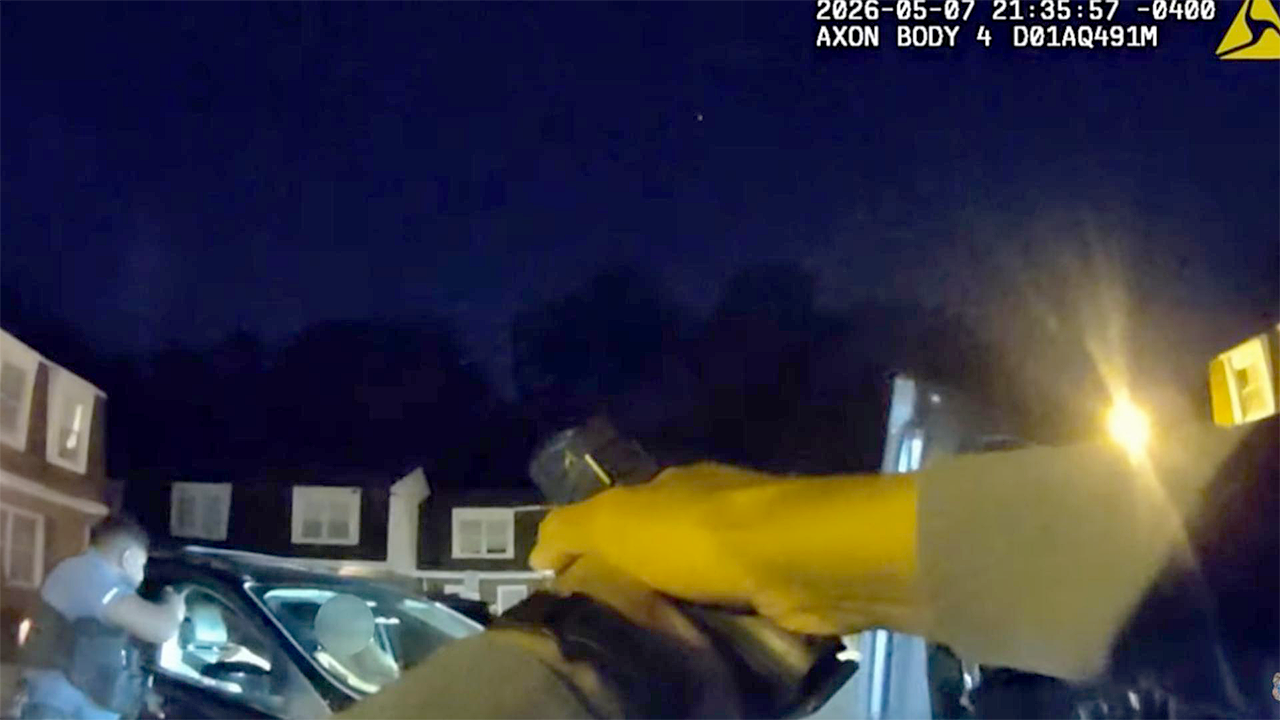
The pursuit that followed was not a mere high-speed chase through open highways; it was a grinding, desperate crawl through the traffic-clogged arteries of a suburban community, as Cooper attempted to evade the inevitable. The reality of this drama is now preserved in the stark, grainy footage of police body-worn cameras—a medium that never lies and leaves little room for fiction. In the released video, we see the scene unfold from the perspective of the officers on the ground. The air is thick with the static of police radios, the sharp commands of officers shouting through the amplified speakers of their cruisers, and the low, anxious hum of idling engines. The camera captures the moments of high-pitched tension as officers approach the stolen vehicle, their weapons drawn and aimed at the woman inside. Their voices are strained, desperate to end the standoff peacefully, barking orders that cut through the evening air: “Turn the car off!” and “Get out of the car!” Inside the vehicle, Cooper is a ghost silhouetted against the dashboard lights. For one fleeting, hopeful instant, she complies partially—raising her hands in the air, a universal symbol of surrender. But that hope evaporates quickly as she refuses to exit the vehicle, remaining a statue of defiance behind the wheel. It is in this tenuous moment that the footage captures a piece of starkly human dialogue from one of the officers, a moment of grim perplexity muttered almost under his breath: “So what, she stole her son’s car?” The comment hangs in the air, laden with confusion and a hint of dark irony. It reveals the heartbreaking twist at the center of the case: the “family member” who came to help was likely her own child or a close relative, and the car she commandeered belonged to that person. This off-camera muttering humanizes the officers, who were not just robotic enforcers but men trying to make sense of a woman who seemed intent on spiraling out of control.
Paragraph 3: The Roar of Desperation and the Split-Second Calculus
A standoff cannot last forever; desperation eventually finds a release valve, and in this case, it came with the sudden, mechanical roar of an engine. With officers positioned around the vehicle, their firearms leveled and their lives on the line, Cooper made a decision that changed the trajectory of the evening from a tense negotiation into a lethal confrontation. Whether it was a panic-fueled mistake, a deliberate act of aggression, or a misguided attempt to escape, the footage shows the vehicle surging forward, hurtling directly toward the officer with the most immediate and dangerous threat. The result was a violent chain reaction—the stolen car struck an officer, ricocheted into two patrol cruisers, and slammed into another vehicle. In that fraction of a second, the officers on the scene faced a harrowing calculus that no training can fully prepare a person for: the split-second decision to use deadly force to protect themselves and the public. The barrage of gunfire that erupted shattered the suburban quiet, a noise so violent it would have sounded like fireworks gone horribly wrong to nearby residents. As the rounds were discharged, the immediate threat was neutralized, but the cost of that action was immense. The scene shifted from a chaotic pursuit to a scene of critical trauma. The officers who had just fired their weapons now had to confront the reality of what had just happened—they had shot a woman, and they had to ensure she survived the consequences of her own terrifying choices. The smoke from the gunfire likely lingered in the air, blending with the smell of burned rubber and the metallic tang of blood, as the dichotomy of law enforcement hit home: the duty to protect versus the weight of the trigger.
Paragraph 4: The Ironic Aftermath of Care in the Wake of Violence
In the deafening silence that followed the gunfire, the body camera footage reveals a sobering transition from combat to compassion. The woman who had moments before been the adversary was now a wounded human being lying on the pavement, her body broken by the bullets fired to stop her. The officers, who had just been in mortal danger, immediately shifted their focus to providing first aid. The video captures the surreal, tragic tableau: the woman lying motionless except for the shallow rise and fall of her chest, her hands being pulled behind her back and secured in handcuffs, even as medical attention is applied. The same hands that had gripped the steering wheel in defiance were now being tended to by the very people she had tried to run over. The officers knelt beside her, applying pressure to her wound, talking to her in low, calming voices, perhaps trying to keep her conscious as sirens from approaching ambulances wailed in the distance. Meanwhile, the officer who had been struck by the vehicle was also receiving assistance, nursing injuries that were thankfully non-life-threatening but undoubtedly painful and jarring. In that immediate aftermath, there is a powerful, humanizing symmetry: two people—a suspect and a law enforcement officer—both bleeding, both vulnerable, both in need of help. It is a stark reminder that the aftermath of a shooting is never clean or triumphant. It is a messy, bloody, and deeply human affair where the lines between enemy and patient blur entirely, and where the officers are forced to live with the double burden of having pulled the trigger and having to save the life they nearly ended.
Paragraph 5: The Sterile Language of Charges and the Fragmented Remains of a Life
As the medical helicopters or ambulances departed, the legal machinery began to grind into motion, reducing a night of chaos into a litany of formal accusations. The injures sustained by Cooper were serious but, mercifully, non-life-threatening; she was stabilized and later taken into custody. The charges filed against her read like a grim catalogue of escalating offenses: carjacking, attempted carjacking, multiple counts of reckless endangerment, assault in the first and second degrees, and related charges. These legal terms, however, fail to capture the full tragedy of the ruined relationships and shattered trust. The carjacking charge alone carries massive weight—it is a violent felony that speaks to the level of fear inflicted upon a victim. The fact that the victim was a family member, perhaps her own child, adds an unforgiving layer of devastation that no courtroom can address. The first-degree assault charges reflect the severity of the actions against the officer who was struck, a person who was simply doing their job and who now carries both physical and psychological scars. In the coming weeks, Cooper will face a legal system that will demand accountability for these actions. She will sit in a courtroom, likely looking small and fragile in a jail jumpsuit, as prosecutors lay out the evidence, the body camera footage playing for a jury. But behind the sterile legal jargon lies a broader truth: this is a young woman whose life has fundamentally shattered. Whatever led her to that intersection—addiction, mental health crisis, desperation, or simple poor judgment—has culminated in a situation where she faces decades behind bars, leaving a family grappling with grief, anger, and the painful question of how someone they loved could betray them so violently.
Paragraph 6: The Human Reflection on Fear, Flight, and the Thin Blue Line
When we consume these stories through headlines and blurbs, it is easy to reduce them to statistics or political talking points about policing and crime. But the footage from Anne Arundel County serves as a visceral, uncomfortable reminder that behind every police report is a web of human frailty, fear, and flawed decision-making. We must ask ourselves: what would drive a woman to flee from officers with such suicidal desperation? The flight instinct that took over her body at that intersection is a primal, lizard-brain response that bypasses logic entirely. She likely felt trapped, terrified of the consequences of her initial reckless driving, and her mind collapsed into a singular, irrational focus on escape at any cost—even the cost of driving into an officer. For the officers on the scene, they were forced into the impossible role of guardians and executioners in the same breath, tasked with making a split-second decision that could save lives or take one. This incident is not a simple story of good versus evil; it is a story of cascading poor decisions meeting the hard, unyielding wall of the law. It is also a story about the fragility of the community itself, where a person’s worst moment ripples out to affect her family, the emergency responders who witnessed the trauma, and the residents who heard the gunshots echo through their quiet neighborhoods. As the case moves forward, we are left to ponder the deeper systemic questions: was there a moment earlier in the evening—or earlier in her life—where intervention could have prevented this? For Cooper, the road will be long and painful, leading through courtrooms and correctional facilities. For the officer who was struck, the physical injuries will heal, but the memory of facing a speeding vehicle will likely linger. In the end, this is a tragedy in every sense of the word—a tragedy of hubris, fear, and the profound, often destructive complexity of the human heart, reminding us that the thin blue line is not just a barrier against crime, but a fragile membrane separating order from absolute, devastating chaos.