





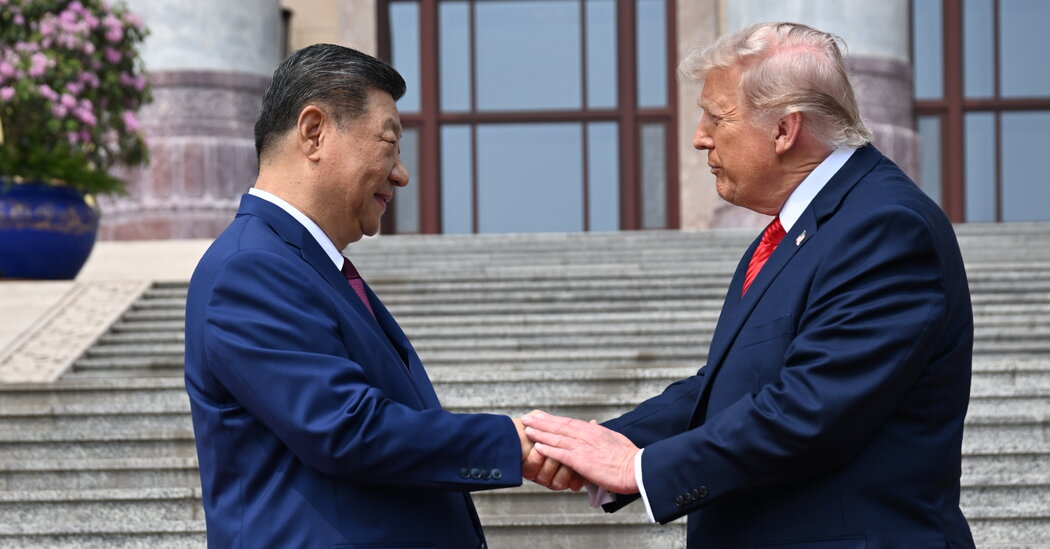
Imagine a crisp autumn day in Beijing, where two titans of the world stage come face to face, not as bitter rivals, but almost like old acquaintances testing the waters of diplomacy. President Donald Trump and China’s leader Xi Jinping greet each other with firm handshakes, then embark on a leisurely walk that feels more like a stroll through history than a high-stakes negotiation. Trump reaches out, touching Xi’s arm not once, but twice, a gesture that speaks volumes in the silent language of power plays. For two men whose nations clash over issues like Taiwan’s future, trade imbalances, and the scarcity of rare earth minerals, this meeting radiates a surprising warmth. It’s as if they’ve decided, at least for this moment, to dial down the enmity and lean into something more collaborative. Trump’s public rants against China back home contrast sharply with this scene, and unlike his tense standoffs with allies like Germany’s chancellor or NATO’s brass, this feels genuine—an attempt to rewrite the script of their fraught relationship. They emerge from their walk exchanging more handshakes, a ritual that underscores a tentative peace, reminiscent of how global leaders have historically bridged divides through these small, symbolic acts. Experts watching closely note that this body language hints at a mutual desire to soften edges, each leader signaling respect in their unique way. Trump’s overt friendliness, like a eager partner seeking approval, stands out against Xi’s measured composure, painting a picture of two cultures colliding in pursuit of common ground. In the grand tapestry of international relations, Thursday’s encounter at the Temple of Heaven feels like a human chapter, where personal rapport might just overshadow ideological rifts.
Yet, this apparent camaraderie starkens when compared to Trump’s other diplomatic encounters, revealing the raw humanity beneath the suits and titles. Picture Trump in the Oval Office with Ukraine’s president—awed, perhaps intimidated, the interaction fraught with unspoken tensions that left the room feeling electric and uneasy. Or consider his infamous 19-second handshake with Japan’s prime minister, a power grip that came across as more domination than dialogue, leaving onlookers wondering if it was a test of wills rather than a greeting. These moments highlight Trump’s reputation for a gruff exterior, especially towards traditional allies, creating scenes that feel like awkward family reunions where old grievances linger in the air. But with Xi, something shifts; it’s as if Trump tucks away that edge, channeling instead a version of himself that’s approachable and eager. Xi, for his part, maintains his enigmatic reserve, a cultural hallmark of restraint that contrasts Trump’s expressive American showmanship. This meeting’s ease suggests both leaders are cognizant of the fragile truce they’ve built since their nations’ trade wars escalated last year, when tariffs flew back and forth like accusations in a marital spat. Observers like Melanie Hart from the Atlantic Council point out Trump’s “thirsty” energy, a palpable longing for personal connection with Xi, as if believing a genuine bond could unlock exclusive deals. Humanizing this, it’s like watching two CEOs from rival firms tentatively shake hands after years of litigation, hoping rapport translates to profits. The scene isn’t triumphant or aggressive; it’s hopeful, a testament to how body language can humanize leaders, turning geopolitical chess games into relatable quests for mutual understanding.
As they walk side by side, the backdrop of the ancient Temple of Heaven adds a layer of poetic depth, transforming their promenade into a symbolic journey through time. The Ming dynasty complex, with its red carpets and imperial echoes, frames their steps along a long path flanked by a military band, the band’s tunes underscoring the occasion like a soundtrack to reconciliation. Experts like Lyle Morris from the Asia Society Policy Institute dissect the subtleties: Xi skillfully avoids Trump’s signature “power pull,” refusing to let his hand be drawn closer, a subtle assertion of equality. Instead, Trump softens the moment with gentle taps on Xi’s hand using his left, a rare display of extra warmth that signals trust beyond mere protocol. Each man pauses to shake hands with entourages—Trump introducing a cadre of American business executives, a gesture he calls a show of “respect” while lobbying for better market access in China. Xi, conversely, arrives without a countergroup, his presence alone standing as testament enough. This asymmetry feels human, like choosing different outfits to the same party: Trump’s entourage brings energy and intention, Xi’s brings dignified presence. The physical closeness they maintain, smiling and chatting easily, contrasts the stilted silence that marked their South Korea meeting amid trade tensions and Trump’s sudden nuclear testing announcement. There, handshakes felt obligatory; here, they flow naturally, humanizing the leaders as men capable of laughter and leisure even as their worlds teeter on brinkmanship. It’s a reminder that beneath the weight of global expectations, these figures share the universal impulse to connect, their walk a ballet of diplomacy where every step and touch narrates unspoken alliances.
Approaching a cluster of children waving flowers and flags, the leaders’ contrasting personalities shine through in charming, relatable ways, turning a diplomatic event into a feel-good tableau. The kids, eyes wide with excitement, hop and cheer, their youthful energy a stark counterpoint to the strategized solemnity of the summit. Trump, ever the crowd-pleaser, claps enthusiastically and beams at the throng, his casual gestures—looking around, waving back—mirroring an American everyman’s charm at a neighborhood parade. Xi, in keeping with his stoic reputation, offers short, measured waves, his posture reserved as he occasionally glances at the hovering cameras, as if mindful of the world’s watchful gaze. Expert Lyle Morris likens Trump’s flair to unscripted showmanship, brimming with enthusiasm that feels authentic and inclusive, while Xi’s demeanor stays scripted, guarded—a cultural rhythm honed by years in China’s structured hierarchy. The children themselves embody innocence, falling silent in orderly rows once the leaders pass, adding a poignant layer of discipline to the scene. This moment humanizes the encounter, evoking memories of family gatherings where one relative thrives on theatrics and another prefers quiet observation. It’s not just politicking; it’s a relational dance, reminding us that leaders, too, respond to the universal joy of children’s delight, their smiles and waves a bridge between generations and ideologies.
Climbing the grand staircase after their promenade, the interaction deepens, with Trump pausing to touch Xi’s arm twice more, a repeat of his earlier warmth that softens the ascent into the symbolic heart of power. Reflecting on their strained meeting in South Korea last year, where tensions over trade and nuclear rhetoric hung heavy, this exchange feels like a redemption arc. Trump praises Xi as a “great leader” and speaks glowingly of how they’ve “worked it out” through past difficulties, his words infused with the optimism of a deal-maker sensing opportunity. At the televised state banquet, he toasts their “fantastic future together,” calling their friendship an honor and predicting relations better than ever—language that personalizes geopolitics, framing it as a partnership between pals rather than nations. Xi, however, sets clearer boundaries, urging caution on Taiwan with references to ancient histories of rivalry, his tone more sage advisor than eager ally. He emphasizes shared interests over differences, calling their stable ties “a boon to the world,” painting a pragmatic canvas far removed from Trump’s effusive hopes. This disparity in demeanor humanizes them: Trump as the charismatic salesman, always pitching the next big win, and Xi as the prudent steward, prioritizing balance. Their differing accounts of the talks—America highlighting investments and fentanyl curbs, China focusing on Taiwan and strategic stability—highlight how perceptions shape reality, much like couples differing on a date’s highlights. It’s relatable, echoing everyday human tendencies to see events through our own lenses, turning high diplomacy into a story of mismatched expectations and cautious optimism.
In the end, experts like Melanie Hart and Ryan Hass dissect these dynamics, noting the leaders’ belief in mutual gain if navigated wisely, with wildly different visions unfolding. Hart observes Trump’s personal yearning for rapport with Xi, hoping it yields special deals, while Hass contrasts the readouts as “almost two different meetings,” underscoring cultural and perceptual chasms. Lily Kuo’s reporting amplifies this, weaving in global context that reminds us of the human stakes—economies, lives, and futures hanging in the balance. Humanizing this summit, it’s akin to two neighbors mending fence disputes: one outgoing, bearing gifts, the other guarded, valuing respect over grand gestures. Through friendly walks, arm touches, and toasts, Trump and Xi transform rivalry into a hopeful dialogue, suggesting that even in a complex, often adversarial world, personal connections can pave tentative paths forward. This meeting, with its body language as a universal translator, leaves us with a sense of possibility—that beneath the headlines, leaders are people, capable of warmth in the face of discord, striving for the kind of understanding that could rewrite the rules of their burdensome relationship. As they depart with parting handshakes, the scene lingers not just as politics, but as a testament to humanity’s enduring quest for harmony.