





In the quiet corridors of global power and along the wind-swept, oil-slicked shores of the Persian Gulf, a palpable sense of dread has settled over the international community. The fragile peace that has long hung over the Middle East by a fraying thread was violently torn apart this week, pushing two heavily armed nations to the precipice of a devastating, full-scale military conflict. In Washington, the atmosphere is thick with a mixture of calculated resolve and highly volatile rhetoric, as policymakers, military strategists, and ordinary citizens watch a rapidly unfolding crisis that threatens to redefine global politics and reshape energy markets forever. What began as a series of localized skirmishes has swiftly ballooned into an existential confrontation, turning the strategic waterways of the Gulf into a staging ground for a clash of monumental proportions. Behind the headlines of airstrikes and military maneuvering lies a deeply human story of anxiety—not just for the soldiers stationed on the front lines and the sailors navigating treacherous waters, but for the millions of ordinary civilians across the Middle East whose lives and livelihoods are held hostage by the decisions made in remote command centers. The psychological toll of this escalating tension is immense, casting a shadow of uncertainty that stretches from the busy markets of Tehran to the quiet suburbs of America, where families of deployed military personnel wait in agonizing suspense for the next update. As the drumming of war beats louder, the world is forced to confront the terrifying reality that the margin for error has evaporated, leaving behind a volatile landscape where a single miscalculation can trigger a catastrophic chain reaction across the entire globe.
The current cycle of violence was ignited by a dramatic and tragic encounter in the skies above the Strait of Hormuz, one of the world’s most critical maritime chokepoints and a constant flashpoint for geopolitical tension. On Tuesday evening, an American Apache helicopter patrolling these highly contested waters was targeted and brought down by an Iranian drone, a hostile act that instantly transformed the cold war between Washington and Tehran into a hot, shooting conflict. The downing of the helicopter was not merely a loss of sophisticated military hardware; it represented a direct, violent assault on American service members who risk their lives daily to keep global shipping lanes open. In the immediate aftermath of the crash, the Pentagon moved swiftly, launching a series of retaliatory airstrikes designed to dismantle the very military infrastructure that enabled the drone attack. For two consecutive days, American warplanes and naval assets pounded Iranian targets, lighting up the night sky with explosions and sending shockwaves through the region. This swift escalation reflects the intense pressure on military leaders to project strength and protect their forces, but it also underscores the terrifying speed with which localized military engagements can spiral out of control. To understand the human dimensions of this conflict is to recognize the sheer terror of those minutes in the air, the desperate search and rescue operations that followed, and the heavy burden carried by commanders who must decide how many lives to risk in the name of deterrence and national honor.
In characteristic fashion, President Donald Trump bypassed traditional diplomatic channels to deliver a stark, uncompromising message directly to the world via his Truth Social platform, signaling an imminent and massive escalation of hostilities. Trump announced in no uncertain terms that the United States would be striking Iran “VERY HARD TONIGHT,” asserting with supreme confidence that the Islamic Republic’s navy, air force, radar systems, and anti-aircraft defenses had already been completely dismantled. This raw, direct style of communication bypassed the highly polished veneer of traditional statecraft, delivering a psychological blow designed to project absolute American dominance while leaving no doubt about his administration’s willingness to use overwhelming force. For the families of service members deployed in the region, such social media pronouncements carry a heavy weight, transforming a highly technical military operation into an immediate, breathing reality of impending danger. By declaring Iran’s defensive capabilities virtually non-existent, the President sought to reassure the American public of a swift victory, yet the theatrical nature of the announcement also served to heighten global anxiety, as allies and adversaries alike scrambled to decipher the line between strategic posturing and the literal commencement of a historic shock-and-awe campaign. This blend of warfare and digital showmanship highlights the modern reality of geopolitical conflict, where words typed on a screen can mobilize fleets, shake financial markets, and change the course of human history in an instant.
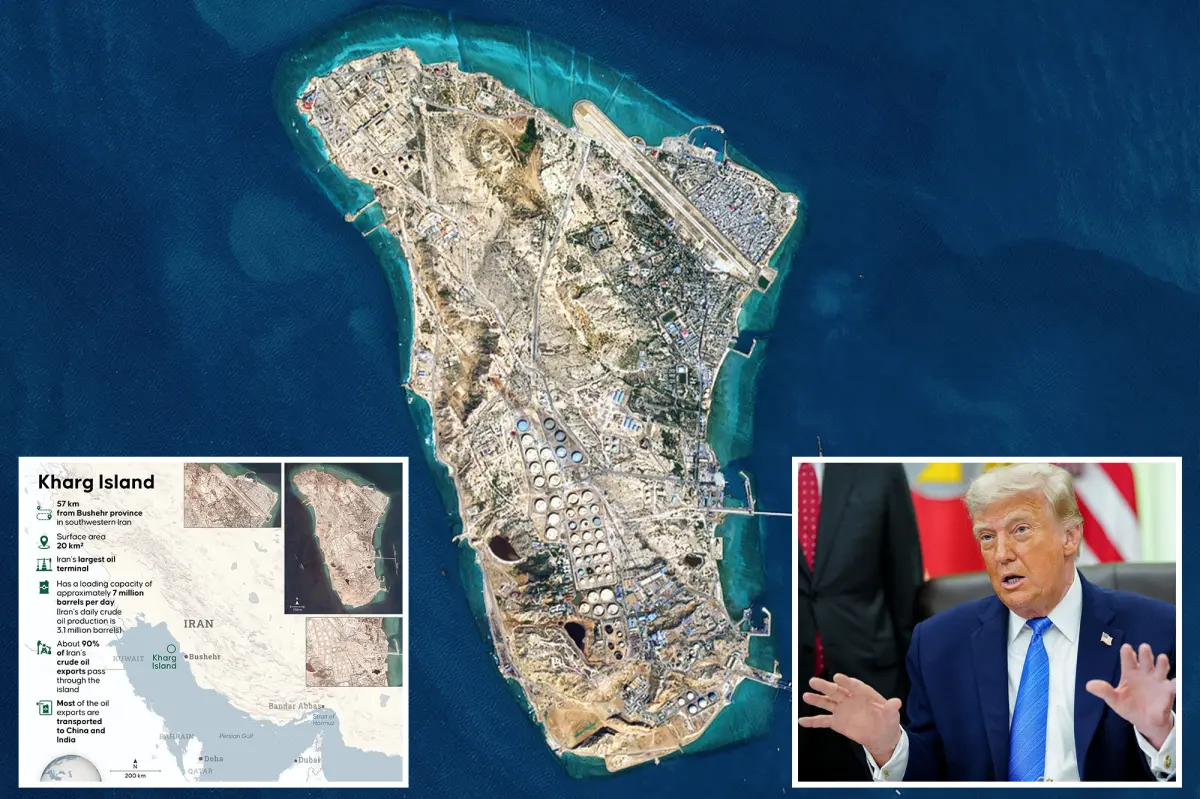
Perhaps the most alarming and geopolitically explosive element of President Trump’s declaration was his explicit warning that the United States would soon seize control of Kharg Island, the crown jewel of Iran’s economic infrastructure. Situated in the northeastern corner of the Persian Gulf, Kharg Island serves as the primary gateway for Iranian commerce, processing an astonishing ninety percent of the country’s crude oil exports and acting as the economic lifeline for its government. Trump’s proposal to take “total control” of Iran’s oil and gas markets—openly drawing a parallel to the aggressive, regime-crippling sanctions and strategic interventions implemented against Venezuela—signals a shift from conventional military deterrence to outright economic warfare of the highest order. For the millions of ordinary Iranian citizens who are already struggling under the weight of severe economic sanctions, the prospect of losing their nation’s primary source of revenue is a terrifying existential threat that promises further poverty, inflation, and social instability. At the same time, global energy analysts are warning that an American military seizure of Kharg Island could trigger an unprecedented supply shock, driving global oil prices to historic heights and impacting consumers worldwide, from drivers at gas pumps in Europe to businesses navigating fragile supply chains in Asia. This intersection of military might and global energy security demonstrates how modern warfare transcends physical battlefields, directly affecting human lives through the invisible mechanisms of global commerce and the raw struggle for resources.
Tehran did not absorb these devastating blows and verbal threats in silence; instead, the Iranian leadership responded with a fierce display of defiance, launching a barrage of missiles aimed directly at American military facilities spread across the region. US installations in Bahrain, Jordan, and Kuwait suddenly found themselves in the crosshairs, as air defense sirens wailed throughout the night, sending thousands of American troops and coalition personnel scrambling into protective bunkers. This calculated military response was a clear signal from Iran that it possesses the reach and the resolve to strike back at the United States and its regional allies, turning neighboring sovereign nations into active zones of conflict. In these moments of terrifying vulnerability, the human reality of war becomes agonizingly clear: young soldiers, thousands of miles away from home, huddled in concrete shelters as the sky above them detonates with the sound of incoming missiles and interceptors. Furthermore, the governments of Bahrain, Jordan, and Kuwait are forced to navigate an incredibly dangerous diplomatic tightrope, caught between their strategic partnerships with Washington and the violent outrage of a powerful regional neighbor. This widening gyre of violence threatens to drag the entire Middle East into a multi-front conflagration, proving that in the modern theater of war, there are no isolated incidents, and the fallout of a single conflict can easily breach national borders to engulf innocent bystander nations.
As the smoke clears from the latest round of strikes and the world braces for the promised escalation, the pathway toward a peaceful resolution seems narrower and more treacherous than ever before. The conflict between the United States and Iran has laid more bare than ever the devastating human cost of brinkmanship, where the pride and strategic ambitions of leaders translate directly into violence, economic ruin, and the loss of innocent lives on the ground. History has repeatedly shown that military occupations and unilateral takeovers of vital resource hubs rarely yield the simple, brilliant outcomes promised by political leaders; instead, they often deteriorate into protracted, grinding conflicts that drain nations of their wealth and moral authority. To humanize this crisis is to look beyond the cold calculations of oil volumes, defense budgets, and troop movements, and to focus instead on the shared humanity of those who will suffer most: the civilian population of Iran facing economic devastation, the American soldiers enduring relentless missile attacks, and a global community yearning for stability in an increasingly chaotic world. As the international community urgently calls for restraint, the choices made in the coming hours will determine whether the region plunges into an era of dark, uninterrupted warfare or if a fragile space can be carved out for diplomacy to silence the guns and avert a global catastrophe.