


At Least 30 Killed in High-Speed Train Collision Near Toledo as Spain’s Rail Safety Crisis Deepens
A Renfe train slammed into an Iryo service on the Madrid-Sevilla line on Wednesday morning, sending carriages off the tracks and triggering an outpouring of grief, political caution, and urgent safety questions.
A Devastating Morning on the Madrid-Sevilla Corridor
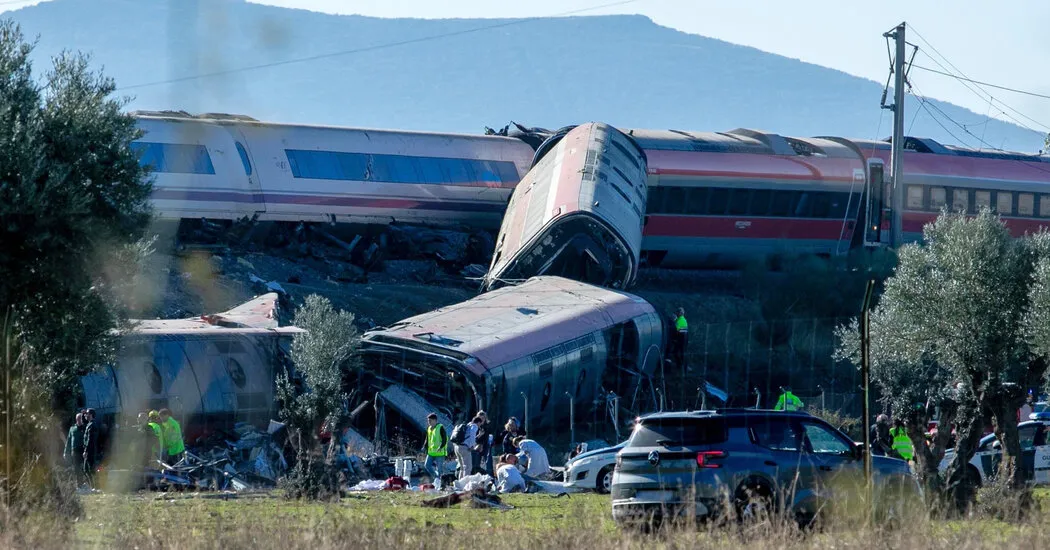
At least 30 people were killed on Wednesday morning when a high-speed passenger train slammed into the back of another train near the Spanish city of Toledo, sending carriages off the rails and down an embankment in a crash that has shattered the country for the second time in less than a year. The death toll was confirmed by a spokesperson for the regional government of Castilla-La Mancha, the district where the accident took place, who spoke on condition of anonymity because they were not authorized to release the figure publicly. The Spanish rail authority, Adif, identified the two trains involved as a Renfe service and another operated by Iryo, saying both were covering the Madrid-Sevilla route. Initial reports suggested that the Iryo train had come to a stop on the tracks and that the Renfe train barreled into it from behind. The Renfe train was carrying 397 passengers, according to local news reports, while the Iryo train had approximately 150 people on board. Isaac Barrientos, a spokesman for Spain’s transportation ministry, told reporters that preliminary information indicated that two carriages of the Iryo train had derailed. The high-speed corridor between Madrid and Seville is one of the busiest in Spain, a route that carries tourists, business travelers and daily commuters through the heart of La Mancha. Toledo, a UNESCO World Heritage city famous for its medieval churches and winding streets, is one of the line’s key stops, and many of the passengers likely had journeys beginning or ending there. The moment of impact was catastrophic. Passengers described being thrown from a dining car, suffering broken limbs, and finding themselves buried beneath other travelers. Some managed to crawl out of shattered windows and stagger into a nearby field, where workers from the surrounding countryside — hearing the sound of the collision — arrived with first-aid kits and discovered the first bodies. The exact sequence of events was still being pieced together, but the force of the crash had left carriages twisted and scattered along the tracks, and rescue teams were carefully working through the wreckage in search of survivors.
A Second Fatal Shock in Less Than a Year
Wednesday’s disaster comes on the heels of an earlier tragedy that had already shaken Spain’s confidence in its railway system. In January, a fatal crash on a southern line involving the same carriers killed 46 people, a death toll that stunned the nation and created deep doubts about the security of what was once a vaunted high-speed rail network. The fact that two deadly accidents involving the same operators have now occurred within a single calendar year has transformed those doubts into a crisis of public confidence. For years, Spain’s high-speed trains were the pride of a country that had emerged from the periphery of Europe to build one of the most advanced transport systems in the world. The Spanish railway network, and especially its high-speed branch, was long considered a model of safety as well as efficiency. The country invested heavily in European-standard signaling systems, concrete-slab track, and sophisticated control centers. That reputation made the January crash all the more surprising, and Wednesday’s collision has made it impossible to dismiss the problem as an isolated event. What makes this accident particularly disturbing is the implication that a stopped train could be struck from behind on a modern high-speed line. That kind of incident should, in theory, be prevented by signaling systems and automatic braking. Investigators have not yet released any findings, but the questions are already being asked across the country. Was the Iryo train stopped because of a mechanical problem? Why was there no warning to the Renfe train? And, above all, what did the people responsible for managing those trains know, and when did they know it? Those questions will likely form the core of a safety review that could take months to complete. But they are also the questions that will be heard in the halls of government, in the news media, and in the homes of ordinary Spaniards who ride these trains every day.
Survivors, Rescuers, and the First Bodies
Accounts from the scene of the crash painted a picture of sudden, chaotic violence. Spanish news reports described an awful impact that tossed passengers out of a dining car, broke limbs, and piled people on top of one another. The dining car, with its open layout and free-moving passengers, was apparently one of the most affected areas. Survivors crawled through broken windows and emerged on the embankment, disoriented and bleeding, before making their way to a field where local workers were already running toward them. Those workers, who had heard the crash and understood immediately that something was wrong, rushed to help with first-aid kits and became the first responders on the scene. They were the ones who saw the first bodies. By the time official rescue teams arrived, the site had already become a swath of organized chaos. Ambulances lined the access roads, helicopters clattered overhead, and police officers began the grim work of marking off the area. The remote location of the collision made the rescue operation slower and more difficult than anyone would have hoped. Several passengers who spoke to Spanish media described the initial seconds as utterly disorienting; the jolt happened so suddenly that many did not know at first where they were or what had occurred. Passengers who were not seriously wounded were helped onto buses and taken to collection points. Others were flown directly to hospitals in Toledo and Madrid. In the hours after the crash, the full scale of the human cost remained unclear, but the testimonies that had emerged suggested that the toll was already heavy, and that it could still rise. Local officials asked the public to stay away from the area so that rescue personnel could work without interruption, while families began the agonizing wait for official lists of victims and survivors.
A Political Storm Paused by Tragedy
The political ramifications of the crash were immediate and unavoidable. With national elections scheduled for the end of November, the accident had the potential to become a turning point in a campaign already defined by sharp disagreements over the competence of Prime Minister Pedro Sánchez’s left-wing government. Within hours, however, the normal rhythm of political combat gave way to a more somber display of unity. Sánchez said he was “shocked by the serious train accident in Toledo,” and his office canceled all of his scheduled meetings for the day. In a message posted on social media, he said emergency services were working on the ground to assist those affected and ensure their safety, in coordination with all the involved administrations. “My affection, solidarity and support to all the victims and their families,” he wrote. The leader of the conservative opposition, Alberto Núñez Feijóo, responded with equal speed, writing that he was “very concerned about the information we are receiving regarding another train accident.” He said the priority now was to assist the victims and support their families, and he voiced full support for the emergency teams working on the ground. Feijóo’s Popular Party canceled all campaign events around the country — a rare decision that reflected how seriously both sides of Spain’s political divide took the disaster. The election campaign had already been dominated by debates over the economy, housing, and immigration; train safety was not among the issues at the top of the agenda. That changed in an instant on Wednesday morning. The response of both the government and the opposition will now be scrutinized not only as a matter of style but as a signal of how prepared Spain is to confront the wider questions raised by the accident. What remained uncertain, however, was whether that unity would last. In previous national tragedies, the early moments of consensus have often given way to recrimination, especially when the investigation begins to expose mistakes or shortcomings. The same could happen here.
The System Beneath the Tracks
Behind the political response lies a deeper, more uncomfortable conversation about Spain’s proud railway industry. For decades, the high-speed rail system was the country’s great technological monument, a source of national pride and international admiration. The first line between Madrid and Seville opened in 1992, in time for the World’s Fair in Seville, and it changed the way Spaniards traveled. It made the journey from the capital to Andalusia a matter of two and a half hours, connected historic cities like Toledo and Córdoba, and created a model that was copied across Europe and beyond. Over time, the network expanded into the largest high-speed system in Europe and one of the largest in the world. Yet the accidents of 2026 have exposed a different reality. The liberalization of Spain’s rail market, which brought Iryo and other competitors onto the tracks alongside the state-owned Renfe, was intended to increase efficiency and bring down prices. It did, in many ways, succeed. But it also made the management of the network more complicated, with several operators running services on the same high-speed lines, relying on the same signaling systems and coordinating with the same infrastructure manager, Adif. In such a system, the line between success and catastrophe can be a single missed signal, a single failure of communication, a single moment of inattention. That is what makes the Toledo crash so alarming, and so essential to understand. The same company names — Renfe and Iryo — have now been linked to two fatal accidents in a single year, and the coincidence is not something the traveling public is likely to ignore. Rail travel in Spain may never again be seen through the same lens of unquestioning confidence.
A Long Wait for Answers
On the ground near Toledo, the rescue was still underway, and the number of confirmed dead — at least 30 — was considered preliminary. Hospitals in the region had mobilized to treat the injured, and Renfe announced that high-speed service from Madrid to the southern region of Andalusia had been suspended, bringing the country’s travel network to a crawl and adding a logistical burden to the already heavy emotional weight of the day. For the families of the victims, the hours since the crash had been filled with fear and silence. For the survivors, there was relief mixed with trauma. And for Spain, there was a sense of déjà vu that no one wanted to feel. The country had been here before, just months earlier, and it had promised to learn from that suffering. Now it must ask, once again, how a routine journey could turn so tragic. The investigation will take months, and the political and legal consequences will likely be measured in years. But those processes are for later. On this Wednesday morning, with the wreckage still lying in the fields of Castilla-La Mancha, the priority was simple: care for the wounded, recover the dead, comfort the families, and begin the long, difficult work of earning back a trust that has now been broken twice. The campaign events were canceled. The political arguments were put aside. In their place was the sound of rescue equipment, the quiet grief of families waiting for news, and the solemn recognition that Spain’s celebrated high-speed network had suddenly become a source of national sorrow. The answers will come, but they will not come soon enough for those who have lost so much.
José Bautista contributed reporting from Madrid.