


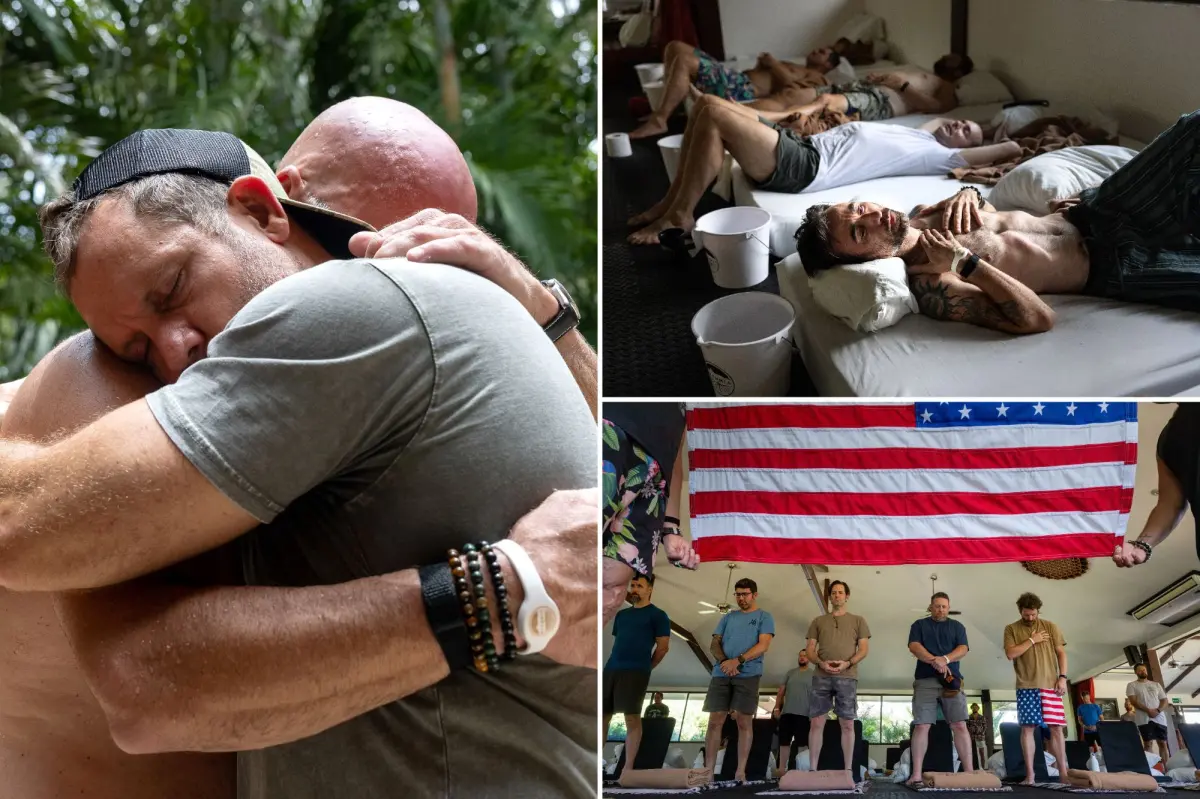
Dave L. sat at the base of a tree in Costa Rica, wrapped his arms around the trunk, and wept. It was a moment he had spent most of his life avoiding. At 44, Dave was a firefighter and a former Army Ranger, shaped by decades of military discipline and by a version of masculinity that treated emotion as weakness. As a Ranger, he had been trained to operate in the harshest conditions on earth, to compartmentalize fear and push forward. As a firefighter, he had run into burning buildings and walked out again, carrying images that could never be unseen. He had learned to bury his feelings, to push through pain, to keep moving even when something inside him was screaming. But on that night, at the end of his fourth ayahuasca ceremony, he could no longer hold the weight. The tears came slowly, then all at once, and with them came a sensation he had almost forgotten: release. “I had trauma trapped in various places of my body, and I could just feel it releasing,” he later said. “Like, for days, I feel like I was just releasing stuff that was holding me back in life.” The tree trunk was rough against his chest, the jungle air warm and damp, and for the first time in years, Dave did not try to escape what he was feeling. He let it move through him. He had come to this jungle retreat because the old way of living was no longer working. His life looked full from the outside, but internally he was running on fumes, feeling like he was falling apart without the tools he had never been given. In that moment under the tree, he began to understand that being strong did not mean being hard. It meant allowing himself to be human.
Dave had not come to Costa Rica alone. He was part of a group of 46 American veterans and first responders—Navy SEALs, Army Rangers, Green Berets, combat controllers, pararescuemen, firefighters and paramedics—who gathered at Rythmia Life Advancement Center in the sun-drenched province of Guanacaste for a week of ayahuasca ceremonies, counseling and meditation. The retreat was co-organized with Coming Home, a nonprofit founded by Navy SEAL veteran Nate Brown that is dedicated to ending veteran suicide through access to psychedelic-assisted healing. The timing was deliberate: the gathering coincided with the 25th anniversary of 9/11, and the need for new approaches remains urgent. A 2026 Department of Veterans Affairs report recorded 6,488 veteran suicide deaths in 2024, an average of 17.7 every day. Ayahuasca, once a hidden Amazonian secret, has sparked a major scientific movement exploring its potential to treat PTSD, depression and addiction. Clinical data increasingly links guided ayahuasca use to lasting relief, with participants reporting profound spiritual lifts and life-altering emotional growth. Yet the brew remains deeply controversial, carrying steep physical and psychological risks that range from severe nausea to rare but dangerous psychiatric and medication complications. Because its active psychedelic ingredient, DMT, remains illegal under federal law, thousands of Americans now travel to specialized retreat centers abroad, where the traditional plant medicine is combined with structured medical oversight. For Dave, the decision to join that exodus was deeply personal. “I wanted to gain the tools of how to be a balanced man in life,” he said, admitting that he felt his life was “falling apart without those tools.” He had been taught survival skills, but not how to be gentle with himself or emotionally available to the people he loved most—and in his 40s, he said, that had become essential.
At Rythmia, the days moved slowly and softly, a stark contrast to the compressed timelines and constant stress these men had known throughout their careers. Mornings began with an hour of yoga, followed by individual and group counseling, educational classes, meditation and relaxation sessions. There were long stretches of unstructured time to visit the on-site mud spa, wander the grounds or simply rest. After dark, the men gathered in tents with the center’s guides and staff to embark on a psychedelic healing journey. Each received a serving of thick, bitter, dark-colored tea brewed from ayahuasca leaves, and what followed was unpredictable: emotional revelations, vivid visions, sometimes dramatic reactions. For Nate Brown, the Navy SEAL veteran who founded Coming Home, the most powerful part of the experience was the permission to stop. “If you can imagine the way these gentlemen have been working their entire adult lives, everything’s about compression timelines under stress,” he said. “So to be able to take them somewhere and allow them to just unravel slowly over the course of a week and watch them rest in mind, body and spirit is just something beautiful to witness.” By the end of the retreat, Brown said, the men looked “10 years younger” in the selfies they had taken when they arrived and when they left. More important than the changing faces, though, was what he saw inside them: men who had spent decades disconnected from their own tenderness beginning to feel it again. “They can’t feel anything but rage and anger, completely out of touch with the sweetness, the softness and the beauty that they all deserve,” Brown said. “And over the course of that week, watching that shift, watching the medicine start opening up these parts of their soul, is something beautiful and amazing.”
The ceremonies were not only emotional journeys; they were also physical trials. Ayahuasca frequently induces vomiting, diarrhea, sweating, yawning and repeated trips to the bathroom—reactions traditionally known as purging, often understood as the body releasing emotional and spiritual toxins. Rythmia’s chief medical officer, Dr. Jeff McNairy, a psychiatrist, estimated that roughly half the participants vomited during a given ceremony night. Staff moved quietly through the space, retrieving buckets, cleaning them and returning them so the flow of the experience was rarely interrupted. For McNairy, the medicine’s purpose is clear. “When people ask me, ‘What’s ayahuasca best for?’ my No. 1 answer is trauma,” he said. During a traumatic event, he explained, fear and doubt can interfere with survival. A soldier in combat must push those feelings aside to act quickly under threat, but when the experience is never processed, the emotions can continue to shape a person’s life—showing up as anger, disassociation, addiction or emotional numbness. The purging, he said, is “a psychosomatic response” of that trapped trauma being released. The risks are serious enough that the organizers took extensive precautions. About 70% of users experience acute nausea, and more than half report unsettling psychological side effects like deep disconnection. If combined with standard SSRI antidepressants, ayahuasca can trigger fatal serotonin syndrome, and it can provoke prolonged psychotic episodes in people with pre-existing psychiatric vulnerabilities. Before the retreat, Rythmia and Coming Home reviewed each participant’s medical history, medication list and mental health status. A 30-day preparation period encouraged mostly vegetarian or vegan meals, fewer heavily spiced foods, and reduced exposure to distressing news stories and horror movies. On-site, a 24-hour medical team of five doctors, twelve registered nurses and additional paramedics stood ready, alongside 45 shamans. As McNairy put it, the center blends “both indigenous and Western together”—a careful balance between ancient tradition and modern safety.
Photojournalist John Moore, a Pulitzer Prize winner who has documented conflict in Afghanistan, Iraq and other war zones, was given rare access to photograph parts of the weeklong retreat, including portions of the ceremonies—an exception to Rythmia’s strict privacy rules. What he witnessed challenged the stereotypes these men carry. “People think of special forces veterans as being hard characters, but everyone is human,” Moore said. “I thought it was touching and really impressive that these former warriors were accessing their human side and trying to become better people, better spouses, better parents and better neighbors.” Over the course of the week, Moore noticed the participants growing more comfortable with emotion, supported by a shared “culture of respect” that made it safe to let their guard down. Dave experienced that safety firsthand. When one man broke down in grief, the feeling moved through the room like a current, touching something in everyone. “You’ve got a room full of killers, people who will run into burning buildings, people that run to gunfire instead of away from it,” he said. “And when you’re in that room, and one man weeps because he’s feeling lost or feeling grief, that is contagious.” Rather than retreating from those emotions, the men leaned into them together. They held each other, cried with each other and saw in each other’s pain a reflection of their own. As Nate Brown said, “To watch these men come out of ceremony and to hug one another and to cry, you can’t put a price on that.” These were men who had spent their careers protecting others by staying emotionless. Now they were learning that letting themselves be seen, and truly seeing each other, was a different kind of strength.
For Dave, the real proof of change came after he left Costa Rica and returned to a life that had not changed. The relationships, responsibilities and pressures that shaped his trauma were still there, waiting for him. But he was different. The first sign was a welcome absence: the constant inner battle had grown quiet. “The war that I usually wage in between my own ear at any given moment is way quieter, way softer,” he said. He does not claim that one retreat erased his trauma, and he does not present ayahuasca as a universal solution. But the experience gave him a new way to meet the feelings he had spent years pushing aside, and it allowed him to do that alongside men who understood the weight he carried. “When you walk away from the ceremony back into life, you can just be met head on with those challenges, with that pain, those dark emotions, those things of daily life that we all push away,” he said. “Now we face it with a new courage and without fear and realize that it doesn’t kill us and that it’s OK, that actually makes us feel more alive.” The men who came to Rythmia were not looking for an escape from their past. They were looking for a way to carry it differently. For seven days, they had the space to reconnect with their emotions and explore a radically different kind of strength—one rooted in vulnerability, self-compassion and connection. And for at least one man, sitting at the base of a tree in Costa Rica, the tears that once felt like weakness had become proof that he was still capable of feeling. That, in the end, was the greatest strength he could bring home.