



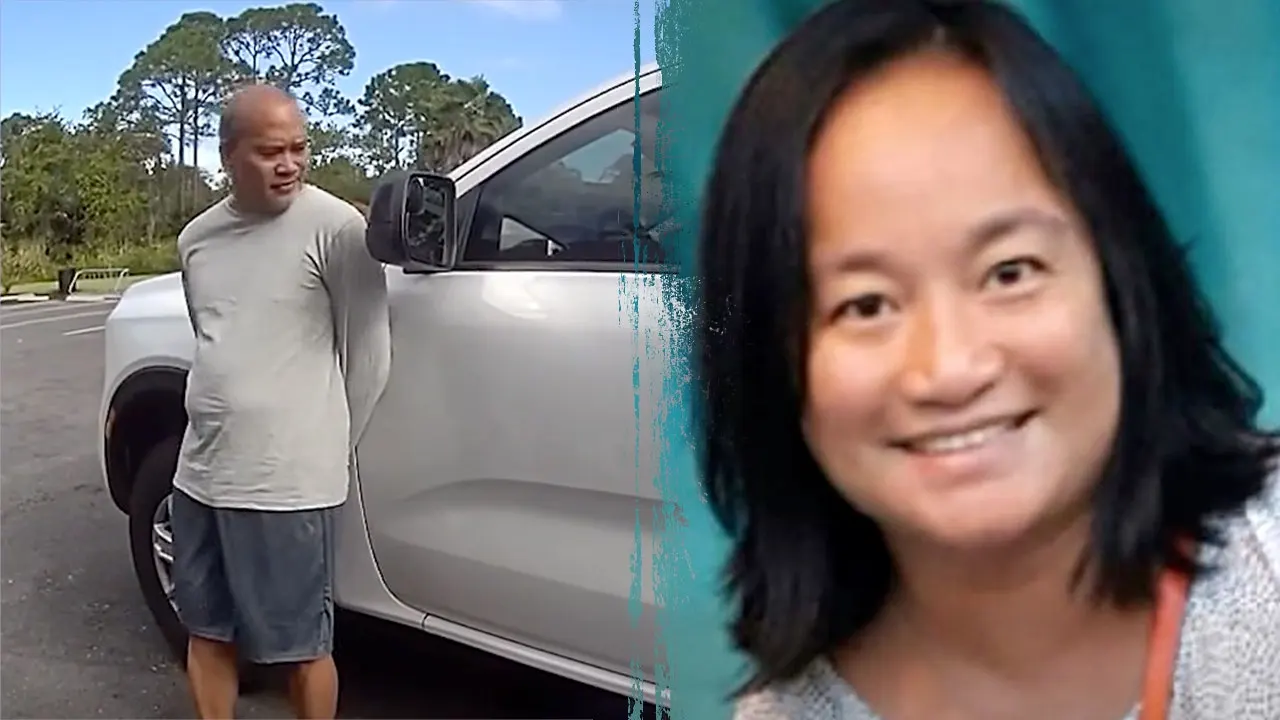
For Maria Gaminde’s family, the past year has been a waking nightmare—a blur of unanswered calls, bizarre messages, and the slow, sickening realization that the person they once trusted most may have been orchestrating an elaborate and cruel deception. Maria, a wife and mother of three young boys, has had no confirmed contact with her relatives since January 2024, and her body has never been found. Now, her husband, Epifanio IX Ramos Gaminde, is behind bars in Volusia County, Florida, charged with first-degree murder in her disappearance. The case, investigated by the Volusia County Sheriff’s Office with help from the FBI, is built not on a recovered body, but on a trail of digital breadcrumbs, suspicious financial activity, and what authorities describe as a calculated scheme to make it appear that Maria was still alive and living overseas. According to Sheriff Mike Chitwood, Epifanio allegedly sent Maria’s identification and credit cards to a relative in the Philippines, along with instructions on how to use them, hoping to create the illusion that she had voluntarily left her family and her life behind. The cruel irony is that these efforts to fake Maria’s continued existence only convinced her loved ones that she was in grave danger, and they eventually pushed investigators to look much more closely at the man who told them Maria had simply walked away.
The timeline that investigators have pieced together paints a portrait of a marriage quietly falling apart, and a man who may have been preparing for a violent end long before Maria disappeared. Maria’s family reported her missing in January 2024 after they lost contact with her. At first, they may have hoped for a simple explanation—a broken phone, a trip, a need for space. But by July of that year, those hopes had curdled into fear. Relatives began receiving text messages and emails that supposedly came from Maria, and they noticed spending activity on her credit cards that did not feel right. Nothing about these communications seemed like the Maria they knew. They reached out to authorities and voiced their growing unease. “The family starts to contact us and say, ‘Hey, something’s not right. These text messages and emails that we’re getting, the spending on her credit cards, too. Something’s not right,'” Sheriff Chitwood recalled during a news conference. That nagging, instinctive sense of wrongness is something anyone who has loved a missing person may recognize: the details are too neat, the messages too vague, and the pattern too convenient. Instead of bringing comfort, those suspicious messages opened a wound, and they gave investigators a thread to pull. Epifanio, for his part, told detectives that he and Maria had been having marital problems, and he claimed she had left for either the Philippines or Japan. But the more investigators looked, the less his story made sense. There were no travel records, no meaningful financial trail, no sightings of Maria at any port or airport that matched his version of events. And as they dug deeper, they uncovered something even more troubling: Epifanio had been arrested twice before on domestic violence charges, a detail that gave the investigation a darker, more urgent context.
What investigators found next would take them across the globe and back. Working with the FBI, Volusia County investigators and prosecutors navigated a complex web of international legal procedures, eventually sending a detective and a prosecutor to the Philippines to interview Epifanio’s niece. That interview appears to have been a turning point. “She gives up everything,” Chitwood said. “She even gives us more information that the FBI has to work with international partners to recover digital evidence from when it occurred.” The niece reportedly provided authorities with the kind of intimate detail that is difficult to invent: the arrival of Maria’s personal documents, the instructions that accompanied them, and the digital evidence that connected the dots back to Epifanio. According to investigators, Epifanio had allegedly emailed his niece Maria’s driver’s license and credit cards, and told her exactly what to do with them. The goal, they believe, was to generate a false trail of activity that would suggest Maria was alive, and that her absence from the lives of those who loved her was her own choice. It was a ploy designed to shift blame onto a victim who could not defend herself, and to give law enforcement a reason to close the case without ever finding her. Instead, it gave investigators the evidence they needed to disprove Epifanio’s story and to build a murder case against him. The niece’s cooperation, along with the digital evidence recovered by international partners, helped tie the scheme directly to Epifanio, revealing a level of planning and calculation that Shitwood and his team found deeply disturbing.
Even with that evidence, the case was far from open-and-shut. Investigators had to trace every bit of Maria’s known activity, looking for the last real proof that she was alive. They determined that Maria’s daughter’s fingerprints—wait, actually, authorities said Maria and her children visited Disney World’s Magic Kingdom on Dec. 16, after confirming their fingerprints were used to enter the park. That December outing, a supposedly happy family visit to the most magical place on Earth, would become a haunting marker: the last confirmed moment Maria was seen and known to be alive. Four days later, Epifanio allegedly sent her a text message asking where she was. After that, communications from Maria stopped entirely, and no more credible messages ever came from her. The messages that continued, purported to come from Maria overseas, were part of the alleged fabrication. “There’s no financial trail. There’s nothing that would indicate that Maria is alive,” Chitwood said. For investigators, this was the stark reality: a woman with a family, a home, and a daily life does not simply vanish without leaving behind some trace of herself evolving and existing in the world. There were no new purchases that made sense, no phone calls to old friends, no social media posts that felt authentic. The absence of any credible signs of life told them more than any fake email could. The investigation had turned from a missing persons case into a homicide investigation, and all evidence pointed to the one person who had the most to gain from Maria disappearing: her husband.
The search of the couple’s property in DeBary, Florida, on Tuesday added a new layer of tension to the case. Authorities had received a tip from a neighbor who reported seeing Epifanio doing extensive work behind the home around the time Maria disappeared. When investigators arrived, they focused on an area where concrete appeared to have been newly added. The image is a visceral one—a quiet suburban backyard, a patch of concrete, and the desperate hope that it holds the final answer to a family’s unbearable questions. Sheriff Chitwood was careful not to promise closure. “We may get lucky, we may not get lucky,” he said. But whether or not Maria’s remains are ever recovered, prosecutors are proceeding with confidence. R.J. Jarizza, the state attorney for Florida’s 7th Judicial Circuit, was blunt about the state’s position: “We’re fully prepared to move forward without the body. And I have complete and total confidence in our ability to prosecute this case.” That confidence reflects the strength of the circumstantial and digital evidence gathered over months of painstaking work, but it also speaks to the shifting reality of modern murder investigations. In an age of texts, emails, digital tokens, and forensic data, it is increasingly possible to prove a crime even when the victim’s remains have been hidden or destroyed. For Maria’s family, that legal reality offers a sliver of hope among the ruins of their grief.
Perhaps the most heartbreaking element of this story is the fate of the three young sons Epifanio and Maria share. The couple came to the United States together around 2008, and their children are now left to navigate the impossible aftermath of their father’s arrest and their mother’s death—a loss they may not yet fully understand. According to the sheriff, the children were with their father when he was taken into custody on the murder indictment, after being stopped for allegedly driving without a license. They have since been reunited with Maria’s family, who, Chitwood said, had been denied contact with the children during the investigation. The emotional weight of that detail is immense: a family already grieving the loss of a daughter, sister, and mother had also been cut off from the three little boys who are living reminders of her. Now, they are doing their best to care for them while authorities piece together what happened. Epifanio, meanwhile, remains held without bond at the Volusia County Branch Jail, and also faces an immigration detainer from U.S. Immigration and Customs Enforcement. When he spoke with investigators, he did not offer clarity. “Every interview he has given us has just been a lie,” Chitwood said. The investigation remains ongoing, and with it, the possibility of more evidence, more answers, and perhaps, eventually, a body to lay to rest. But for those who loved Maria Gaminde, the truth they have already heard has brought not the peace of resolution, but the pain of confirmation. They have lost her, and they have learned that the person they once welcomed into their family may have been the one to take her away. Yet in the search for justice, they have also found something else: a network of investigators, advocates, and strangers who refuse to let Maria be forgotten. It is a small comfort, but sometimes that is enough to keep going in the dark.