






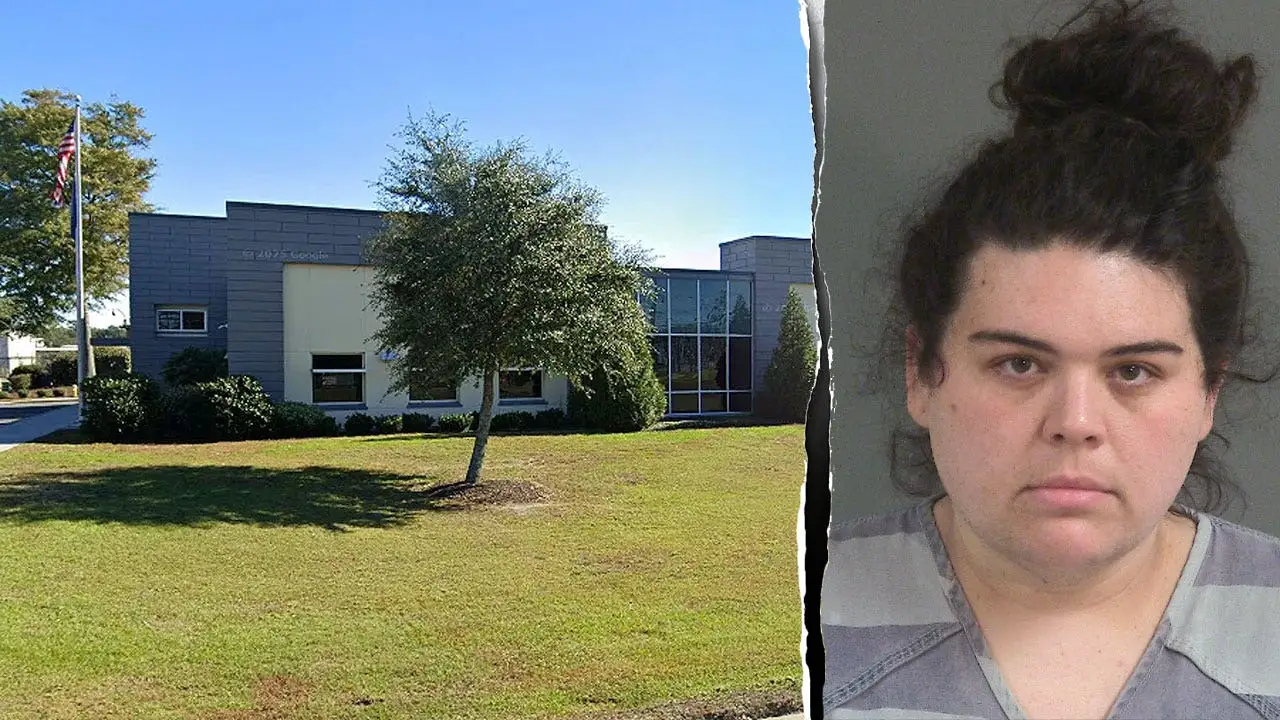
In the late September heat of Ladson, South Carolina, a small community just outside Charleston found itself staring into the face of an incomprehensible tragedy. Charleston County deputies arrived at a modest home on the morning of September 29 for a welfare check, not anticipating that they would walk into a scene that would forever alter their psyche and ignite a legal case full of grief, rage, and unanswered questions. Standing outside the home was 31-year-old Justine Marie May, a mother of two young daughters. She was crying, speaking incoherently, and visibly unable to process what was happening around her. When deputies stepped inside to check on the children, they discovered both girls dead. The ages alone were enough to cut through the strongest heart: one child was roughly a year and a half old, the other barely two and a half. They were still babies, still in the softest, most dependent stage of life, still needing a mother’s hands to guide them, feed them, and love them. Instead, authorities would later allege, those tiny lives had been left to wither in silence and isolation. As news of the arrest spread, a mixture of anger and sorrow rippled through the community. For many, the tragedy was not just another headline about abuse or neglect; it was a raw reminder of how vulnerable children are, how fragile the bonds of care can be, and how a family in distress can be hidden behind closed doors until it is too late to intervene.
According to court documents reviewed by Fox News Digital, May now faces two counts of homicide by child abuse, a charge that in South Carolina carries enormous weight and rests on the allegation that she failed to fulfill the most fundamental obligation of parenthood. During the investigation, May told detectives that the previous two weeks had been a blur. She could not remember the last time she had given her daughters food or something to drink. She reportedly acknowledged that the children died because they did not eat, and she admitted that not feeding them was neglectful. She also said that during those weeks, she had been the only person at home and the sole caregiver for the children. The details in the affidavits are stark and devastating. Investigators accused May of showing an extreme indifference for human life, arguing that her refusal or inability to provide basic sustenance was a main contributor to the children’s deaths. Separate arrest warrants were issued for each child, reflecting the distinct and irreplaceable loss of every small life. The legal language is clinical, but behind it lies the aching truth: two little girls spent what should have been weeks of giggles, storybooks, peanut butter sandwiches, and warm baths instead fading from hunger and thirst while their mother, by her own account, slipped into a state of mental fog so thick she lost track of time and care. Her words—“I can’t remember”—are as haunting as any confession, because they suggest not malice in the moment but a deeper collapse, one that still leaves the children just as dead.
As the investigation unfolded, another layer of pain emerged: the presence of law enforcement in the family’s life in the weeks before the deaths. The Charleston County Sheriff’s Office confirmed that deputies had contact with May and her children twice in August and three times in September. On each occasion, they reported seeing no obvious signs of concern. Their last known visit while the girls were still alive occurred on September 20, only nine days before the children were found dead. Those encounters now haunt the public conscience. How, people ask, could a family struggling this deeply have been invisible to deputies? How many small signals were missed, how many quiet desperate moments were hidden behind a composed face or a tidy living room? The families of first responders, social workers, and court officials all know that the line between a routine wellness check and a preventable death is often terrifyingly thin. Depression, exhaustion, and isolation are not always visible through a window or a short conversation. A parent can answer the door with a smile while their mind has already become an unlivable place. In response to these painful questions, the Charleston County Sheriff’s Office has opened an internal review by its Office of Professional Standards. The South Carolina Law Enforcement Division’s Special Victims Unit and the Department of Child Fatalities are also assisting in the investigation. These procedural measures are necessary, but they cannot bring back two girls. They cannot soothe the dreams of the deputies who found them, nor can they erase the shame that a mother will carry for the rest of her life.
To humanize this story is not to excuse the outcome. It is to recognize that behind every awful statistic is a human being whose mind and spirit can break under the weight of unmet needs. Justine Marie May is now an accused person, sitting in the Charleston County jail, facing charges that could lead to decades behind bars. But before she was a defendant, she was a mother. Perhaps she was once a young woman who dreamed of having children, who painted their tiny nails, who sang lullabies that only they could hear. At some point, something went catastrophically wrong. The “blur” that she described to detectives is a common word among people who have experienced severe depression, psychosis, sleep deprivation, or trauma. It is the brain’s way of protecting a person from a reality too painful to bear. To be the sole caregiver of two toddlers is already a monumental task; to do it in silence, without help, without a village, is a risk that no one should have to take alone. May told investigators she believed her children died because they did not eat. That admission is enough to invoke horror, but it also reveals a woman who, in some lucid moment, could see what she had done—and could not undo it. Parental neglect that results in death is always a moral tragedy. But the path from a healthy family to a broken one is rarely straight. It is paved with missed appointments, sleepless nights, lost support systems, and a thousand little reasons to ask for help that never get spoken.
The legal system now must decide how to weigh all of it. Under South Carolina law, homicide by child abuse is a serious felony, and the decisions made in this case will set an example for how the community treats parents who fail, whether deliberately or through collapse. Many people will look at May and see a monster. Others, perhaps those who have walked through the shadow of postpartum depression or custodial isolation, will see a broken person who needed a hand and instead got a criminal charge. Both views can be true at once. Children deserve to be protected, and parents deserve to be supported before their worst days become tragic endings. The fact that deputies encountered May and her children five times in roughly two months suggests that someone, somewhere was aware enough to make visits. What those visits lacked was depth, or perhaps the kind of training and resources that could have uncovered the reality behind the doors. The investigation by the sheriff’s office and outside agencies aims to answer these questions. But the outcome cannot change the fact that the girls did not have to die. A meal delivered from a community pantry, a neighbor checking in, a doctor’s phone call, a mental health evaluation for May, a different answer at the door—any one of these could have altered the story. Instead, two small birthdays will never be celebrated. Two tiny voices will never again call for their mother. And a community must learn to live with the terrible truth that sometimes the best hearts in the room are not enough to save everyone.
As days turn into weeks, and the jail records confirm that May remains in custody, the community of Ladson, South Carolina, is left to mourn. Memorials of teddy bears and flowers may fade, but the ache will not. The case is a painful reminder that child abuse is not always something that happens in dark basements by strangers; sometimes it happens in homes where mothers cry incoherently at the doorway, where the grass grows too long, where the curtains remain drawn, where the children are too quiet. It is a reminder that parenting is not just a biological bond but an endless, daily act of feeding, holding, washing, and reassuring—and that when a caregiver is broken, the bond suffers with them. The children who died were only one and a half and two and a half years old. They could hardly speak. They could not defend themselves. They depended entirely on the world around them, and that world failed them. The legal system will continue its work, the internal reviews will run their course, and Justine Marie May will answer for her actions. But perhaps the most profound human response to this tragedy is not anger alone. It is grief, followed by the kind of reflection that leads to real change: more compassion for struggling families, more honest conversations about mental health, and more courage to open someone’s door and see beyond the surface. Two little girls are gone, and no amount of justice can bring them back. But their memory can still speak to us, if we are ready to listen—telling us that the most fragile among us rely on the strongest parts of our humanity, and that we must never turn away from a mother who is drowning, because her silence may be the last cry a child ever hears.