





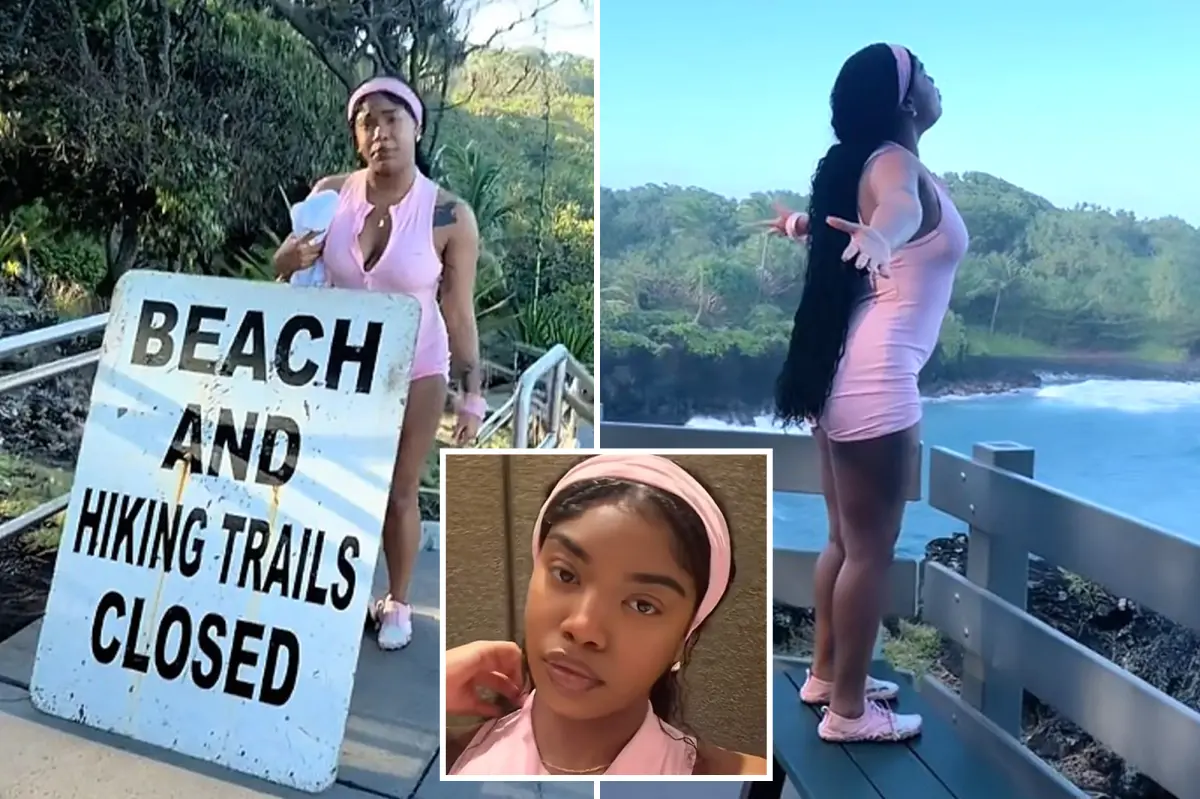
A birthday is supposed to be special—a day when the world seems to open up and everything is about celebration. For a visitor from North Carolina, that meant a trip to Hawaii, to the island of Maui, to a famous black sand beach that looked like a dream. But when Nuri Abdullah arrived at Waianapanapa State Park on September 26, the dream collided with reality. The park was closed. Heavy rain and hurricane conditions had made the coastline dangerous. Signs were everywhere. Barriers were up. A locked gate blocked the road. For many people, that would be the end of the plan—a disappointment, perhaps, but an obvious one. For Abdullah, it was an inconvenience to be ignored. In a TikTok video that soon went viral, she walked right past the closure sign and announced her intention to the camera: “You see this? Guess what. I don’t care about it. I’mma go down anyway.” The clip shows her slipping past the yellow sign, entering a closed state park as if it were a personal playground. She filmed the dramatic cliffs, the churning waves, and the black volcanic rocks. “Black sand beach, we got some waves,” she said, capturing the kind of footage that gets likes and shares. “Look at these beautiful black rocks. Black sand that has minerals and stuff.” To her, it may have been a triumph—an adventurous birthday experience, a story to tell, a video that proved she would not let rules ruin her special day. But to anyone who knows Hawaii, the moment was not triumphant. It was reckless, disrespectful, and illegal.
Waianapanapa State Park is not just another beach on a tourist map. Located near the small town of Hana on Maui’s rugged east coast, the park is one of Hawaii’s most beautiful and culturally significant places. It is known for its striking black sand beach, sea caves, volcanic arches, and lush coastal trails. Visitors come from around the world to witness its raw beauty. But that beauty can turn deadly. At the time of Abdullah’s visit, the park had been officially closed because of Hurricane Polo, which had brought heavy rain, powerful winds, flash flooding, falling debris, and dangerous surf to the area. The closure was not a suggestion or a bureaucratic technicality. It was a safety measure designed to protect lives. State officials later explained that to reach the beach, Abdullah had to pass through a locked gate and walk by multiple signs that clearly stated the trails and beach were closed. She did not stumble into the area by accident. She made a series of deliberate choices to ignore every signal meant to keep her out. In her video, she seemed proud of that decision, as if the closure signs were challenges to overcome rather than warnings to heed. That attitude may be common in the age of social media, where every destination feels like a backdrop for content and every rule feels like an obstacle to getting the perfect shot. But for the people who live in Hawaii and for the officials responsible for public safety, the stunt was a serious violation. It put her own life at risk and placed an unnecessary burden on emergency responders who would have to rescue her if something went wrong. The fact that she saw only the beach and not the danger is itself a kind of privilege—the privilege of expecting that nature will always forgive us and that the rules do not apply to our special moments.
Andrew Laurence, a spokesperson for the Hawaii Department of Land and Natural Resources, made the official response clear. “When we look at the video here, clearly she’s trespassing,” he said. “The park was closed. That means the gate at the road was locked and then she went past the two signs that said that the area was closed.” But the violation was not only about breaking a law. It was about the risk that nobody could save her. Laurence told Hawaii News Now that the rough surf captured in Abdullah’s own footage showed exactly how serious the danger was. The waves she admired were not just dramatic visual effects; they were powerful forces that could sweep someone off rocks and into the ocean within seconds. “She could have died before anybody could get to her,” he said. That sentence is worth pausing over. A birthday trip could have become a tragedy. A video meant to be fun could have been the last record of her life. The park’s remote location means emergency services are far away. In conditions like those created by Hurricane Polo, rescue is difficult even under ideal circumstances. There are no lifeguards watching over the black sand beach. There is no quick response team waiting nearby. There is just the ocean, the wind, the rain, and whatever little space a person has to cling to. People sometimes believe that nothing bad will happen to them—that the warnings are for others, that they are stronger, smarter, or luckier than the people who end up in the news. But nature has no regard for birthdays, selfies, or confidence. The same waves that made Abdullah’s video impressive could have killed her. And if she had been injured or drowned, her family would have received a devastating phone call, and the community would have faced the trauma of a loss that never should have happened. That is the hidden cost of ignoring a closure sign: it is not only a legal issue, but a potentially fatal risk.
The harm, however, went beyond the danger to Abdullah herself. The residents of Hana and the broader Native Hawaiian community were deeply hurt by the video. Waianapanapa is not just a scenic destination; it is a place with deep cultural and spiritual significance. The state Department of Land and Natural Resources notes that the park contains historic sites, cemeteries, and a heiau, or Hawaiian temple. It is a place where ancestors are buried and where the culture of Hawaii is still alive. For descendants, this is not ancient history or folklore. It is a matter of respect. When someone ignores closure signs, tramples through sacred land, and acts as if the space exists only for their entertainment, it sends a message that their culture is less important than a tourist’s fun. Giselle Davidson, a Hana resident, put it plainly: “There’s a certain level of respect that anybody should have when visiting that space. And unfortunately, in this case, it was pretty clear that she was trying to get attention and she was breaking the law.” The comment is especially striking because it points to the motivation behind the video. Abdullah was not simply trying to enjoy a beach; she was recording herself for an audience. The black rocks were props. The waves were a backdrop. The closure signs were part of the drama. She was making a statement about herself, not honoring the place she was in. That kind of self-centeredness is not new, but social media has amplified it. Every year, tourists do dangerous and disrespectful things to get content: climbing protected structures, disturbing wildlife, trespassing onto sacred sites, taking stones from places where taking is forbidden. Each viral video teaches others that this behavior is acceptable. But local communities pay the price. They watch their homes become backdrops for people who have no connection to the land and no desire to understand it. They see their ancestors’ resting places treated as tourist attractions. They hear excuses and apologies that feel too little, too late.
The backlash was immediate and intense. On social media, people expressed a mixture of anger, sadness, and exhaustion. “Then they wonder why Hawaii people don’t like tourists!” one commenter wrote. Another added, “I don’t get why folks choose to visit a place then disrespect it.” These are not random, thoughtless remarks. They reflect a larger reality: Hawaii has a complicated and painful relationship with tourism. For more than a century, the islands have been marketed as a tropical paradise, a place where outsiders can come to escape their problems. But that paradise was built on the displacement and suffering of Native Hawaiians. The overthrow of the Hawaiian Kingdom, the seizure of land, the suppression of language and culture—these are not distant memories. They are living histories that still shape the present. Tourism often carries the weight of that history. When a visitor arrives with a sense of entitlement, acting as if the islands are a theme park with no rules and no culture, it reminds local residents of a painful pattern: their home is a commodity, their traditions are decorations, and their voices are ignored. Of course, most people who visit Hawaii are kind and respectful. But the actions of one person can be enough to stir resentment because they fit into a familiar and exhausting narrative. The woman from North Carolina did not create that narrative by herself. She simply stepped into it, captured it on video, and posted it for the world to see. For many viewers, she became a symbol of everything that is wrong with modern tourism—the disregard for place, the obsession with personal image, and the willingness to do harm for entertainment. The comments were harsh, and some may have gone too far. But underneath the anger is a legitimate demand: if you come to someone else’s home, you must act like a guest.
Two days after the video went viral, Abdullah posted an apology. She acknowledged that she knew the beach was closed and said she never intended to disrespect Hawaii or its residents. “I want to take time out to apologize for the recent video that’s been causing a lot of drama and it’s just been a lot,” she said in a follow-up TikTok. “To all the Hawaiian natives, I do want to apologize to you guys for disrespecting your land and for ignoring the sign.” For those who had been hurt or angered by her video, this apology was probably a welcome first step. It recognized the mistake and expressed regret. But then came a second part. “To all the people who are being disrespectful, rude and sending me threats, you guys can go to hell,” Abdullah added. That final sentence changed the tone. It was understandable, perhaps, to be overwhelmed by hate messages and threats. No one should have to face harassment, and people who respond with threats are not helping. But adding that line to a public apology made it feel defensive and combative. It undermined the humility of the moment and made it seem as though she was more concerned about the damage to her own reputation than about the damage she had caused. Under Hawaii administrative rules, entering a closed state park can carry a fine ranging from $500 to $2,000 and up to 30 days in jail. It remains unclear whether state officials will pursue further action against Abdullah. But regardless of what happens legally, the incident offers a lesson. A place like Waianapanapa is not just a postcard. It is a living place with a history, a community, and sacred meaning. The signs that say “closed” are not the enemy of joy. They are there to protect the people who pass through and to honor the land that hosts them. Travel should open our eyes, not blind us to the needs and values of others. The best way to celebrate a birthday in Hawaii is not to break rules and film yourself doing it, but to arrive with openness and respect—and to accept that sometimes, staying away is the kindest thing you can do. In the end, everyone makes mistakes. What matters is what we learn.