






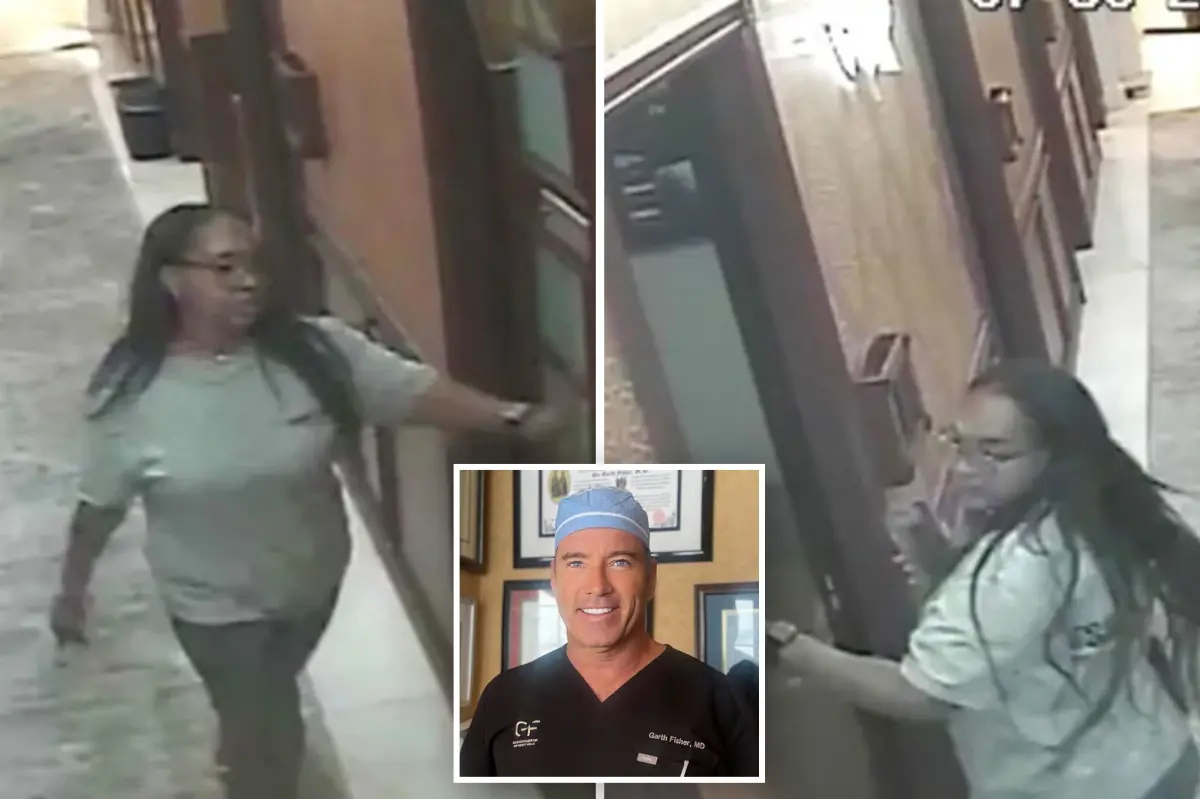
In the late afternoon of July 30, under the flawless blue sky of Beverly Hills, a medical building on South Spalding Drive hummed with quiet activity. Patients waited in tasteful chairs, their faces calm but their hands perhaps a little tense, while plastic surgeons and their staff prepared for another day of transformation. The building, home to several celebrity physicians, was in the middle of construction, and the usual rhythm of consultations and procedures had been layered with the banging of hammers, the whine of drills, and the constant presence of workers in hard hats and dusty boots. That is why, when a woman in a work shirt walked through the front door and said she needed to check the water pressure in one of the offices, no one thought to question her. She looked like she belonged among the construction crew, and in a place already filled with strangers, her presence felt as ordinary as a delivered package. That, authorities say, was exactly her plan. The woman is accused of using a construction-worker disguise to burglarize multiple offices in the building, including those of Dr. Garth Fisher, the physician made famous by ABC’s “Extreme Makeover,” and Dr. Paul Nassif, the star of the reality series “Botched.” The surgeons, along with a growing network of concerned staff and patients, are now offering a $2,500 reward for information leading to her arrest. It is not just the stolen wallets and credit cards that have rattled them; it is the realization that a thief walked through their sanctuary in broad daylight, wearing a costume, and vanished before anyone even knew a crime had happened.
The first sign of trouble came when a front-desk employee named Miluzka Romero encountered the woman. Romero was at her station, sorting through paperwork and greeting patients, when the woman appeared and introduced herself as a construction worker. She smiled, gestured at the logo embroidered on her shirt, and explained that she had to check the water pressure in the office. It was presented as a routine request, the kind of thing that happens a hundred times during a renovation. There was no reason for suspicion. A building under construction means a constant flow of inspectors, electricians, plumbers, and general contractors, all of whom expect access and cooperation. Romero, whose job is rooted in hospitality and trust, dutifully walked the woman through the office, opening doors and pointing out bathrooms. At one point, the woman stopped near Dr. Fisher’s private workspace, next to a small restroom, and cheerfully stepped inside to flush the toilet. That flush was the tiny performance that made the whole story believable, a mundane gesture of official duty that confirmed, in Romero’s mind, that this woman was exactly who she claimed to be. The surveillance footage later captured the strange scene: a visitor in a work shirt being escorted by an unsuspecting employee, peeking into rooms, nodding, inspecting, and then leaving without a moment of turbulence. In hindsight, the flush of a toilet might have been the signal that the woman was not really checking water pressure at all, but rather mapping the office, memorizing where wallets might be kept and where she could return. But at the time, all Romero saw was a courteous worker doing a forgettable job.
The woman left the building, and the incident seemed over. Then, a short time later, she returned, this time with a new story: she had forgotten her phone. Another co-worker, perhaps too kind to turn away a flustered visitor, let her back inside. This time, the woman did not ask for directions or tour the offices. She went straight to the areas she had already scouted, moving with the speed and confidence of someone who knew exactly where she was headed. Within minutes, she was gone again. It was only when Dr. Fisher and his wife began receiving a flood of notifications—unauthorized charges on their credit cards and Apple Pay, ringing in rapid succession, thousands of dollars disappearing in a digital instant—that anyone realized what had happened. They pulled up the office surveillance feed and watched in disbelief as the woman, clearly visible in high-definition, calmly removed wallets from private spaces. There was no panic in her movements, no hesitation. She handled the wallets as if they were her own, sliding them into a bag and walking out. For Dr. Fisher, a surgeon celebrated for precision and trust, the violation felt almost personal. His office had always been a place of safety, a private realm where patients shared their deepest insecurities and the staff operated on a foundation of confidence and discretion. That illusion shattered in a moment. The woman had not used a crowbar or a weapon; she had used a story, a shirt, and a few minutes of misplaced trust, and she had left behind a trail of stolen identities and shaken employees.
The scope of the scheme became clearer as the day went on. Investigators and staff learned that the woman had allegedly hit two other offices in the same building, including one belonging to Dr. Nassif. Each time, she wove the same construction-worker narrative, asking to inspect something, wandering through the space, and disappearing with whatever she could lift. The repetition was almost brazen. She had no apparent fear of being recognized or remembered, and why would she? In a construction zone, workers come and go, and everyone’s attention is on the project, not on the person carrying a toolbox. Her costume was not just a disguise; it was an invisibility cloak. Surveillance footage later showed her not only inside the offices but also at an Apple Store, where she allegedly used the stolen cards to make purchases, perhaps enjoying a brief shopping spree before the banks and credit card companies caught on. There was something almost darkly comedic about the image: a woman who had infiltrated the glossy world of celebrity plastic surgery, then wandering into a sleek technology retailer to buy expensive gadgets funded by the identities of people who make their living perfecting appearances. But the comedy quickly faded into a feeling of vulnerability. If she could walk into the offices of two famous surgeons and leave without a struggle, what was stopping anyone else? The building’s construction had turned out to be a perfect cover for a quiet predator, and the staff were left to wonder how many other visitors had passed through their doors with less innocent intentions.
The two plastic surgeons are now appealing to the public for help, offering a $2,500 reward for information that would lead to the woman’s arrest. The Beverly Hills Police Department is investigating, and The California Post has reached out for comment, though so far no additional details have been released. The reward is a signal, not just of frustration, but of determination. Someone in this city must know who she is. She may have been a stranger to the office staff, but she was not invisible to everyone; she interacted with people, smiled, spoke, moved through the neighborhood, and paid for goods with stolen cards. The image of her face, captured clearly on multiple cameras, now circulates through the community as doctors, nurses, and security teams review their protocols. For Romero, the incident has become an uncomfortable lesson. She was being polite, and her politeness was weaponized. The woman exploited a basic human instinct—the desire to be helpful, to make a visitor feel welcome, to avoid embarrassing a worker who seems to belong. Those instincts are not wrong, but they are dangerous when they are not tempered by verification. In the days since the burglary, the office staff have likely begun to change their habits: double-checking visitor badges, asking for identification, escorting strangers with more caution. The building will eventually finish construction, the scaffolding will come down, and the offices will return to normal. But the memory of the woman in the work shirt will linger, a reminder that the very qualities that make a community seem safe—openness, courtesy, and trust—can also be used as entry points for those who wish to betray them.
At its core, this strange and troubling story is about the intersection of fame, trust, and the illusion of security. Celebrity plastic surgeons are used to controlling the narrative around their lives. Their offices are designed to soothe, their staff are trained to protect confidentiality, and their reputations are polished with the same care as their patients’ smiles. But no amount of marble flooring or high-end waiting-room decor can protect against a person who is essentially invited inside by a social engineer. The woman in the construction shirt understood something fundamental about human nature: that people want to believe each other, that a logo is a symbol of authority, and that a toilet flush is an answer to a question nobody wanted to ask. She didn’t have to break a window or pick a lock; she simply became a plausible part of the environment. In a city like Beverly Hills, where image is reality and appearance can open any door, her performance was almost a kind of twisted artistry. The doctors, who have spent their lives reshaping faces and bodies, are now searching for a face they cannot sculpt away—a face they saw only in the cold light of a surveillance monitor. The $2,500 reward may seem small in a world where these doctors routinely perform procedures costing tens of thousands of dollars, but it is an offering, a gesture that says this neighborhood will not be fooled quietly. When the next visitor arrives asking to check the water pressure, someone will pause a little longer. When the next stranger returns to retrieve a forgotten phone, someone will watch a little closer. The theft of wallets and credit cards will be resolved by banks and detectives, but the deeper loss is harder to quantify. It is the loss of easy, innocent trust, the kind of trust that lets a front-desk employee take a stranger by the hand and show her through the building without a second thought. In a world that grows more cynical every day, that kind of trust is precious. And in one afternoon, a woman in a construction shirt stole it, flushed a toilet, and walked away.