






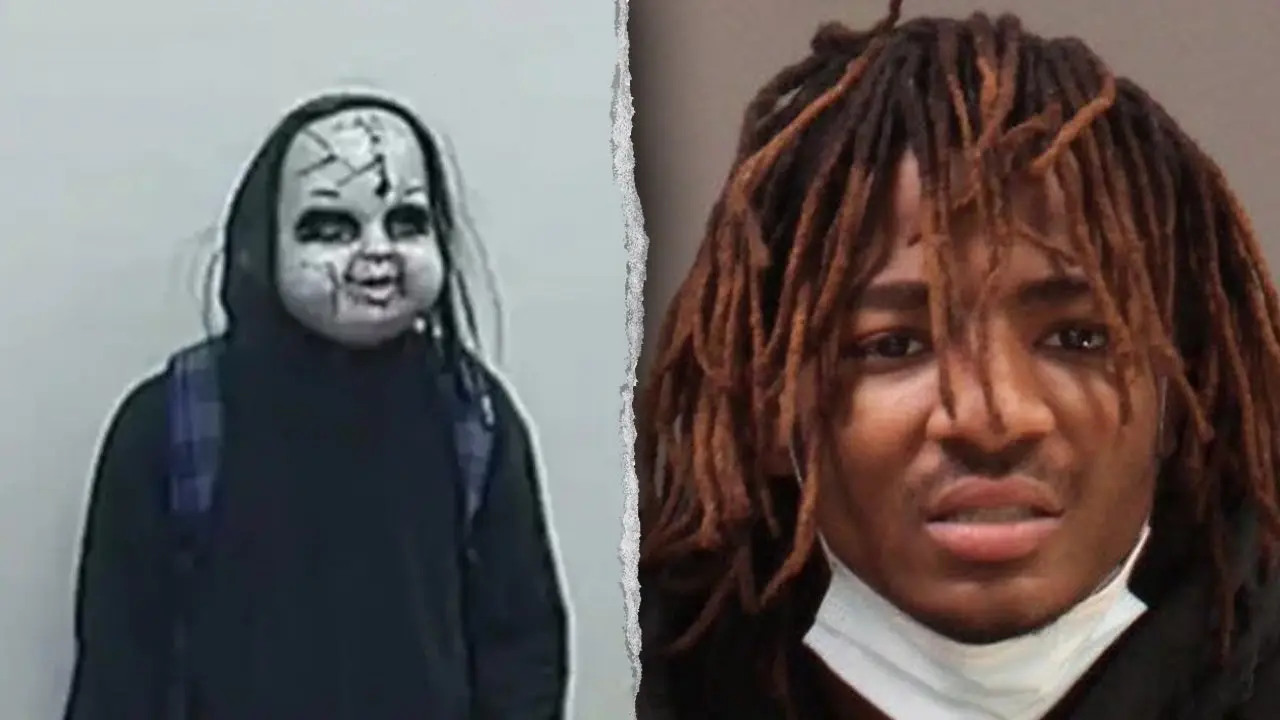
The usually vibrant, resilient streets of Philadelphia have been plunged into a palpable unease, a quiet tremor of fear that now overshadows the city’s customary cacophony of honking horns and street-corner chatter. In the wake of a series of brazen, terrifying encounters, police have finally placed a name to the spectral figure that has been stalking its residents: Zymire Hughes. The 22-year-old has become the focus of an intense manhunt, with an active warrant for his arrest swirling around him like a storm cloud. The fear gripping the community isn’t just about random street crime; it is about the theatrical, almost cinematic cruelty of the suspect’s methods. He doesn’t merely rob or threaten—he terrorizes, using a grotesque Halloween mask resembling the iconic horror movie doll Chucky to amplify his menacing presence. The mask, with its wild red hair and maniacal stitched grin, transforms a simple predator into a scene straight out of a slasher film, leaving victims with a psychological scar that cuts far deeper than any physical bruise. As police urge the public to remain on high alert, there is an underlying, troubling worry that this terror, born on the asphalt of Philadelphia, may have already seeped beyond the city limits. Authorities fear Hughes may have fled Pennsylvania, potentially seeking refuge in other corners of the country, making this manhunt not just a local concern but a nationwide one. The city waits with bated breath, burdened by the terrifying uncertainty of whether the nightmare is truly over or if the masked menace is merely lying in wait elsewhere, ready to unleash his particular brand of fear on a new group of unsuspecting victims.
The terrifying saga unfolded last Wednesday, when the peace of a typical evening was shattered by a series of chilling, escalating encounters. According to eyewitness accounts and police reports, Hughes, dressed in his frightening Chucky-style disguise, was not merely wandering the city; he was actively hunting. One woman became the focus of his predatory attention when he reportedly pursued her relentlessly, chasing her through the streets as her heart pounded against her ribs and the sound of his footsteps grew closer with each desperate stride. The terror escalated from simple pursuit to outright psychological warfare when he allegedly began yelling at women, demanding to know if they were “ready to die.” These were not idle, empty threats; they were the desperate, unhinged words of someone who had clearly crossed a line into a dangerous realm of intimidation and malice. The absurd yet deeply disturbing nature of this ordeal was perfectly encapsulated when he attempted to enter a local Dunkin’ Donuts. The staff, likely startled and alarmed by the sight of a masked figure in a public space, refused him service—a simple act of defiance that probably only fueled his already inflamed anger. Surveillance cameras captured Hughes running up to unsuspecting pedestrians, launching himself at them like a phantom emerging from the shadows. The victims were left shaken, their sense of security shattered by the sudden realization that ordinary errands—walking home, grabbing a coffee, or simply traveling across town—could turn into a waking nightmare in an instant. Each clip of the surveillance footage reveals a predator in motion, his movements erratic and dangerous, leaving the entire city wondering how a young man could descend so deeply into such a terrifying performance. The fact that no serious physical harm has been reported does nothing to diminish the severity of the psychological assault he has inflicted upon these innocent people, nor does it lessen the profound dread that now hangs over the neighborhoods he terrorized.
In a dark narrative filled with helplessness, one extraordinary moment emerged as a beacon of defiant courage, a stunning reversal of script. The chase ended dramatically when Hughes allegedly came face-to-face with Jameka Wilson, a woman whose training and fierce resilience proved to be his undoing. Unlike the previous victims who fled in terror, Wilson stood her ground, her eyes locked on the masked assailant with an unwavering intensity. When Hughes threatened her, moving toward her with that grotesque, stitched face, Wilson did not retreat. Instead, she assessed the situation with a strategic calm that belied the chaos unfolding around her. “He was not guarding his midsection, so she kicked him hard in the chest,” Wilson later recounted, a brilliant description of a counter-attack that was both swift and devastatingly effective. The kick landed with enough force to send the attacker stumbling backward, his confidence shattered by the sudden shock of physical resistance. He pivoted on his heels and ran, his retreat as swift as his earlier approach had been menacing. This single act of self-defense did more than just thwart an attack; it humanized the terrifying predator, revealing him to be a coward when confronted with real strength. Wilson’s bravery has become a symbol of empowerment for the city, a reminder that victims are not always passive, that even in the darkest moments, the human spirit can roar back. Her story, shared with the world through local news outlets, has ignited a conversation about self-defense, martial arts, and the unyielding determination to reclaim one’s personal power. The image of a masked man running from a woman who refused to be a victim is a satisfying twist in an otherwise grim tale, offering a glimmer of hope and a reminder that even the scariest monsters often have feet of clay. Her story is now a counter-narrative to the pervasive fear, a powerful lesson in situational awareness and the transformative impact of a well-aimed kick.
As the dust begins to settle on the initial wave of panic, the Philadelphia Police Department has shifted its focus from reaction to tireless pursuit, releasing a detailed description of Hughes to aid in his capture. He is described as a Black male with a medium complexion, standing approximately 5 feet 8 inches tall, with a thin build. When he was last seen, he was wearing that chilling white Chucky-style Halloween mask with the signature black hair, and carrying a black and blue plaid backpack. But the physical description is only part of the puzzle. Investigators have uncovered that Hughes has connections to both California and Nevada, suggesting a history of transience or perhaps a network of contacts scattered across the country. This revelation has substantially complicated the manhunt, as police now have to coordinate with agencies thousands of miles away, sharing bulletins and hoping for a lucky break across state lines. The question burning on everyone’s mind is: where did he go? Did he catch a bus, a train, or manage to get a ride from an unsuspecting friend? The lack of clarity is deeply frustrating for law enforcement officials who are eager to close this terrifying chapter and restore a sense of safety to their community. The active warrant serves as a formal declaration that Hughes is a wanted man, but the physical act of bringing him into custody requires a stroke of luck or a crucial tip from a member of the public. His ability to vanish so quickly after such a public spectacle suggests a level of cunning or desperation, but it also highlights a vulnerability—a masked man traveling with a distinctive plaid backpack is hardly incognito. Police urge anyone with information to come forward, emphasizing that even the smallest detail could be the key to putting this nightmare to rest and ensuring the safety of every citizen, not just in Philadelphia, but in whatever city may have unwittingly become his new hunting ground.
Beyond the immediate crime, the incident has triggered a profound psychological ripple effect throughout the community and across the nation, touching on deeper cultural anxieties. The Chucky mask is not just a random accessory; it is a deeply embedded cultural symbol of terror, instantly recognizable to anyone who has watched the horror franchise. By choosing this specific disguise, Hughes tapped into a primal fear deeply rooted in American pop culture, weaponizing a childhood nightmare into a tool of adult intimidation. The juxtaposition of a 1990s slasher icon on the gritty, modern-day streets of Philadelphia created a surreal and deeply unsettling visual that has been replayed endlessly on news broadcasts and social media feeds. This is more than just a crime spree; it is a performance art of intimidation, a deliberate act designed to maximize fear and confusion. The psychological impact on the victims cannot be overstated. They were not just subjected to a physical threat but to a theatrical degradation, forced to confront a living nightmare that blurred the lines between fantasy and reality. The aftermath has seen heightened anxiety in the neighborhoods involved, with residents walking with a cautious over-the-shoulder glance and parents keeping their children closer than ever before. The city is grappling with a unique kind of urban anxiety—one that repurposes familiar faces and spaces into potential sites of horror. Moreover, the incident has sparked a broader discussion about mental health and the state of young adults who veer into such radical, destructive behavior. How does a man in his early twenties decide to terrorize strangers with a Halloween mask? Is it a cry for help, an act of pure malice, or simply a deranged attempt to experience a fleeting sense of power? These questions linger in the air, adding a layer of societal introspection to the pursuit of justice, prompting experts and laypeople alike to examine the warning signs that may have been missed.
In the end, the story of Zymire Hughes is one of chaos meeting resilience, a stark testament to the unpredictability of human behavior. For the residents of Philadelphia, it serves as a grim reminder that safety is a precarious illusion, vulnerable to the whims of those who choose to abandon morality. Yet, the narrative is not devoid of hope or redemption. Jameka Wilson’s swift counter-attack proved that courage can be found in the most unexpected places, and that a predator’s power relies heavily on the assumption of victim passivity. The city’s police force is working diligently, leveraging the public’s help to track down a man whose fifteen minutes of terrifying fame has made him a pariah. The call to action is clear: if you see Hughes, do not approach him, but contact authorities immediately. The public must act as the eyes and ears of law enforcement, sharing information and watching out for the safety of their neighbors. As the manhunt continues across state lines, there is a collective prayer for swift justice, not just for the women he terrorized, but for the restoration of the city’s peace of mind. The memory of the masked figure will likely linger for some time, but so will the memory of the woman who stood firm, kicking back at the darkness. Philadelphia is a city forged in resilience, built on the grit and determination of its people, and this incident, while deeply disturbing, will not break it. It will only sharpen its resolve. The hunt for Hughes is not just a police operation; it is a collective act of reclaiming the streets, ensuring that no one ever has to live in fear of a plastic mask again. We must remain vigilant, supportive, and unwavering in our commitment to justice, trusting that the system will eventually catch up with the man behind the mask, and that the dawn will always break after the longest, darkest night.