




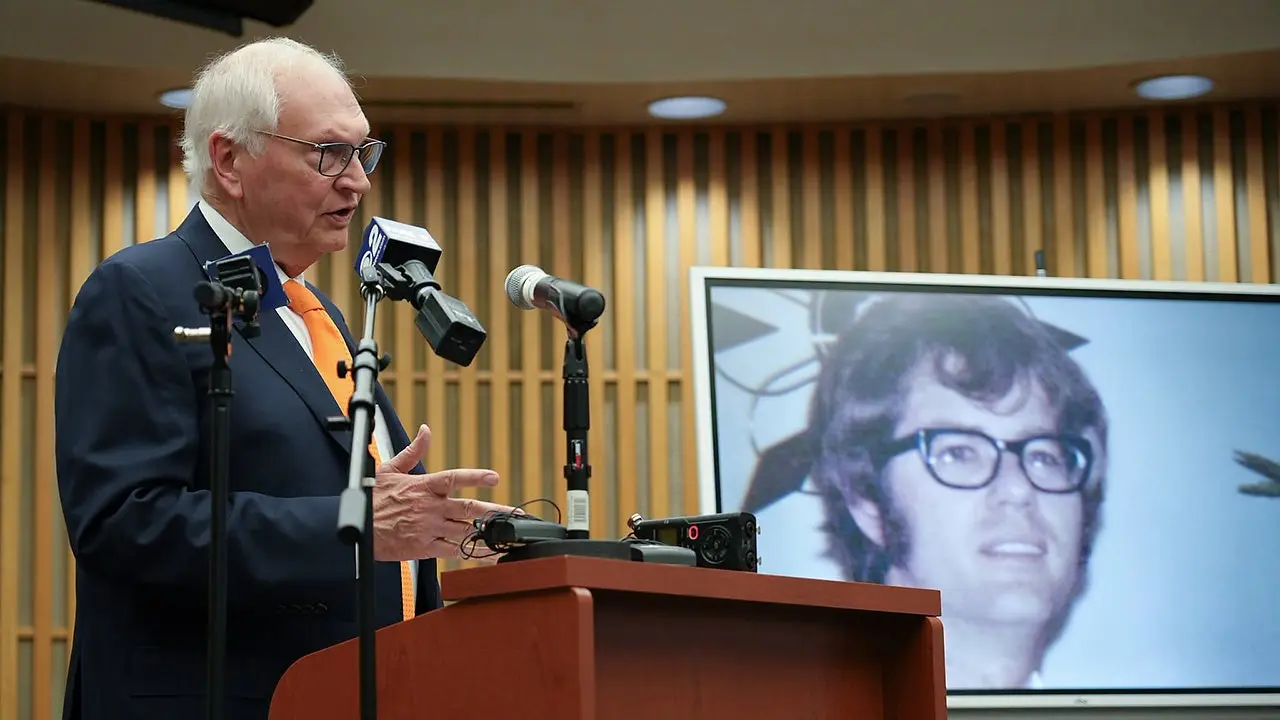
For over forty years, he was known only as the “Unknown Wanderer,” a specter haunting a Boise, Idaho church. His was a mystery that began with a solitary death and ended with a name, a history, and a chilling echo of one of America’s most infamous unsolved crimes. The man who walked into Sacred Heart Catholic Church on a December day in 1982 and died from cyanide poisoning has finally been identified as Dr. Mathew Francis Betkouski, an organic chemist whose past was steeped in the very knowledge required for the act that took his life. This identification, announced by the Ada County Sheriff’s Office, has not only closed a chapter on a decades-old cold case but has also reopened the files on the 1982 Chicago Tylenol murders, placing Betkouski at the center of new scrutiny, not as a named suspect, but as a figure of profound and compelling interest.
The Tylenol murders remain a scar on the American psyche, a moment when the simple act of taking a headache reliever became a gamble with death. In late September 1982, seven people in the Chicago area died after ingesting Extra-Strength Tylenol capsules that had been laced with potassium cyanide. The randomness of the victims, the calculated nature of the tampering, and the sheer terror it instilled in the public made it a national nightmare. The perpetrator was never caught, and the case has haunted investigators, forensic psychiatrists, and the families of the victims for generations. It is into this landscape of unresolved pain that the story of Dr. Betkouski has now emerged. While the Ada County Sheriff’s Office has been careful to state they cannot place him in Chicago during the critical period and are not naming him as a suspect, the evidence they have uncovered paints a portrait of a man who was both intellectually capable and disturbingly preoccupied with the mechanics of murder.
The journey to identify Betkouski was a masterclass in modern investigative tenacity. For decades, the man who died in the church was a ghost with no past. He carried no identification, and his fingerprints yielded no matches in any database. The only clues were nearly thirty keys found on his person. The breakthrough came when investigators, refusing to let the case go cold, meticulously traced these keys, eventually finding one that led to a post office box in Jacksonville, Florida, where Betkouski had once lived. This crucial link allowed them to obtain a DNA sample from his brother, which was then compared to DNA recovered from the dead man’s wallet. The match was conclusive, finally giving the “Unknown Wanderer” his true identity. But the identification was just the beginning of a far more unsettling discovery, as the subsequent investigation into his life revealed a history that would make any criminal profiler sit up and take notice.
What investigators unearthed was the profile of a man whose life seemed to be a prelude to the very crime they were re-examining. Betkouski was an organic chemist, a profession that gave him both the knowledge of and access to lethal substances. Former colleagues came forward with chilling recollections. One remembered him discussing the concept of the “perfect crime,” while another scientist recalled Betkouski explicitly stating that poison could be introduced into over-the-counter capsules, a macabre preview of the Tylenol plot. The evidence grew more tangible with the discovery of a map of Chicago and a bottle of sodium cyanide among belongings stored at his family’s home in Los Angeles. While sodium cyanide differs from the potassium cyanide used in the Tylenol murders, the presence of such a lethal poison, combined with his stated knowledge of poisoning capsules, created a deeply troubling picture. Even more intriguing, photographs showed that Betkouski had visited Chicago, though investigators believe these were taken in December 1981, months before the killings.
The timeline of Betkouski’s final weeks adds another layer of complexity to the story. He vanished from his home in New Mexico on October 15, 1982, a little over two weeks after the Tylenol murders. He then remained off the grid for over seven weeks, a period of time that remains largely unaccounted for. When he finally resurfaced, it was in Boise, Idaho, where he walked into a church and died by his own hand, having apparently altered his appearance in the intervening weeks. This strange, self-imposed exile, culminating in a secluded suicide, fits a narrative of a man perhaps haunted by his actions or, conversely, a man who had accomplished a dark goal. The mystery of his movements is a void that investigators are now desperately trying to fill, asking anyone with information about his communications or whereabouts in 1982 to come forward. As Ada County Sheriff Matt Clifford stated, “This isn’t over,” signaling that the investigation is far from complete.
The reaction from those who have studied the Tylenol case for years has been one of cautious, yet profound, validation. Dr. Park Dietz, a forensic psychiatrist consulted during the original investigation, has reviewed the evidence against Betkouski and offered a striking assessment. He described the current development as feeling like “very likely closure” to a case that began over four decades ago. Dietz revealed that he and other forensic psychiatrists, psychologists, and criminal profilers were anonymously presented with the information on Betkouski, and the unanimous conclusion was that he was a viable suspect. This professional consensus, born from an independent review of the evidence, lends substantial weight to the theory that the mystery of the Tylenol murders may have finally been solved in all but official name. While the investigators in Chicago must now conduct their own rigorous review, the confluence of Betkouski’s expertise, his stated intentions, and the physical evidence makes him a compelling figure, the strongest lead this case may have ever had. For the families of the seven victims, the identification of a potential perpetrator, even posthumously, might offer the first glimmer of an answer to a question that has defined their lives for forty years.