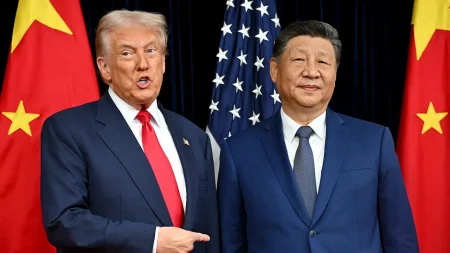





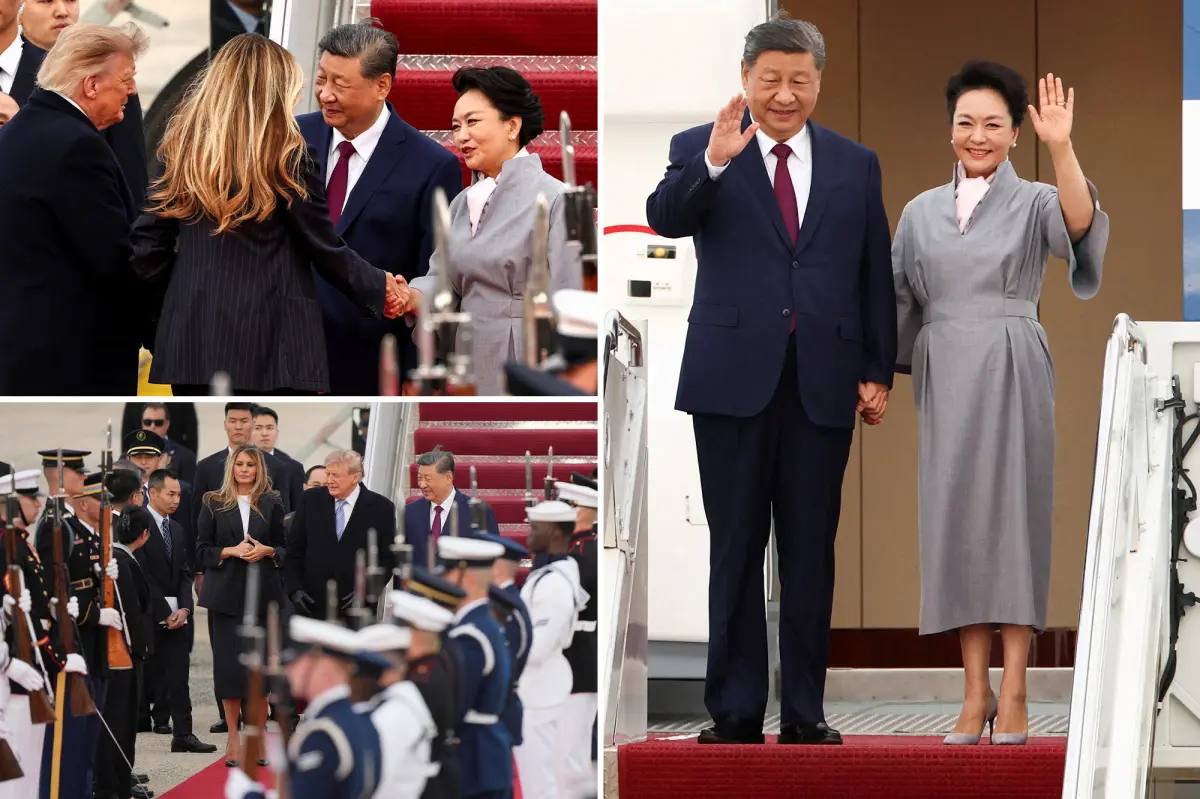
It was an evening of carefully choreographed symbolism on the tarmac at Joint Base Andrews, a scene that felt equal parts military parade and diplomatic theater. President Trump, accompanied by first lady Melania Trump, made the unusual decision to personally greet Chinese President Xi Jinping as he stepped off his plane shortly before 6 p.m. The gesture was not lost on historians: the last time an American president welcomed a foreign leader at Joint Base Andrews was in 1962, when John F. Kennedy met British Prime Minister Harold Macmillan. Xi, for his part, had not extended the same honor when Trump visited Beijing in May, making Trump’s presence at the bottom of the stairs all the more striking. As Xi descended, the two leaders shook hands against a backdrop of American military might—six F-16s and six F-22s lined up on the tarmac like silent sentinels, while service members rolled out a literal red carpet across the concrete. It was a moment designed to project both warmth and strength, a delicate balance that has defined the Trump-Xi relationship from the very beginning. For all the formalities, there was something almost intimate about the scene: two of the most powerful men on earth, meeting face to face after months of tension, each aware that the world was watching their every move. The pageantry was unmistakably American, but the subtext was global, touching on trade, security, and the fragile trust between rivals who need each other far more than they would like to admit.
Behind the grandeur, however, lay a packed agenda of contentious issues that have tested the U.S.-China relationship for years. The three-day state visit was expected to pair the ceremonial splendor of a White House state dinner with tough, behind-closed-doors conversations on tariffs, fentanyl exports, artificial intelligence, and Beijing’s role in conflicts ranging from Iran to Ukraine. Trump has repeatedly said he believes that a strong personal relationship between the two leaders can yield real benefits for the American people, even if the specifics of what that means remain murky. He has often spoken of Xi with a kind of grudging respect, describing him as a brilliant leader and a friend, yet that friendship has not prevented the two countries from sliding into economic confrontation. For Xi, the visit was an opportunity to reset a relationship that has careened between cooperation and crisis, while for Trump it was a chance to claim credit for managing the world’s most consequential bilateral relationship. But as a senior U.S. official acknowledged before Xi’s arrival, there were no guarantees of concrete agreements. The two leaders would talk, dine, and smile for cameras, but the real work would happen in the quiet moments, where personal chemistry either bridges gaps or exposes them. In many ways, the visit was a test of whether two men who have mastered the art of public performance could translate their personal rapport into tangible progress on issues that affect billions of lives.
The centerpiece of the visit was to be a state dinner at the White House on Thursday, an occasion Trump was likely to use to show off his recent renovations, including a new granite helipad emblazoned with the presidential seal and an enormous ballroom with concrete walls now protruding from the site of the former East Wing. It was a fitting metaphor for a relationship that has been perpetually under construction, always being renovated, never quite finished. The Trump-Xi relationship has had its share of ups and downs, marked by warm in-person greetings that often masked deeper strains. The two leaders seemed to genuinely enjoy each other’s company in the early days of Trump’s presidency, bonding over shared instincts for power and a mutual disdain for diplomatic niceties. But the warmth soured during the COVID-19 pandemic in 2020, when blame and recrimination replaced cooperation, and again during last year’s trade war, when tariffs and counter-tariffs escalated into a full-blown economic conflict. Yet here they were again, sitting down to dinner in the White House, as if the intervening years of tension could be smoothed over with fine china and polite conversation. That is the strange nature of great-power diplomacy: it is built on relationships that must endure even when trust is broken, and both Trump and Xi seem to understand that their personal connection, however fragile, is one of the few tools they have to manage a rivalry that could easily spiral out of control.
The trade war that brought them to this moment was a brutal reminder of how quickly economic interdependence can turn into economic warfare. Trump, seeking to force a new trade deal that would rebalance the U.S. trade deficit and punish China for its role in the fentanyl crisis, ramped up tariffs on Chinese goods last year, and Xi retaliated in kind. The result was a spiral that pushed U.S. tariffs on Chinese goods to nearly 150 percent, a staggering figure that disrupted supply chains, raised costs for businesses, and injected uncertainty into the global economy. The confrontation only began to cool after an October meeting between Trump and Xi in South Korea, where Xi agreed to do more to crack down on fentanyl exports—a crisis that has killed roughly 488,000 Americans over the past decade, with deaths peaking in 2022 and 2023. The numbers are abstract, but the human consequences are not: families torn apart by addiction, communities devastated by overdose epidemics, and a sense of urgency that Trump has seized upon as a central justification for his hardline stance. For Xi, the trade war was an economic and political challenge, threatening to undermine China’s growth and expose the vulnerabilities of its export-driven model. The two leaders were, in a sense, prisoners of their own positions, each needing to show strength at home while finding a way to avoid a catastrophic rupture abroad.
Nowhere was the tension more evident than in the fentanyl issue, which remains one of the most emotional and intractable problems in the bilateral relationship. A senior U.S. official told reporters ahead of Xi’s visit that the Trump administration is dissatisfied with Xi’s actions to reduce fentanyl smuggling. “It does not appear that China has elevated this issue,” the official said. “China is the overwhelming, predominant supplier of precursor chemicals to the cartels in Mexico and remains so. And they have done a number of anecdotal things, including a few arrests recently, but we’d like to see much more systemic change.” The frustration in those words was palpable, reflecting a deeper sense that Beijing has not fully grasped the severity of the crisis from an American perspective. Fentanyl deaths have dipped in the United States, but they remain elevated, and factors such as the availability of test strips, overdose antidotes, and improved border detection may have eased the impact as much as any action by China. Still, about 35,000 Americans died in the past year alone—a number that represents not just statistics but real people, each with a name, a story, and a family left to grieve. For Trump, the fentanyl issue is both a policy priority and a political rallying cry, a way to frame the trade war as a moral crusade rather than just an economic dispute. For Xi, it is a point of contention that threatens to define China as a source of harm rather than a partner in global stability, and his willingness to address it will likely determine whether the state visit produces any lasting breakthroughs.
Perhaps the most telling moment of the Trump-Xi relationship came in 2017, during Xi’s visit to Mar-a-Lago, when the two men were enjoying dessert and Trump revealed that the United States had just conducted airstrikes on Syria. “We had the most beautiful piece of chocolate cake that you’ve ever seen and President Xi was enjoying it,” Trump remembered afterward. “He was eating his cake. And he was silent.” That anecdote captures the strange paradox of their relationship: personal warmth coexisting with the raw exercise of American power, a dessert interrupted by the reality of war. It is a reminder that even the closest personal bonds between leaders are always shadowed by the interests they represent. Trump’s decision to greet Xi at Joint Base Andrews was another such moment—a gesture of respect that was also a display of strength, a handshake beneath the wings of fighter jets. The two men have spent years navigating a relationship that is at once deeply personal and profoundly geopolitical, and this state visit is the latest chapter in that ongoing story. Whether it will end with a new trade deal, a meaningful commitment on fentanyl, or simply more beautiful chocolate cake remains to be seen. But the world is watching, as it always is, waiting to see whether two leaders who have so often seemed to enjoy each other’s company can turn that chemistry into something more than a momentary thaw. For now, the red carpet has been rolled out, the fighter jets are lined up, and the dinner table is set. The rest is up to the two men at the center of it all.