






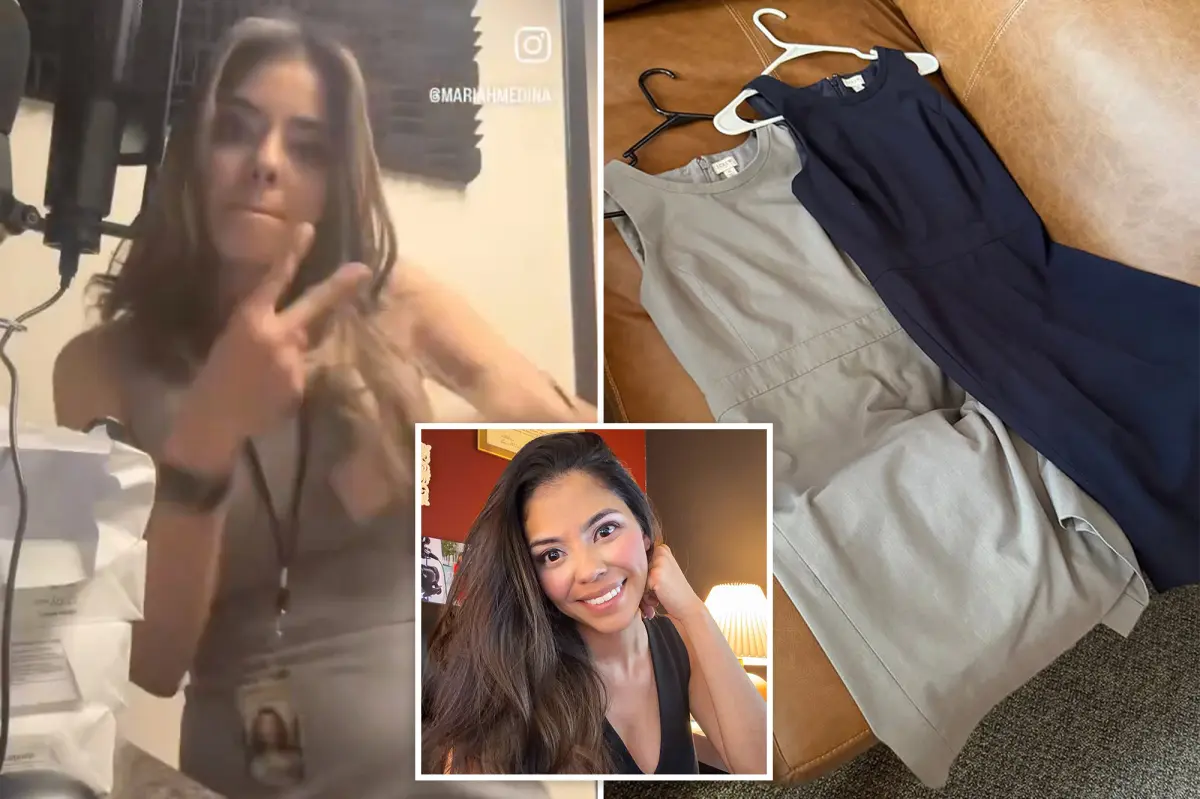
Courtrooms are not forgiving places, especially in a Texas summer, when the air conditioning can be barely noticeable and the heat settles over everything like a damp, heavy blanket. Mariah Medina, a 25-year-old San Antonio defense lawyer and former television reporter, arrived at court wearing what she thought was a perfectly reasonable outfit: a modest sleeveless sheath dress she had worn countless times on air and in other courtrooms without a single comment. But the judge took one look and called it a “tank top.” Medina was genuinely confused. This was not a casual top. It was a tailored dress, professional enough for television, modest enough for any courtroom. She calmly explained that it was a shift dress, but the correction had already landed. After the hearing, she shared a photo of the outfit on social media, along with her disbelief. The post went viral, and suddenly a routine day in court became a national conversation about women, dress codes, and the quiet ways professional women are policed. Medina did not set out to fight this battle. She was just trying to do her job in the stifling heat. But the judge’s comment touched a nerve, and she found herself at the center of a debate she never expected. What she did not anticipate was the backlash from other women. “The number of women attorneys who are just so ugly on the internet, I was like, ‘this is so strange,’” she told the Post. The nasty letters and chilly messages came from male lawyers too, but the female criticism stung the most, because she had expected solidarity from women who knew exactly what it was like to stand before a judge and be judged before they even opened their mouths.
Medina’s dress was not provocative. It was not revealing. It covered her torso, fell modestly above the knee, and exposed only her arms from the shoulder to the elbow. In San Antonio, where the summer heat can make formal attire feel unbearable, sleeveless dresses are not a bold fashion statement; they are a survival strategy. Medina had worn the same dress on television, where appearance is scrutinized intensely, and no one had ever complained. She had worn it to other courts, too, and no one had even blinked. The judge’s characterization of it as a “tank top” was not just inaccurate; it was dismissive, implying she had shown up in something casual and inappropriate. She was stunned that such a simple piece of clothing could generate so much disapproval. The only exposed part of her body was her arms, and that, she argued, made the entire episode feel less about professionalism and more about control. She later joked, “Texas has the strongest right to bear arms, but when it comes to ‘bare arms’ that right ends between the shoulder and the elbow, I guess.” The line captured the absurdity of the situation perfectly, and it resonated with women who had been subjected to similar dress-code policing for years. It also exposed a double standard that many female lawyers know all too well: men can appear in short sleeves and nobody says a word, but a woman’s bare arms can be treated as a distraction, a disrespect, or a sign of unprofessionalism. Medina was not trying to make a statement. She was trying to be comfortable and presentable in a state famous for brutal summers. The fact that her flesh was the problem said far more about the culture than about her wardrobe.
In the days that followed, however, Medina discovered that she was not as alone as the nasty comments suggested. Her colleagues in San Antonio rallied around her in ways that were both touching and theatrical. One male lawyer, in a playful gesture of solidarity, bought a suit with short pants, a visual joke meant to highlight how ridiculous the scrutiny of women’s clothing has become. Other lawyers shared their own stories of being criticized for everything from necklines to shoe choices, and the flood of support reminded Medina that the legal profession, for all its rigid traditions, is full of people willing to challenge the status quo. Her peers understood something the judge apparently did not: that a woman’s ability to advocate for her client has nothing to do with the length of her sleeves. Yet the online backlash continued, and much of it came from an unexpected quarter. Self-identified female attorneys questioned her judgment, accused her of being disrespectful, and insisted she should have known better. Some suggested she was playing the victim or drawing attention to herself. The letters, Medina said, were simply “ugly.” She had expected a measure of sisterhood—or at least an acknowledgment that navigating a male‑dominated profession is hard enough without women attacking each other over a dress. Instead, she found some women eager to enforce the same outdated standards that had humiliated her. Male lawyers sent chilly messages too, but their criticism was less surprising. It was the judgment of other women that lingered in her mind, leaving her disappointed in the profession she had chosen to serve.
Medina’s experience is not an isolated one. Courtroom dress codes have long been a quiet source of anxiety, especially for women. Men wear dark suits, and no one asks whether their jackets are too loose or their pants too long. Women, however, are expected to walk an impossible tightrope: be authoritative but not aggressive, professional but not masculine, attractive but not distracting, modest but not outdated. The rules are rarely written down, which means they are often enforced based on a judge’s personal taste or mood. The lack of clear standards creates a climate of uncertainty, where a woman can do everything right and still be called out. Medina’s photograph made the injustice visible. The dress in the image is conservative by almost any measure. It does not cling, plunge, or provoke. It is the kind of garment worn by newscasters, executives, and lawyers for decades. Many women have gone to work in similar outfits without a second thought. So why was she singled out? The arbitrariness of the criticism is what makes it so dangerous. When dress-code enforcement is left to individual judgment, it becomes a way to humiliate and intimidate, to remind women that their place in the legal profession is conditional. It shifts the focus from the case to the body, making the lawyer the object of scrutiny instead of the advocate she was trained to be. That is why Medina’s story resonated so deeply: countless women recognized the moment, the flash of heat in the face when someone in power signals that you do not belong, and the frantic feeling that you must have missed a rule that was never actually written down.
At the heart of the controversy is a pointed play on words that cuts to the core of Texas culture. The state is famously zealous in defending the right to bear arms, yet it seems to have little tolerance for bare arms. Medina’s joke about the boundary between shoulder and elbow was not just witty; it was a sharp observation about how liberty is selectively applied. In Texas, gun ownership is fiercely protected, while women’s bodies are regulated in both formal and informal ways. The legal culture prizes individual freedom, but that freedom often does not extend to women who want to dress comfortably in the summer heat. The image of a young female lawyer being scolded for a sleeveless dress is a reminder that “professionalism” is never neutral. It carries assumptions about gender, class, and tradition. The courtroom remains one of the most formal spaces in American life, and for many judges, formal means male: long sleeves, long pants, dark colors, serious tailoring. Women are allowed into that world, but only if they can approximate a masculine standard of dress without actually wearing masculine clothes. They are asked to blend in while standing out, to be competent while being cute, to be powerful without taking up too much space. Medina’s critics suggested she should have worn a blazer, as though the solution were simple. But a blazer in a San Antonio courtroom can mean sweating through an entire hearing. And more to the point, Medina should not have had to explain herself. The judge’s comment was not really about fabric or sleeves. It was about who defines what a lawyer looks like, and what happens to women who challenge that definition simply by showing up as themselves.
Ultimately, Medina remains unbothered and unbowed. She has not changed the way she dresses, and she has not let the nasty letters push her into silence. If anything, the backlash has made her more determined to stand up for herself. She knows her career will involve many more courtrooms, many more judges, and many more attempts to define what “appropriate” means. But she is no longer willing to shrink. Her fight is not just about one dress; it is about the principle that a lawyer should be judged by her words, not her shoulders. By sharing the photo, she let everyone see the evidence, and the evidence did not match the accusation. The dress was modest; the criticism was absurd. Medina’s response—calm, sarcastic, and defiant—offers a model for anyone who has ever been told to fit into a mold they never chose. She brought a reporter’s instincts to the story: she documented the moment, framed the narrative, and showed receipts. She did not whine or lash out. She simply told the truth, made her joke, and let the world react. In the end, the judge’s attempt to shame her only exposed the thinness of the rule itself. Medina has become, almost reluctantly, the face of a movement of women refusing to accept courtroom dress codes that have no clear standard. She is not asking anyone else to wear sleeveless dresses. She is asking only that women be judged on the quality of their advocacy, not the length of their sleeves. The support from her peers, including the male colleague with the short pants, proves she is not alone. And if her experience makes the next female lawyer think twice about her outfit, Medina hopes it will be for a different reason—not out of fear of a judge’s disapproval, but with confidence that her bare arms are nobody’s business. In Texas, the right to bear arms is sacred. The right to bare arms should not be a harder fight to win. Medina has decided she will not back down until it is.