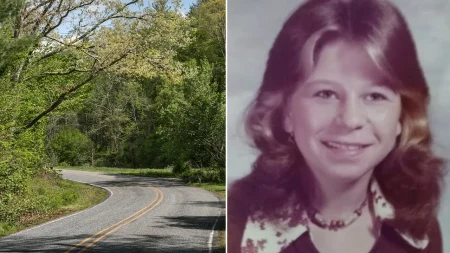





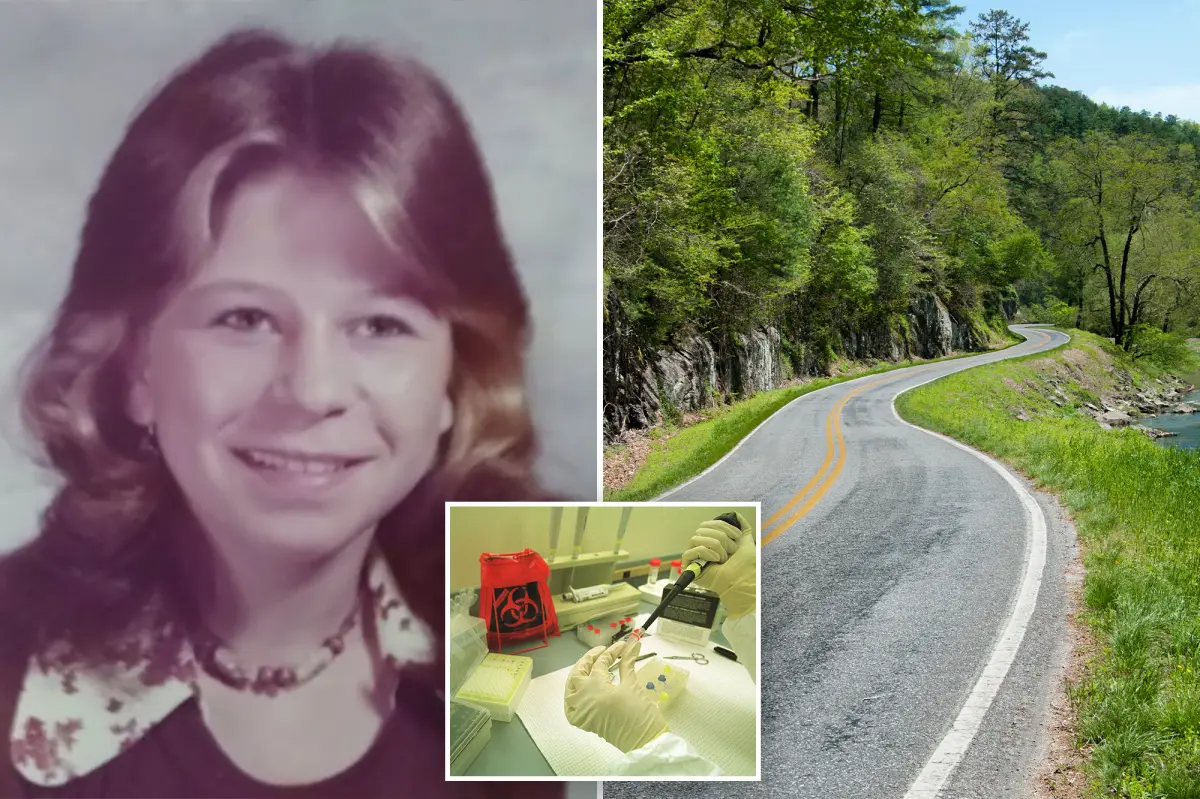
For nearly half a century, the rolling, wooded landscapes of Wilson County, North Carolina, held a secret. It was a silent, somber mystery that began with a grim discovery in the final days of 1977 and would baffle investigators for generations. On December 29th of that year, skeletal remains were found in a secluded wooded area near a Firestone manufacturing plant. The scene was a stark and lonely one, offering few immediate clues. The local authorities who responded knew they were dealing with a tragedy, but they had no idea that the identity of the person lying there would remain an enigma for the next 47 years, a persistent ghost haunting the cold case files of the state.
An initial examination by the medical examiner provided the first sketchy details of the victim. The remains were determined to be those of a white female, likely between the ages of 16 and 23. The state of the bones also told a tragic secondary story: they had been there for a considerable amount of time, likely between six months and two years before being discovered. This placed the time of death somewhere in the mid-1970s, a period when forensic science was in its infancy compared to today’s standards. With no immediate match to a missing person report and such a limited physical description, the case was a difficult puzzle from the very start. The circumstances of the discovery—the remote location and the condition of the remains—strongly suggested foul play, leading investigators to classify the case as a homicide, though the killer, and even the victim, remained utterly unknown.
For decades, the case grew cold, a collection of dusty files and fading memories. The initial investigation, while earnest, hit a wall that was built from the technological limitations of the era. Without the benefit of modern DNA analysis, investigators were forced to rely on more traditional, and often painstaking, methods. They compiled missing person reports from across the state and the nation, hoping for a thread to pull. The primary tool for identification was dental records. For years, dedicated detectives and analysts compared the victim’s dental charts against those of missing girls and women, hoping for a match that would give their Jane Doe a name and a history. But again and again, the records came back negative. The decades rolled on, and the identity of the young woman found near the tire plant faded from the public consciousness, becoming just another entry in the long list of America’s unresolved mysteries.
Then, in 2010, a renewed sense of purpose emerged. A state anthropologist, reviewing the case with fresh eyes, made a critical decision to fully embrace the potential of new forensic technology. The decision was made to submit the preserved bone sample for DNA testing and, crucially, to enter that genetic profile into national and federal databases. This was a turning point, shifting the investigation from the analog into the digital age. While this new approach didn’t immediately unlock the mystery, it laid the essential groundwork. For another decade, the DNA profile sat in the system, a silent beacon waiting for a connection. It was a waiting game, a delicate balance of hope and patience, until the scientific landscape evolved once more, providing a revolutionary tool that would finally begin to unravel the decades-old knot.
The real breakthrough came in 2024, when the North Carolina State Bureau of Investigation (SBI) made the case a priority once again. Their specialized Cold Case Investigative Team took a fresh, comprehensive look at the evidence, armed with tools and techniques that were unimaginable in 1977. The key was a new application of forensic genetic genealogy. This wasn’t just comparing DNA profiles to find a direct match; it was a much more powerful process. The SBI used a genealogy service to take the victim’s DNA profile and search public and private databases for distant relatives. By building vast family trees and triangulating connections, genealogists could trace the lineage backwards through dozens, and potentially hundreds, of distant cousins until they landed on a specific family and, ultimately, a specific missing person. When the case qualified for this advanced, specialized testing, forensic scientists were able to extract preserved genetic material from the old bone sample—a final, crucial extraction that contained the key to the entire mystery.
The science of genetic genealogy pointed unmistakably toward a 15-year-old girl named Cindy Marcell Blizzard, who had run away from her home in the small community of Monkton, Maryland, in the spring of 1977. The distance between her rural Maryland home and the woods of Wilson County, North Carolina, is over 500 miles (roughly 800 kilometers), a detail that only adds more questions to the case. How did a teenager from that area end up so far from home? The identification was a monumental feat of modern forensic science and sheer investigative perseverance, but it was made possible through a collaborative effort between multiple agencies, including the FBI’s NCIC Investigation and Operational Assistance Group, the Maryland Department of State Police Homicide Unit, and the Raleigh Police Department’s Intel Unit.
While the victim, now finally known as Cindy Marcell Blizzard, has been given her name back, the full story of her final days remains incomplete. Although the identification has given closure to a decades-long question, the SBI has stated that the manner of death is still undetermined, though investigators will continue to treat it as a homicide. The circumstances surrounding her death remain a focal point for law enforcement. They are now tasked with re-examining the case not as a nameless Jane Doe, but as a runaway teenager with a life, a family, and a story. The search for answers continues as investigators work to retrace Cindy’s final steps, understand how she traveled so far from home, and who might have been responsible for her death. For her family, the long wait is finally over in one sense, but a new, painful chapter of questions begins. The name Cindy Marcell Blizzard is no longer just a missing person’s file; it is a testament to the unyielding power of science, the dedication of investigators who refuse to give up, and the simple, profound truth that every person, no matter how long forgotten, deserves to have their name and their story returned to them.