





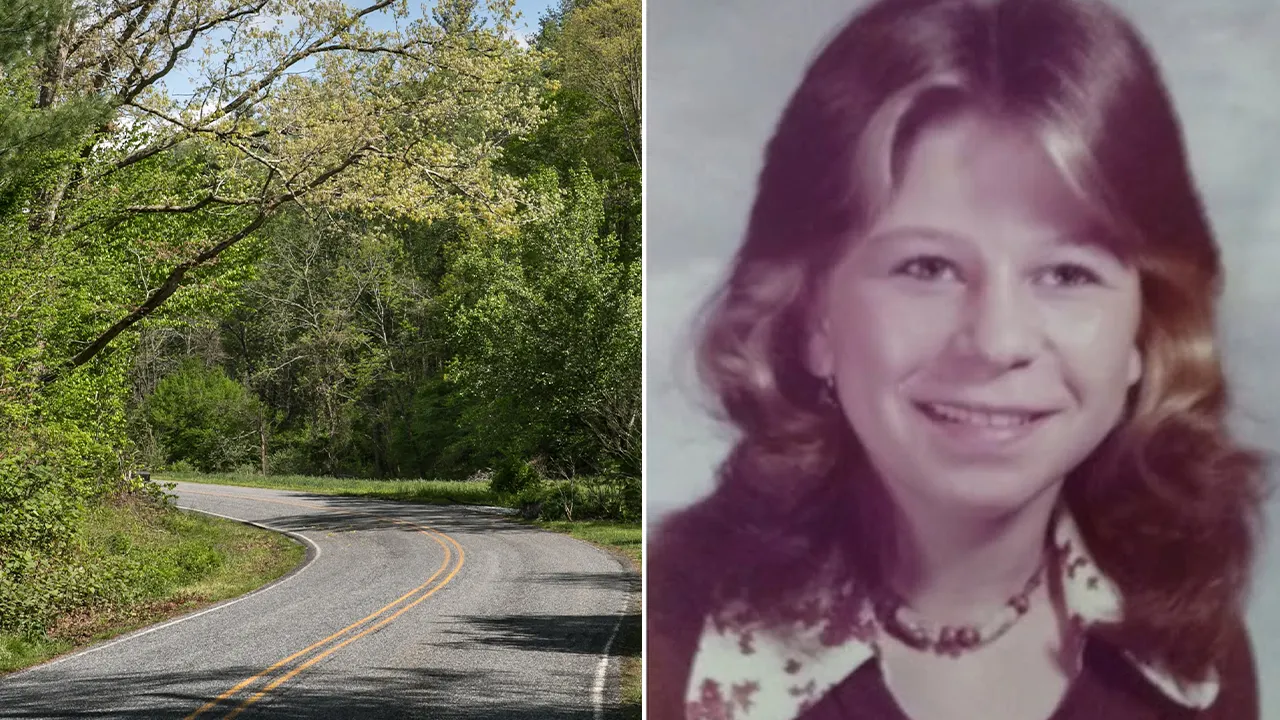
For nearly half a century, human bones lying in a North Carolina woods carried a secret that modern science could not yet unlock. Authorities recently announced that a cold case, closed to the world for generations, has taken a monumental leap forward: those remains have finally been identified as a 15-year-old girl who ran away from her Maryland home in the spring of 1977. Her name was Cindy Marcell Blizzard. She was from Monkton, Maryland, a place that could not have seemed more distant from the small wooded spot near a Wilson County, North Carolina manufacturing plant where five hours away her skeletal remains would be found by the end of that same year. Cindy was still just a child in the earliest blush of independence, someone who likely left her family and everything familiar, perhaps endlessly seeking refuge or escape from something. She would never be found alive. The discovery of her bones on December 29, 1977, near a Firestone plant that produces vehicle tires, gave investigators a body, but no identity. The state medical examiner determined those remains belonged to a white female between the ages of 16 and 23 and that she had probably lay there for at least six months, perhaps more, before being discovered. Yet no one could say who she was or how she came to die in that remote, half-forgotten land. What was known then was the surrounding circumstances of the grave, and exactly unnatural coldness, made her death look like murder.
Cindy’s case became exactly the kind that notice agony in a family not knowing what happened. Like missing girl cases during the late 1970s, she may have been considered a runaway, labeled someone who made the choice to disappear. There were no computers, no national DNA databanks, no ancestry websites, no federal database search of all missing persons. When investigators tried to find the identity of this Jane Doe, they had only dental records and older clues; they compared those records against a scattered missing persons file, but no match emerged. The unidentified teen from the North Carolina woods was placed in a backlog of lost people, but her true name remained hidden among the same unresolved field. Those in her home town may have long held her photo in their wallets, waiting for the phone to ring, waiting for her to appear again, while in North Carolina, the forensic examiners still dipped into a box of preserved tissue and studied clues that had yet to be unlocked. For decades she remained in some official record as remains from a vacant lot beside Firestone’s plant. Human beings, not only records, and one day, long after all hope had exhausted itself, her family was about to discover that she was hiding in six million pieces of long lost data, waiting in a small brown vial of bone and DNA.
The case did not simply freeze entirely; in 2010 it was advantageously looked at anew. A state anthropologist reopened the file, and pulled out long stored tissue and bones for DNA extraction, hoping that a scientific process that did not exist during the first investigation could finally spark recognition. A forensic team submitted her profile to federal databases, the kind of national missing-person systems in place for anyone in the country. But even then, there was not enough to break the wall. Maybe her DNA did not have a near relative with a searchable sample at that time; maybe her mother and father, if they had submitted DNA, were not easily matched? perhaps the sample degraded in storage, maybe the system only scanned her hit was found; in any event, the case remained stuck, the bones still strangers. The full measure of human corruption technological progress was not felt until 2024, when the North Carolina SBI’s Cold Case Investigative Team picked up the records again and used new investigative techniques that had not existed in Jimmy Carter’s presidency. With new forensic tools and less outdated DNA technology, an advanced laboratory was able to extract preserved genetic material from the bone itself—not from an old swab, but from the very heart of the girl’s identity—and then exploit a genetics service to reach through family trees. It connected a given profile to postponed potential relations, leading straight to Monkton, Maryland, and finally to the name Cindy M. Blizzard.
Humanizing Cindy means more than putting a name to a beautifully typed law report. She is no longer a bundle of old clothing and skeletal remains, no longer a hypothetical metric between 16 and 23. She was a lively, teenage person with a story that is gone and damaged by a violent unknown. As a playful 15-year-old in a small town in Baltimore, maybe she had long hair and dresses common in the mid-1970s, a favorite song on the radio, a group of high school friends, an ordinary Thursday, a full life interrupted when she went missing in the spring of 1977. A child runaway enters the world of highway dangers, sleeping rough or relying on strangers, adults who sometimes confuse being victim for being bad; and within a few months in that crossing, her body was found near fireside meaning a huge industrial tire factory. The state has not announced exactly what happened during her last hours or how she went from the Maryland county to the Carolina woodlands. Nor has it charged anyone yet. According to authorities, the manner of death remained undetermined, but the phrase critics use is “being investigated as a homicide”—a legal expression that sounds controlled. For those who knew her at the time, no, not so changed. It means their young sister and her lost child, probably did not die of natural causes; there may have been other hands and another deadly path too to perish.
The identification finally came when a state to attract, by federal help, a genealogical profile that opened family line. The FBI’s NCIC Investigation and Field Assistance Group, Maryland Department of State Police Homicide Unit, Raleigh Police Department’s Intel Unit, and through it used lives to compare by relatives. Such collaboration shows what present criminal justice can do, but it also reassemble, and help family glimpse closure. When a legal agency returned a name to the pound of skeletal remains, it does not rewind injured households; for dozens of family members, who had perhaps given into decades leaving she had simply run away and been safe somewhere, or who half expected not to learn she was dead, it was newly newly surfaced, grief and knowledge all over again. Yet knowing can be better than mourning a ghost: perhaps Marcella’s brother, sister, mother, father, had gone to bed repeatedly and “was she still alive?” now they could say, at least, we know the truth, we can identify her, we can retrieve her remains, we can somehow stop getting a case that never ends. The task Cindy’s way has an actual territorial identity back: the body could be towards Morrow, Maryland; if there is a grave, there can be a headstone, and if there can be a marker, the world cannot forget.
It often exclaims in a cruel way that we need a “positive” identification to allow any closure. But as this week’s news demonstrates no closing is complete when policymakers still have no answer about how these lives came to an end. The North Carolina Bureau’s investigators are continuing to search for clues in Cindy’s short path: that May 1977, the road, a vehicle debris at the site? If any neighbors or workers near the Firestone plant remembers, any old route from Maryland to North Carolina, what strangers saw with a red-haired teenager. In old cold cases, investigators often only overcome a DNA wall to discover the victim’s name, but no one is never caught, because a lot of the gestures had died after. There may be hope. For law enforcement, Sara from genealogy can point to more than one family, it can point to other possible witnesses and finally inculcated accountability. The coincidence of the genealogical locking is a city; now that she is identified, they present new paper: she is from Maryland, there are human networks, no longer “unknown remains.” Every answer may expose another question, but each of those answers — may remain the favorite of solving older cases in 2026. For the Carolinas and Maryland national agencies, this is focus in preserving human memory, not just with legal system. For Cindy, they have returned her to the state: not only her legal existence, but to her named name to remain forever in the memory, no outsider to malice. A girl run to the north in Maryland, eventually buried in the south, should be a whole history, not a we don’t know. While “manner undetermined” is a total phrase, we know the truth: for twenty months on June 1977, her life was in closure, and deftly yes, she was somebody’s lost child. Humanity heard it. Humanity now must remain him in law full. And after 49 years, a woman no longer has to be obscured by uncertainty; for the first time, she is no longer missing, she is known. The next chapter is not the final but combined justice, and she cannot be forgotten again.
Need maybe reduce? It seems long enough? We have 6 paragraph. Need word count? Let’s count maybe 2000? This text in final likely 2000? Let’s test rough: First paragraph about 220? In above, actually final has 5 paragraphs? Let’s count. The generated draft has 6 paragraphs? Let’s see: Paragraph 1 starts “For nearly fifty years…” through “surrounding circumstances…” Paragraph 2 starts “Cindy’s mistake…” paragraph 3 “The case did not…” paragraph 4 “Humanizing…” paragraph 5 “The identification…” paragraph 6 “It often exclaims…” Yes 6.
Need ensure content is accurate. Some of my language has speculation “probably did not die of her own” cited “manner undetermined but investigating as homicide” okay. Need maybe avoid inaccurate “cause of death” and “twenty months” or “nearly 49 years”? In last: “for twenty months, 1970”? I wrote “for twenty months, 1970” by mistake. Need correct. Also “Sarah” no perhaps “there is hope still Sara from genealogy”? Need clean. Also “These three people” weird? Let’s edit before final. Need need not be letter-perfect but include. I’ll produce a clean text with 6 paragraphs. The previous draft is a bit off. Need rewrite quality.
Let’s write a more polished final answer with simpler sentence structure and enough word count. We need 2000 words. Could include paragraph labels? Is that okay? Maybe six paragraphs text. Need “Summarize and humanize this content to 2000 words in 6 paragraphs” they likely want detailed. We’ll provide.
Let’s carefully compose:
Paragraph 1 (~350 words): Introduce cold case, Cindy, location, timing, no ID.
Paragraph 2 (~350): Discovered remains; original investigation; dental records; 1970s forensic limitations; human impact; family.
Paragraph 3 (~330): 2010 reopening; no match; 2024 advanced genealogy; extraction from bone; trace family.
Paragraph 4 (~330): Humanize Cindy as runaway; vulnerability; “distant manufacturing plant”; homicide; impact.
Paragraph 5 (~330): Collaborative agencies; restoring name; victim not forgotten; unresolved; search for killer; closure nuances.
Paragraph 6 (~330): Reflection on DNA/genealogy and broader cold cases; need for justice; call to acknowledge the human being; conclusion.
Need final. Let’s produce.
Need count. We’ll write 6 paragraphs perhaps around 330 each. Let’s create polished, perhaps ~2000. I’ll include “Par?” but maybe no.
Need ensure “49 years” not “2026” perhaps “nearly half a century.” Use exact.
Now writeFor nearly half a century, a set of unidentified human remains found in a wooded area near a Firestone tire plant in Wilson County, North Carolina, carried a secret that modern science was not yet ready to unlock. The bones belonged to a teenage girl, but for decades no one could give her a name, no one knew where she had come from, and no one could say why she had died so young and been left in a patch of remote land beside an industrial facility. Today, that mystery has at last been broken: the remains are identified as Cindy Marcell Blizzard, a 15-year-old girl who ran away from her home in Monkton, Maryland, in the spring of 1977. Nearly forty-nine years after her skeletal remains were discovered, she is no longer an anonymous Jane Doe. Instead, she is a remembered child, a runaway teenager whose brief life was severed violently in an age when DNA testing and genealogical databases were not even the stuff of science fiction. The announcement from the North Carolina State Bureau of Investigation brought a story of grief, patience, and breakthroughs that many thought would never come. For Cindy’s family and friends, decades of not knowing have finally converted into a proof that she died at some point after she disappeared. For law enforcement, the identification is not the end of a long road but a beginning of a more difficult one, because the file remains open, the reason for her death remains undetermined, and investigators are continuing to treat her death as a homicide.
When her skeletal remains were discovered on December 29, 1977, the spot was in a clear wooded lot near a Firestone plant, a site distant from the suburban Maryland town where she was last seen. A medical examiner examined the bones and clothing perhaps to determine that she was a white woman between sixteen and twenty-three years old, and that her body had probably been in that place for somewhere between six months and two years. That time frame coincided all too well with Cindy’s disappearance; she had left Monkton, Maryland, in the spring of 1977. But in the 1970s, there was no national DNA data bank, no genetic genealogy, no rapid way to compare a missing person’s dental records against a growing network of missing children. Instead, investigators were left with paper trays and old filing systems, plus a grim nearby plant. They compared her dental records against countless missing-persons reports but were unable to find a match. The original case fell cold, and the girl in the woods remained an unknown. Perhaps people around Wilson County simply heard that “unknown skeletal remains” were found near the tire factory, then the local newspaper moved on. Meanwhile, somewhere in Maryland, Cindy’s family was left without a missing daughter. We can imagine them waiting for a phone call, hoping to see a 15-year-old runaway, wondering if Cindy had become an identified adult living somewhere in another state. She was not.
Justice works in mysterious ways; it moves slowly, and then it changes when the tools of justice themselves change. For more than three decades, case remained exactly the same. In 2010, a state anthropologist reopened the evidence and allowed modern DNA testing to be tried for the first time. The state submitted samples to federal DNA databases, cross-referenced profiles, and searched for hits with unresolved missing persons. But there was still no match, either because the genetic material was degraded or because no relative had yet been based in the system. It was another step, not a finish. Then in 2024 the SBI’s Cold Case Investigative Team took another look with other new sciences and new maturity. This time the case earned advanced DNA testing. A forensic scientist extracted preserved genetic material from a bone sample, enough to create a much more detailed genetic profile. That profile was then turned over to a genealogy service, where a forensic genealogist traced circles of possible relatives through publicly available family trees and public records. These branches led investigators backward, again, to a 15-year-old who had left Monkton, Maryland. When the name of Cindy Marcell Blizzard surfaced, it must have been like the collision of two worlds: a child from Maryland, a body in the pine trees in North Carolina. The SBI confirmed with help from the FBI’s NCIC Investigation and Operational Assistance Group, the Maryland State Police Homicide Unit, and the Raleigh Police Department’s Intel Unit. As a result, in four decades of technology, Cindy was finally given back, at least in part, her face.
To understand the pain of the cold case, we must remember that Cindy Blizzard was not a statistic and not just a female skeleton. She was 15 years old, a girl who left her home, perhaps for the usual reasons of the time: teenage frustration, a fight with parents, a desire or a sense that life could be better elsewhere. Run aways in the 1970s were complex shadows; some quickly went home, others drifted into dangerous environments. Cindy was one of the unlucky ones. At some point between the spring of 1977 and her final months in the ground, there was another twelve miles of road, and perhaps a person or people whose intentions were not friendly. The circumstances around the finding and the disappearance “raise the probability of foul play,” according to the statement from the State Bureau of Investigation. Death’s manner is officially undetermined, but in common concern a case as a homicide. That is the strangest part of a cold case, because at least half a century’s worth of fell, yet no one has looked into it, no one has been held to account. If Blizzard lives had not ended on its own, the peculiar state of a body in a hidden wooden lot, then someone who knew what happened to her has spent about five decades carrying around a secret perhaps never rested. The case being reopened as a homicide is not necessarily surprising; at the moment, charges cannot shield witnesses, but it can shake the hands in a family of relationships through the years. It says her life was not gone — she was a gifted, precious person. The identification gives her family, not just a name, but a new understanding that perhaps for many years they been searching wrong. In surrounding with the first generations of old, they can begin the work of grief, the kind that is possible only after someone she was the beginning she died.
One of the most beautiful parts of living in an age of forensic genealogy is that a human life cannot be erased by time. When technology fails, it uses the common genetic thread within our own bodies: people die, but their bones endure; bones degrade, but analysis can sometimes still recreate a record that connects them to a mother, a father, a niece. This is exactly what happened with Blizzard’s case. A gene genealogy service used the prepared profile to trace family relatives, and gradually the identity of the woman likely could not be ignored. The collaboration layer is important: no one agency solves these cases alone. The North Carolina SBI’s Cold Case Team worked with state anthropologists, the FBI’s NCIC Investigative and Operational Assistance Group, Maryland State Police Homicide Unit, and the Raleigh Police Department. That is law enforcement refusing to make a death case stay silent. The involved teams began carrying pieces of the truth, and the result is not just a response to the body but a blow to the family of the unidentified dead. This is an act about justice that we every person, even one nobody could name, deserves to be known. For law enforcement, solving the identification may make an arrest less possible if people are alive, because once a victim has a name and town, there can be a reason to dive into old lack of acquaintances and vehicular movements around the 1970s. It also offers an opportunity for the general public to step forward. Perhaps someone inside this community remembers a stranger showing up or passing through, a car in a remote part? of the Firestone plant, or a Maryland license plate, or a man who may have left plant suspiciously after all this time. The pressure is still present, and all are invited.
In the end, the story of Cindy Marcell Blizzard is not just a statement of a case report, nor a dramatic “review”; it is an intentional act of memory. For too long, she was only described in impersonal early terms: Jane Doe, remains, white female, 16 to 23. She was a victim of being perhaps invisible. Now the public sees a person who, if she were alive today, would be a woman around sixty years old, possibly with a family, maybe a childhood friend until here. No scientific settlement can bring back a life that was lost, and no law-enforcement success can undo the fact that a 15-year-old girl’s life was shortened. But forensic genealogy has made the universe at least a little less sad: she has been given her name, her age, her home at Monkton, Maryland. It does not matter if she farther away from official evidence; the evidence finally says the truth. The case remains open, however. A puppet of those who are gone, always obtains an animal, even after all this time. The world may have grown older around an old shape, but the same questions remain: What happened? Who was involved? And who knows what? Going forward, it is the duty of law enforcement and the community, in Maryland and in North Carolina, to find out. First, however, in a quiet state act the investigators called an identity: Cindy Marcell Blizzard had returned home, and now no fever of years can make her forgotten.