






Paragraph 1: A Routine Flight Turned Catastrophic
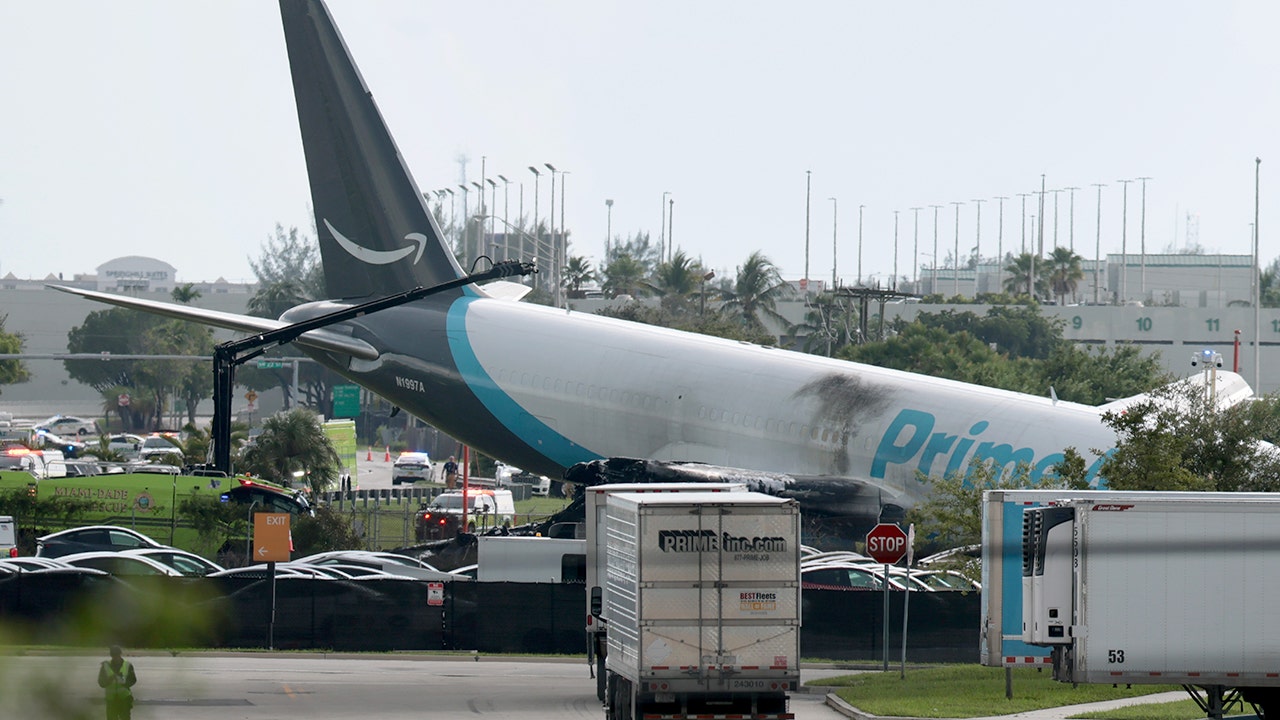
It was supposed to be an unremarkable Sunday, the kind of quiet morning that airports see thousands of times a year. An Amazon cargo jet, Prime Air Flight 7598, was making its final approach to Miami International Airport, carrying a hold full of ordinary goods and a crew of two experienced pilots. But in a matter of seconds, that routine landing became a nightmare that would leave five people dead, five others injured, and a community reeling. The aircraft overran the runway, tore through airport property, and slammed into two vehicles before coming to a stop near a parking lot. On Tuesday, federal investigators began to piece together what went wrong, and their first findings offered a sobering glimpse into the final moments of the flight. According to the National Transportation Safety Board, the plane’s wheel brakes were applied, but two other critical braking systems—the speed brakes and the thrust reversers—showed no indication of being deployed. The revelation raises difficult questions about what happened in the cockpit, what the pilots experienced, and whether the tragedy could have been prevented. For now, investigators are urging patience, emphasizing that they are only at the beginning of a long and meticulous process. But for the families of the victims, the wait for answers is agonizing. They want to know how a plane that should have slowed down kept going, how a cargo flight carrying contact lenses ended in such devastating loss, and why five people who were simply in the wrong place at the wrong time never made it home.
Paragraph 2: The Critical Question of Braking Systems
To understand the significance of the NTSB’s announcement, it helps to understand how a large jetliner slows down after landing. When a plane touches down, pilots rely on a combination of systems to bring it to a safe stop. The wheel brakes, which clamp down on the landing gear’s wheels, are the most familiar. But there are also speed brakes—panels on the wings that pop up to disrupt the airflow and reduce lift, helping the plane settle onto the runway and increasing the effectiveness of the wheel brakes. Then there are thrust reversers, which redirect the engine’s exhaust forward, creating a braking force that helps decelerate the aircraft. All three systems work together to stop a heavy plane within the length of a runway. According to the NTSB’s preliminary data, however, only the wheel brakes were used on Flight 7598. There was “no indication in the recorded data that speed brakes or thrust reversers were deployed,” said Chihoon Shin, the NTSB investigator in charge. That does not necessarily mean the pilots made a mistake—there could be mechanical failures, electrical issues, or other factors that prevented those systems from engaging. But it is a critical clue, and investigators are not yet ready to draw conclusions. “When we analyze the full list of parameters, we’ll have a better idea of the aircraft’s performance during this landing. Was it normal? Was it not? And what was working and what was not,” Shin said. “So I’m not going to speculate on what should have been right now.” That cautious, methodical approach is typical of the NTSB, which is known for refusing to jump to conclusions before all the evidence is in. But for the public, the wait is hard. The image of a massive cargo jet plowing through a fence and into vehicles is haunting, and the idea that systems designed to prevent exactly this kind of disaster may not have functioned is deeply unsettling.
Paragraph 3: The Pilots Behind the Controls
In the midst of the technical details, it is easy to forget that there were human beings in the cockpit, two men whose lives have been forever changed by what happened. The NTSB identified the captain as a 55-year-old pilot with 7,145 flight hours, according to his latest Class 1 medical certificate, dated March 31, 2026. The first officer was 37 years old, with 2,655 flight hours, and his medical certificate was dated April 13, 2026. These are not rookies; they are experienced aviators who have spent years in the air, navigating weather, traffic, and the countless small challenges that come with flying cargo across the country. They are also, right now, the only people who know exactly what was happening in the cockpit during those final moments. Investigators plan to interview them, hoping to understand how they were manipulating the controls, what they saw, and what they were thinking as the runway rushed toward them. “What we need to do is talk to the crew and get their account to understand how they’re manipulating the controls in order to get a better understanding of the situation,” Shin said. “That’s something that we need a complete understanding of.” The pilots survived the crash, which means they will have to live with the weight of this tragedy for the rest of their lives. They will be questioned, scrutinized, and perhaps blamed, even if the investigation ultimately finds that they did everything right. Behind the statistics and the medical certificates are two people who likely wake up every night replaying the moment when their landing went horribly wrong. They are not just witnesses; they are survivors of a trauma that no amount of flight hours could have prepared them for. And as the investigation unfolds, their stories will be central to understanding what happened.
Paragraph 4: The Victims and the Devastating Sequence of Events
The crash was not just a failure of machinery; it was a human tragedy that unfolded in a matter of seconds. The plane, after overrunning the runway, tore across airport property and struck a van that was carrying seven people. That van was crushed in the impact, and five of its occupants were killed. The remaining two were among the five injured. The plane did not stop there. It continued through the airport fence, crossed into an area beyond the airport’s perimeter, and struck another civilian vehicle before finally coming to rest near a parking lot. The sheer force of the impact is difficult to comprehend. A cargo jet, even one that has slowed somewhat, carries enormous momentum. When it hits a stationary object, the results are catastrophic. The victims were not passengers on the plane; they were people going about their day, perhaps working at the airport, perhaps driving to pick someone up, perhaps simply in the wrong place at the wrong time. Their names have been released, and their families are now left to grieve in the harsh glare of public attention. The injured, meanwhile, are facing long recoveries, both physical and emotional. They will carry the scars of this day for the rest of their lives. The crash also left a visible scar on the airport itself—a torn fence, a damaged runway, and a community of airport workers who now have to confront the fragility of their own safety. For them, the airport is no longer just a place of travel and commerce; it is the site of a tragedy that could have been any one of them. The NTSB’s investigation will take months, but for the families of the victims, the pain is immediate and unrelenting. They are not looking for statistics or technical explanations; they are looking for answers, and they are looking for justice.
Paragraph 5: The Cargo, the Investigation, and the Search for Answers
In the midst of the devastation, there is a strange irony in the details of what the plane was carrying. Officials confirmed that there were no hazardous materials on board. The cargo was mostly contact lenses, weighing 32,222 pounds, along with a flight kit. It is a mundane cargo, the kind of thing that flies across the country every day without anyone giving it a second thought. Contact lenses are not dangerous; they are not explosive; they are not the stuff of dramatic headlines. And yet, on Sunday, this ordinary cargo became part of an extraordinary tragedy. The plane was operated by Prime Air, Amazon’s cargo airline, and it was on a routine mission to deliver goods to people who would never know the story behind their packages. The NTSB is now combing through every piece of data from the flight, from the performance of the engines to the position of the controls to the weather conditions at the time of landing. They will analyze the full list of parameters, as Shin put it, to determine whether the aircraft’s performance was normal or abnormal, and what was working and what was not. They will also examine the runway itself, the airport’s safety systems, and the circumstances that led to the plane overrunning the runway. It is a painstaking process, one that requires patience and precision. But it is also a process that matters. The findings will not bring back the five people who died, but they could prevent future tragedies. They could lead to new safety protocols, new training requirements, or new engineering solutions that make it less likely for a plane to overrun a runway again. In that sense, the investigation is not just about assigning blame; it is about learning, improving, and honoring the memory of those who lost their lives by ensuring that their deaths were not in vain.
Paragraph 6: A Community in Mourning and a Call for Accountability
As the investigation continues, the broader community is left to grapple with the aftermath of a tragedy that feels both random and preventable. Miami International Airport is one of the busiest airports in the country, a place where millions of people pass through every year. It is a hub of commerce, travel, and connection, and it is now also a place of mourning. The airport has set up support services for employees and witnesses, and the city has come together to remember the victims. But there is also a growing sense of anger and frustration. How could a plane overrun a runway at a major airport? How could it strike vehicles on airport property? How could five people die in what should have been a routine landing? These are the questions that demand answers, and they are the questions that the NTSB is working to answer. The investigation will be thorough, but it will also be slow, and in the meantime, the families of the victims are left waiting. They deserve transparency, accountability, and a commitment to ensuring that this never happens again. The pilots, too, deserve a fair and complete investigation, one that considers all the factors that may have contributed to the crash. The NTSB has promised to be methodical, to avoid speculation, and to follow the evidence wherever it leads. That is the right approach, even if it is not the fastest one. In the end, the story of Flight 7598 is not just a story about a plane crash. It is a story about the fragility of life, the importance of safety, and the need to learn from tragedy. It is a story about five people who died too soon, five people who were loved, and five people whose lives mattered. As the investigation unfolds, we must remember them, and we must demand that the lessons of this crash are not forgotten. Only then can we begin to heal.