





Here is a summary and humanized expansion of the provided text, presented as a comprehensive narrative.
—
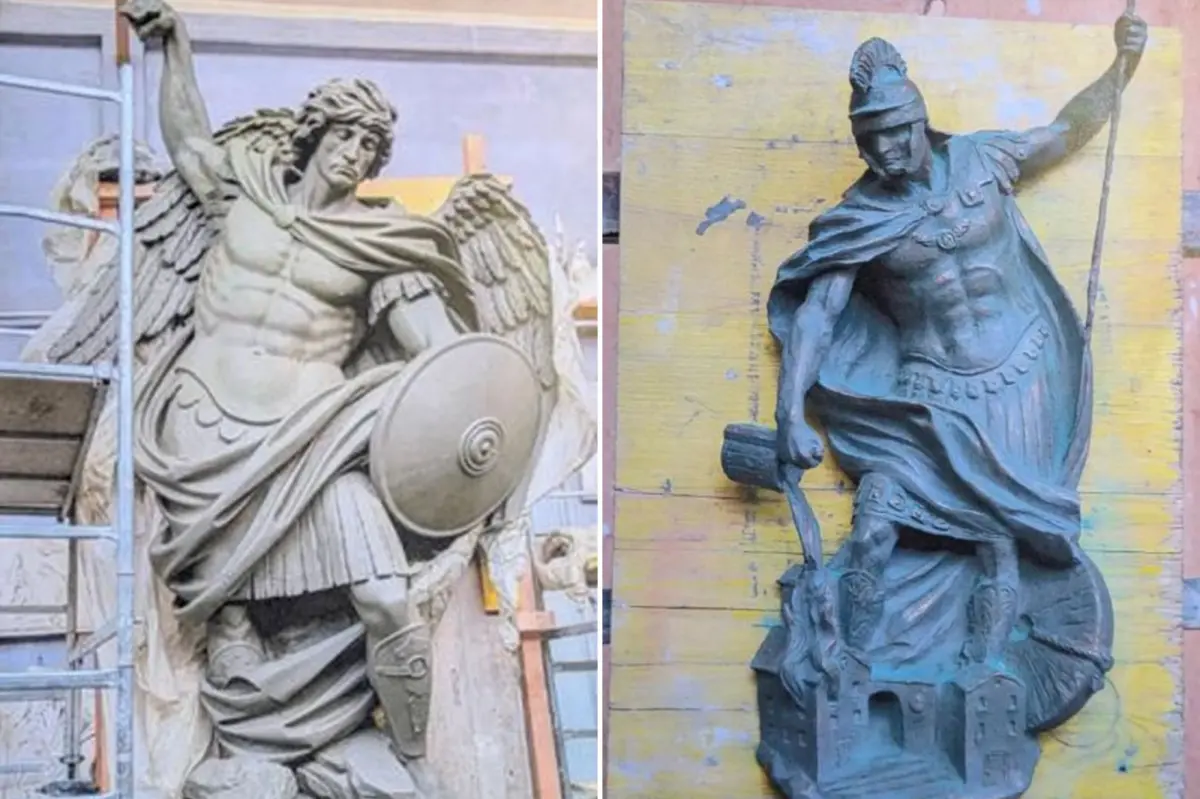
In the historic city of Quincy, Massachusetts, a quiet controversy has erupted into a significant legal and civic battle over the meaning of public memory, the nature of religious symbols, and the delicate boundary between honoring civic heroes and endorsing a specific faith. At the heart of the dispute are two monumental statues, intended to stand as silent sentinels of protection and sacrifice outside the city’s new public safety headquarters—a building meant to house its police and fire departments. The statues depict St. Michael the Archangel, a figure traditionally seen as a warrior and protector in the celestial realm, and St. Florian, a third-century Roman soldier who is widely venerated as the patron saint of firefighters, a guardian against the perils of flames. For the city’s mayor and many residents, these figures represent the quintessential guardians of those who risk their lives daily. They are not meant as theological statements, but as profound gestures of gratitude, resilience, and moral fortitude, embodying the courage and selflessness expected of first responders.
However, the decision to place these 10-foot-tall religious effigies on public land has ignited a fierce debate, culminating in a recent ruling by the Massachusetts Supreme Judicial Court. The state’s highest court delivered a significant setback to the city by upholding a lower court’s decision to temporarily block the installation of the statues. The ruling stipulated that, at least for now, the statues cannot be erected, as their permanent placement outside a government building could be interpreted as the government improperly endorsing religion. The court’s reasoning hinges on the specific language of the Massachusetts Constitution, which contains some of the oldest and most explicit protections against state-established religion in the nation, often referred to as the “Anti-Aid Amendment.” This legal provision demands that the state maintains a strict neutrality in matters of faith, ensuring that no one feels that their government is favoring one creed over another, or religion over non-religion. The court’s decision suggests that the sheer scale and explicitly religious nature of the statues, positioned as they would be at the very entrance of a civic structure, create an environment where the city’s intent to honor could be overshadowed by an impermissible religious message.
This legal drama, which began in May of the previous year, traces its origins to a lawsuit filed by a coalition of advocacy groups, including the American Civil Liberties Union (ACLU) of Massachusetts, Americans United for Separation of Church and State, and the Freedom From Religion Foundation. The plaintiffs argued that the city’s plan was a clear violation of the constitutional principle of separation of church and state. They contended that the government’s decision to prominently display Catholic saints sent a powerful and exclusionary signal to citizens of other faiths or no faith at all, making them feel like second-class members of the community they serve. They further pointed out that the plan had not been part of the initial public discourse when the building was approved, raising concerns about the process of its implementation. For them, the issue was not about diminishing the service of police officers or firefighters, but about upholding a foundational principle of American democracy: that the government should never act as a theological instructor, and that public spaces must be welcoming to all, regardless of their personal beliefs. The lawsuit sought a preliminary injunction to halt the installation, a request that was granted by a lower court judge and has now been affirmed by the Supreme Judicial Court.
In response, the city of Quincy, represented by The Becket Fund for Religious Liberty, a prominent legal organization specializing in religious freedom cases, has vowed to continue the fight. The city’s legal team, led by senior counsel Joe Davis, maintains that the opposition to the statues is based on a misinterpretation of the law and a misunderstanding of the city’s intent. They argue that the statues serve a primarily secular purpose: to inspire and honor the bravery, sacrifice, and honorable character of the city’s first responders. In their view, St. Michael and St. Florian have transcended their purely religious origins to become universal symbols of protection, bravery, and public service. They are cultural touchstones that represent the ideals of the profession, analogous to how Lady Justice, though rooted in Greco-Roman mythology, is an accepted secular symbol of the judiciary. The city’s attorneys argue that preventing the installation of the statues is an act of hostility toward religion, forcing the city to scrub any historical or culturally significant symbol that might have a religious connotation, even when the primary purpose is civic recognition. “Quincy chose these statues to honor the courage and sacrifice of its firefighters and police,” Davis stated emphatically, framing the issue as one of free expression and the right of a community to define its own memorials. “The city should not have to hide public art simply because some people may think of religion when they see it.”
The ruling has, unsurprisingly, drawn sharply contrasting reactions from the two sides. The ACLU of Massachusetts, through its legal director Jessie Rossman, praised the court’s decision as a victory for the constitutional guarantee of religious neutrality. Rossman argued that the Massachusetts Constitution is exceptionally clear on this point: the government must not, under any circumstances, appear to favor one religion over another. She framed the ruling as a confirmation that the state’s commitment to pluralism is not a mere suggestion but a binding legal requirement. “Here in Massachusetts, our state constitution is clear: The government must remain neutral in matters of religion and must not elevate one faith above others,” Rossman said. “The Supreme Judicial Court affirms those principles, which are the essential foundation of a pluralistic society where people of all faiths and no faith can flourish.” Her statement underscored the belief that true inclusivity is not just about tolerance, but about a scrupulous absence of government endorsement of religious symbols in public spaces.
On the other side, the disappointment in Quincy’s City Hall was palpable, but so was the determination to see the project through. Mayor Thomas Koch, who had championed the statues, expressed his disappointment while reaffirming his commitment to the cause. For the mayor, the statues are a deeply personal tribute to men and women who routinely place themselves in harm’s way for the safety of their neighbors. “Quincy’s firefighters and police put their lives on the line for this city every day, and these statues were chosen to honor their bravery, service and sacrifice,” Koch said. His statements are filled with the rhetoric of civic pride and the desire to provide moral encouragement to those who serve. The city’s legal team, alongside The Becket Fund, has signaled its intention to continue the litigation, seeing this preliminary ruling as just one battle in a longer war. They will likely argue for a more nuanced interpretation of the constitution, one that allows for the recognition of historical and cultural symbols, provided that the primary government purpose is clearly secular.
Ultimately, this case in Quincy has become a powerful and highly visible microcosm of the ongoing national conversation about the place of religion in American public life. It is a conflict between two deeply held values: the desire of a community to honor its heroes in a way that feels meaningful and to maintain a heritage that may be intertwined with religious history, versus the constitutional imperative that government remain a neutral arbiter in the realm of faith, creating a space where all citizens feel equally valued and represented. The court’s decision, for now, leans towards the latter, but the fight is not over. As the legal battle moves forward, the two statues remain in limbo, their future uncertain, serving as a powerful symbol of a society still struggling to define the delicate boundaries between public expression, civic duty, and the sacred.