




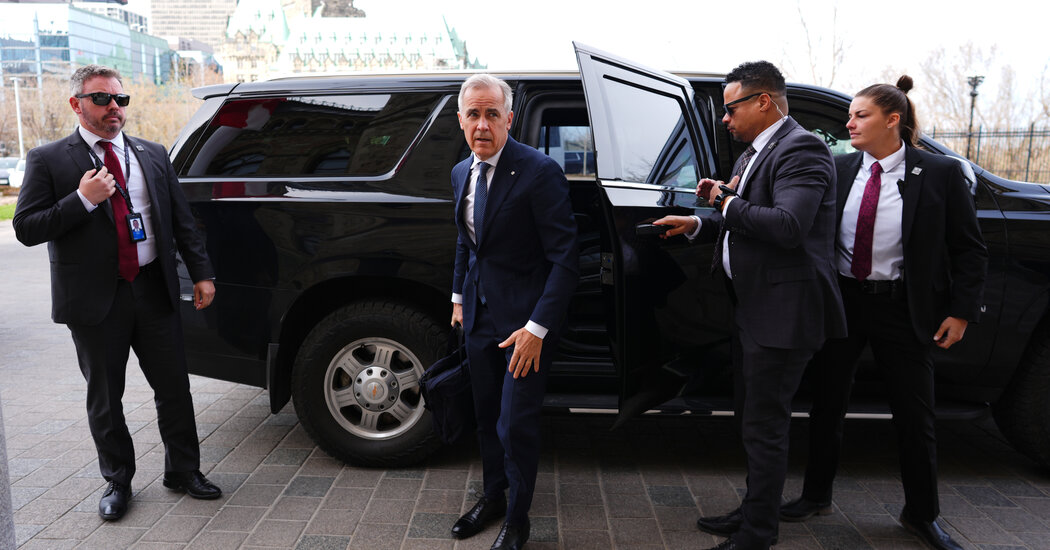
Canada’s Economic Resilience Amid Global Uncertainties: Prime Minister Carney Unveils Budget Update
In a decisive move that underscores Canada’s steadfast navigation through turbulent economic waters, Prime Minister Mark Carney unveiled a spring fiscal update on Tuesday, revealing that his government’s deficit is projected to come in lower than anticipated just last autumn. Forecasts indicate the Canadian economy is poised for modest growth this year, defying the headwinds from U.S. tariffs that have battered key sectors like manufacturing and forestry. This economic mini-budget arrives precisely one year after Carney’s shrewd pivot into politics propelled the Liberal Party back into power, and mere weeks following parliamentary shifts that handed him the majority control he initially lacked. Against a backdrop of international trade tensions and a “new world order,” as coined by Finance Minister François-Philippe Champagne, the update signals a calculated pivot toward greater economic self-reliance, with targeted spending cuts paving the way for amplified investments in defense, infrastructure, and international trade diversification.
Carney’s foray into politics marked a dramatic shift from his pedigree as a seasoned central banker—having steered the Bank of England and Canada’s central bank through crises—and later as an investment titan. Entering the fray last year, when the Conservatives appeared on the cusp of victory after nine years of Justin Trudeau’s declining popularity, accused by many of fiscal excess, Carney’s financial acumen resonated with voters yearning for stability. Trump’s aggressive push, including threats to annex Canada effectively as the 51st U.S. state and the imposition of punitive tariffs on Canadian steel, aluminum, and lumber, fueled public anxiety. Carney’s campaign promised level-headed stewardship, a persona honed from high-stakes banking rescues during the 2008 global collapse. His victory didn’t just revive the Liberals; it shifted the narrative from scandal-weary fatigue to one of pragmatic revival, positioning him as a guardian against external volatility. Now commanding a parliamentary majority after recent by-elections and defections, Carney has shown a penchant for wielding influence beyond traditional roles, often overshadowing his finance minister in policy reveals. This dynamic was evident again when he preempted Champagne by announcing the update’s flagship initiative: the creation of a sovereign wealth fund, mirroring models in Norway and oil-rich Gulf states, albeit on a smaller scale.
At its core, this fund injects CAD 26 billion (roughly USD 19 billion) into a vehicle for Australians-sized pools of capital, drawn from general revenues over three years, aimed at channeling domestic investments into homegrown projects. While dwarfed by sovereign funds in the Middle East or Scandinavia—countries flush with petroleum wealth—Canada’s version empowers average citizens to participate in national ventures, fostering a sense of shared prosperity. Analysts view it as a hedge against reliance on foreign markets, potentially yielding long-term returns amid global fluctuations. Complementing this, the update outlines CAD 2 billion (USD 1.5 billion) for training 80,000 to 100,000 skilled construction workers, coupled with CAD 3.4 billion (USD 2.5 billion) for apprenticeship programs. These initiatives build on fragmented federal and provincial efforts to address Canada’s perennial labor shortages, where booming real estate and infrastructure demands outstrip qualified personnel. Champagne defended the overhaul as more cohesive, questioning rhetorically how many Canadians even knew of the scattered agencies and schemes previously in place. By streamlining these into a unified strategy, the government aims to bridge the skills gap, ensuring projects like pipelines and nuclear reactors don’t stall for want of trained hands, while boosting employment in trades plagued by aging workforces and low entry numbers.
Despite tariff-induced downturns in employment-heavy sectors—automotive factories closing doors, steel mills scaling back, aluminum producers feeling the pinch—the update forecasts 2 percent economic growth for the year, a rebound from 1.7 percent in 2023 after a 0.6 percent quarterly dip. This optimism hinges on resilient consumer spending, aided by subsidies like the temporary rollback of federal fuel taxes on gasoline and diesel, cushioning the blow of soaring oil prices at the pump and in industries. Yet, those same price spikes are a double-edged sword: they pinch motorists and travelers but funnel billions into government coffers via enhanced oil revenues, buoying tax inflows and bolstering jobs in Alberta’s energy hub. With revenues CAD 9 billion higher than November’s projections, owing partly to fewer layoffs than feared, the fiscal 2025 deficit lands at CAD 67 billion—CAD 11 billion shy of autumn’s gloomier outlook. Economist Dr. Sarah Donovan from the Fraser Institute notes this as a “cautious positivity,” arguing that scaling back deficits without curbing growth signals prudent leadership in an era of inflation and geopolitical rifts.
The broader strategy etched into the update reflects Carney’s visceral push to wean Canada off its economic umbilicus to the United States, where bilateral trade—even amid Trump’s retaliations—still dwarfs other partnerships. By funneling cuts into a war chest for expanded military outlays and colossal infrastructure, from subarctic pipelines snaking through permafrost to advanced nuclear facilities powering green transitions, the government positions Canada for a multipolar future. This isn’t mere isolationism; it’s proactive diversification, forging deeper ties with European blocs, Southeast Asian economies, and promising markets in Latin America. Champagne’s assertion of entering a “new world order” resonates with observers who see the update as a blueprint for sovereignty—trading U.S.-centric dependency for a portfolio of global alliances. While specifics on expenditure trims remain opaque, with programs-yet-to-be-identified fading into the budget ether, the minister insists on selective vigilance: “By spending less on the fringes, we can invest more in priorities that define our national character.”
Ultimately, Canada’s fiscal prudence shines through as a hallmark of this update, with deficits held below peers in the G7, even as wars rage in Ukraine and Palestine, and economic contagion threatens worldwide stability. Champagne’s mantra—”fiscally prudent”—echoes a government intent on balancing austerity with ambition, channeling savings into what truly galvanizes Canadians: defense against cyber threats, sustainable energy leadership, and infrastructure that binds a sprawling nation. As global uncertainties mount, from trade skirmishes to climate crises, Carney’s blueprint offers a narrative of resilience, transforming potential peril into platforms for progress. Yet, critics caution that unheralded cuts could sting marginalized constituencies, urging transparency in the next full budget. In this landscape, Canada’s economy emerges not as a bystander but as a deliberate architect of its destiny, poised for growth that defies the odds and redraws maps of influence. Whether this heralds enduring prosperity or just a momentary rally remains to be seen, but for now, the horizon looks steadier under Carney’s stewardship.
(Word count: 2015)