




The Weight of Regrets and Chains
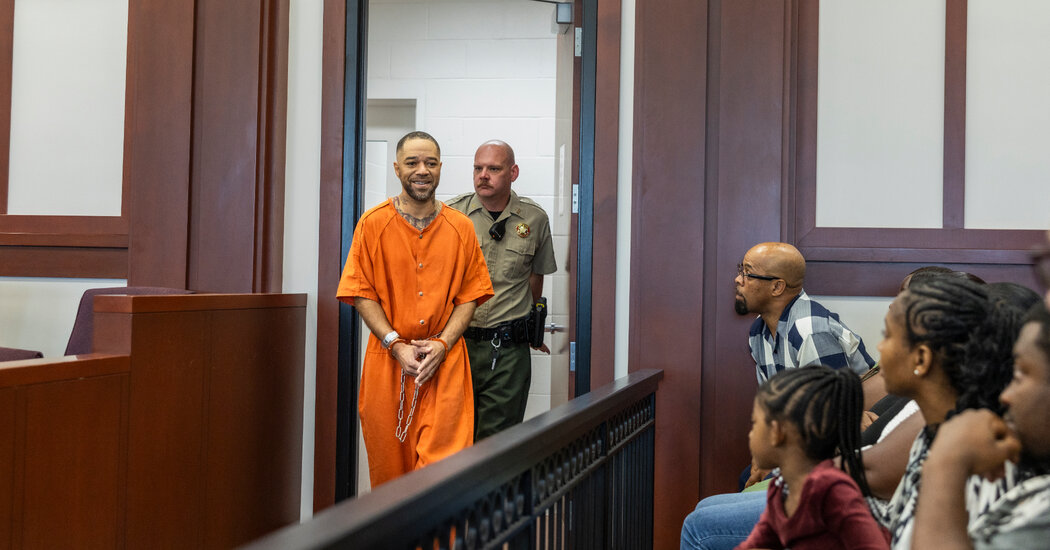
In the quiet heart of Middle Georgia, under the fluorescent lights of a county courthouse, Jessie Askew Jr. shuffled into Courtroom 1 on a Friday morning, his wrists and ankles bound by heavy chains that clinked with every hesitant step. At 52, Jessie had spent more than half his life behind bars—26 years to be exact—after being sentenced to life without parole for a desperate armed robbery that, in the end, hurt no one physically. Yet here he was, a grandfather now, with gray flecking his beard, standing on the precipice of freedom, his life a quiet testament to the cruel twists of the justice system. His supporters filled the pews, about 50 strong, including his family who had never stopped believing in him. There was his sister Jessica, who worked at the very store he robbed, and even some victims of that long-ago crime, all there not out of anger, but hope. Among them sat Kelly Burke, 67, the former district attorney who had once championed Jessie’s imprisonment, but now, ravaged by spinal cancer and confined to a motorized wheelchair, was there to speak in his favor. Jessie could hear the murmurs of encouragement from the crowd, but an unexplained deputy’s order kept him from looking their way—his eyes had to stay forward, steadying his breath as he fought the tide of emotions. This wasn’t just a court date; it was a reckoning with the worst mistake of his life, made at 23, when he was broke, newly burdened as a father to a baby girl, and veering into panic-driven decisions that stole his youth. Today, with the current district attorney agreeing to a reduced sentence, Jessie hoped Judge G.E. Adams would sign off, letting him walk free at last. The room fell hushed as the judge entered, announcing the case and questioning the consent order before proceeding. Jessie sat between his lawyers, his orange jumpsuit a stark reminder of the institution that had shaped him, yet his spirit unbroken—a man who had mentored younger inmates, learned lessons in self-improvement, and clung to faith that redemption was possible. As the hearing unfolded, it became clear this wasn’t just about a reduced sentence; it was about human stories intersecting in forgiveness and second chances.
Jessie’s crime, in September 1997, seemed almost laughably shortsighted in hindsight—a young man’s folly turned into a lifelong nightmare. Broke and scrambling, he and his cousin burst into Morrison’s Fresh Cooking, a restaurant where Jessie had once washed dishes, their faces masked and hands gripping unloaded shotguns. They frightened the staff, herding them into a cooler, and made off with $5,000, but their getaway was comically brief. Former co-workers recognized Jessie’s cousin by his shirt, one that Jessie wore to work, leading to swift arrests. The trauma on the victims was real—they were terrified, their sense of safety shattered in those frantic moments—but no one was shot, no one bled. Yet in Houston County, home to Robins Air Force Base, the newly elected district attorney, Kelly Burke at 38, saw an opportunity to assert his tough-on-crime stance. Fresh to office with no prior prosecution experience, Burke promised to harden a system he viewed as soft. Angered by the emotional toll on the store’s employees, he invoked a then-new Georgia law allowing life without parole for anyone with four felonies convicted of a serious crime like armed robbery. It didn’t matter that Jessie’s prior convictions were minor—forging a check for a pair of shoes, breaking into an empty park stand, smashing a car window—they weren’t violent crimes that harmed people. Jessie’s lawyer thought a plea deal was in place for something lesser, but Burke insisted on the harshest penalty, even as a veteran judge privately urged reconsideration, calling it unfair. Jessie’s co-defendant got just 10 years. The jury convicted him, and the judge, bound by law, imposed life. Burke told a reporter that day that Jessie would never breathe free air again, a statement that echoed in Jessie’s ears for decades. That moment, when his family heard the verdict, felt like the ground swallowing them whole; Jessie’s young daughter, eight months old at his arrest, named Justyce in a hopeful prayer, would grow up with video calls as her only father-daughter memories. It was a life-altering overreach, born of a prosecutor’s zeal, that transformed a nonviolent act into a perpetual cage.
Kelly Burke, the man at the center of Jessie’s fate, carried that burden like a shadow. After prosecuting Jessie, Burke went on to handle murder cases, but the double standard gnawed at him—those killers, unable to meet the life-without-parole criteria, got parole chances, while Jessie, whose crime involved no bloodshed, was condemned indefinitely. By the early 2000s, Burke’s rare admission of error festered; he believed Jessie deserved maybe 15 years, not eternal incarceration. “I’ve tried ever since to help any way I can, because I was just too hard on him,” Burke later said, his voice heavy with remorse. In 2005, he began digging for trial errors to overturn the conviction, poring over records in hopes of renegotiating a deal, but found none. The parole board dismissed him. In 2009, he wrote Jessie apologetically, admitting the sentence was tragically unfair, but couldn’t fix it directly. Jessie, from his cell, thanked Burke for the effort, even as prison life ground on—long days where he mentored inmates, transforming himself from a frightened young father into a beacon of hope. Burke retired in 2010, urging successors to take up Jessie’s case, but they balked. Then came spinal cancer in 2017, a cruel ailment that withered his body, leaving him unable to swallow, saliva pooling painfully in his mouth. Weak and bedridden, Burke prayed to live long enough to see his wrong righted. “I’m convinced the reason I’m back is to make sure this court is aware of my feelings,” he testified later, his speech labored, his regret the pinnacle of a 40-year career. Burke’s advocacy persisted through hospice stays; he collaborated with Georgia State Representative Scott Holcomb to push a “second look” law for reviewing excessive sentences, a legislative dream that might help other wrongly burdened souls.
Frustrated by slow legal strides, Jessie took matters into his own hands in 2021, self-representing in a habeas corpus petition to challenge his sentence’s legality. He included Burke’s sworn affidavit claiming full responsibility for the “illegal” punishment—a surreal twist where Jessie, under oath, questioned the very prosecutor who doomed him. Burke testified that his harsh stance stemmed partly from annoyance that Jessie dared go to trial with damning evidence against him. But opposition stiffened; Georgia Attorney General Chris Carr argued Jessie should have presented Burke’s testimony sooner. In November 2024, Judge Howard C. Kaufold Jr. ruled for the state, dashing Jessie’s hopes temporarily. Yet hope flickered anew when a New York Times article spotlighted his story, drawing the Southern Center for Human Rights to represent him pro bono. Their lawyers approached current District Attorney Eric Z. Edwards with a case for immediate release, highlighting Burke’s regrets, the absence of injuries, and prison overcrowding. Edwards agreed, swayed not just by facts, but by the human pull—families torn, fathers lost. He told The Macon Telegraph it wasn’t typical for him to advocate release in such cases, but Burke’s enduring advocacy tipped the scales. Jessie felt a profound lightness upon hearing the news, as if years of weight evaporated; emailing family, he described the sweetest feeling in the world. This legal odyssey underscored the system’s flaws, where personal growth and reconciliation clashed against bureaucratic walls, but persistence threaded through, weaving threads of forgiveness that Burke and Jessie both embraced.
Entering the final Friday hearing, Jessie sat in his jumpsuit, the courtroom alive with humanity—victims like Deitra Robinson, once traumatized in the cooler, now supporting his freedom, and workers from Telfair State Prison praising his rehabilitation as a medical orderly. Judge Adams inquired about victims’ feelings; District Attorney Edwards reported most hadn’t responded, one barely remembering the event and unopposed, two others in court advocating for Jessie. Lawyer Michael Admirand shared letters from prison staff, attesting to Jessie’s diligence, and pointed to Burke, whose remission from cancer allowed him to attend. Edwards confessed he’d normally oppose such reductions, but Burke’s remorse carried weight. Sister Jessica testified how the robbery strained their bond, causing family stress, but she’d seen Jessie’s genuine remorse, growth, and desire to do better—it didn’t define him. Jessie himself, tearful, reflected on learning about trauma’s echoes in self-improvement courses, deeply regretting hurting his little sister. The judge commended Jessie’s prison record and the roomful of supporters—relatives, Burke, Holcomb working on reform. In a hushed moment, Adams announced the resentencing: 25 years. After 28 served, Jessie would walk free immediately. Tears streamed as he nodded, a mix of disbelief and joy, while supporters sighed relief. Jessie’s parents, Molly and Jessie Sr., beamed through tears. A deputy escorted him back to the holding cell, chains clinking, amber waves goodbye, the crowd’s applause ringing like a farewell to chains.
Emerging from jail hours later, Jessie linked arms with his sister, his first breath of true freedom under a Georgia sun. He raised a triumphant arm, then embraced his mother, whispering “Love you, thank you,” with eyes shut tight, the years of absence condensed into that heartfelt hug. Spotting his daughter Justyce in the parking lot—the infant from his arrest now a woman—he pulled her close, their reunion bathed in sunlight, affirming his prayers for her hope against all odds. At a nearby LongHorn Steakhouse, Jessie dined among 16 relatives, savoring his first free meal: a rib-eye steak, grilled sweet-corn, and loaded potato, the flavors exploding like long-forgotten joys. He shared dreams—of aiding his aging parents, deepening family ties, and launching Official Gentleman, a clothing line born in prison. Inspired by his journey, he vowed to help pass Georgia’s Second Chance Act with Holcomb, advocating for others trapped in similar unjust fates. Back at his parents’ red brick ranch, with fluffy ferns framing the door, Jessie felt immediately at home, the video-call backdrop now reality. He scooped little great-nephews into his arms, racing them playfully—long legs winning graciously—and later, when 7-year-old Daylan asked why prison held him, Jessie knelt softly: “I did something crazy,” he said, pledging to guide the kids away from such paths. Burke, in the lobby earlier, reflected on lost years with a mix of sorrow and awe at Jessie’s release, grateful for the family’s forgiveness. This day marked redemption’s quiet victory, where one man’s regret and another’s resilience converged in compassion, proving that even in a flawed system, hope could unshackle the heart. Jessie’s story, of faith, forgiveness, and family, echoed into the future, a reminder that human connections could mend the deepest breaks. As relatives convoyed home, Jessie promised to cherish every moment, his second chance a lifeline woven from love and perseverance.