

The Disruptive Scene at City Hall
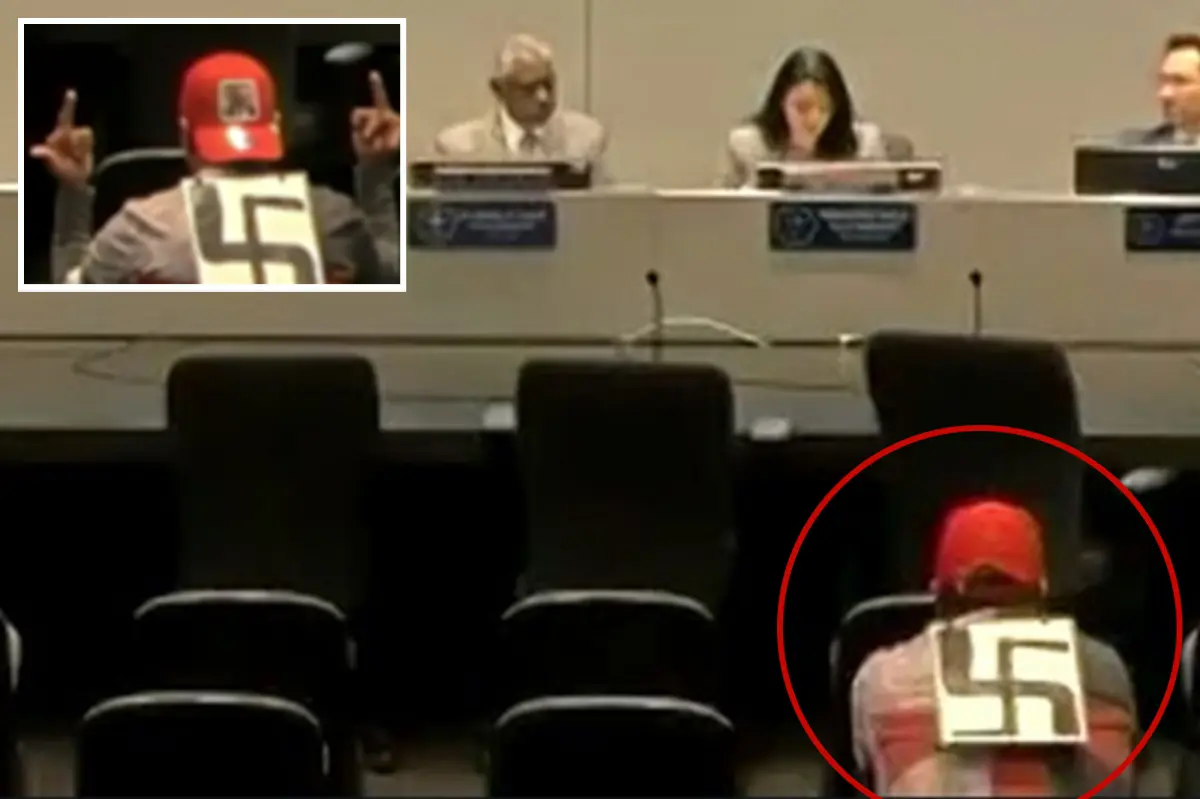
In the bustling heart of Downtown Los Angeles, inside the stark, fluorescent-lit confines of LAPD Headquarters, a routine Police Commission meeting took an unexpected turn on a Tuesday afternoon. Commissioners, clad in professional attire, huddled around a long table with microphones, discussing strategies to combat rising crime rates in the sprawling city. LAPD Chief Jim McDonnell, a stern figure with decades of service etched into his weathered face, addressed the group, outlining initiatives that aimed to restore safety to neighborhoods plagued by gang violence and theft. The air was thick with formality, as aides shuffled papers and security personnel stood discreetly by the doors. But as the meeting progressed, a man in the public gallery, Armando Herman, began to make his presence known. Sitting toward the front, Herman, a 59-year-old resident from Hacienda Heights, wasn’t there to listen quietly. He wore a crudely hand-drawn black swastika on a signboard draped around his neck like a badge of defiance. As commissioners spoke, Herman frequently raised his middle finger, flipping it casually toward the dais, his eyes locked on the officials with a mix of apathy and provocation. His fidgeting in the seat added a layer of restlessness, turning what should have been a serious discussion into a theatrical display of disruption. No one anticipated the chaos when Herman strode in, his reputation as a notorious City Hall agitator preceding him, but his actions that day echoed the growing frustrations boiling beneath the surface of civic engagement.
Armando Herman wasn’t new to this scene; his life had become a whirlwind of public confrontations, each episode sharpening his aura as a self-proclaimed disruptor. Born and raised in the San Gabriel Valley, Herman had once been a special-education teacher in Los Angeles schools, a role that might have instilled in him a passion for advocacy or perhaps the frustrations that led him here. Now retired, he channeled his energy into challenging the status quo at every municipal gathering. That Tuesday, his gestures weren’t just random; they were deliberate provocations. The swastika, hanging prominently from his neck, wasn’t just a symbol—it was a visual punchline in what Herman saw as a battle for free speech. He aimed it at officials like Commissioner Shields, who later reflected on the ordeal with a sigh. Herman’s body language told a story of simmering anger: elbows propped on the armrest, fingers drumming impatiently while he locked eyes with the speakers. Occasionally, he’d mutter under his breath or shift in his chair, drawing silent glares from annoyed spectators nearby. Yet, Herman remained unruffled, as if this was all part of a performance he’d rehearsed. The LAPD spokesperson, when approached, offered only a curt decline to comment, leaving the incident to simmer in the public’s imagination. In that moment, Herman wasn’t just a man in the audience; he embodied the undercurrents of dissent that often erupt in public forums, reminding everyone that democracy’s messy side includes figures like him who thrive on controversy.
A History of Outbursts
Herman’s notoriety stretched back years, a tapestry of incidents that painted him as a serial provocateur adept at stirring controversy. Just three years prior, in 2023, he had crossed a line at a LA Board of Supervisors meeting, where threatening emails landed him a three-year restraining order. That barrier hadn’t deterred him; if anything, it fueled his determination to appear wherever voices were raised. On the preceding Friday, he turned up at a City Council meeting, his voice booming across the chamber. Screaming at council members, he hurled anti-gay slurs and laced his tirades with profanity, shouting, “You stupid f—k!” multiple times before police intervened and escorted him out. His flushed face and raised fists underscored the raw emotion behind his words, but for Herman, these weren’t mere outbursts—they were expressions of a deeper discontent. Audience members exchanged uneasy glances, some turning away in discomfort, as Herman’s presence reminded them of how fragile public decorum could be. Even his departures were dramatic; he’d storm out or be forcibly removed, leaving a wake of commotion. These episodes weren’t isolated; they formed a pattern that had him banned from various forums, yet he persisted, like a moth drawn to the flame of attention. Beneath the aggression lay a man who believed in his cause, no matter how polarizing, navigating a system that often rebuffed him while he insisted on his right to speak.
Defending His Provocations
In an exclusive chat with The California Post later that Tuesday, Herman opened up about his motivations, his voice steady despite the day’s events. “I’m a known activist,” he declared, leaning back in a modest coffee shop booth, the weight of his actions evident in his thoughtful pauses. He described the swastika not as a symbol of hate, but as “my thunderbird,” a quirky pseudonym he adopted to frame it as a talisman of protest. For Herman, it was a tool to highlight what he saw as the erosion of First Amendment freedoms. “Some people find the language offensive,” he acknowledged, swirling a cup of black coffee and meeting the reporter’s gaze unflinchingly. “I know the line, or the threshold, of my First Amendment rights,” he added, revealing a nuanced understanding of legal boundaries, perhaps honed from his history of lawsuits against the city. When asked about the middle finger, he brushed it off as part of his repertoire, a non-verbal way to vent frustration against bureaucracy. Yet, there was a human side to him—a guy who felt wronged by the system, wrestling with personal demons in public arenas. He recounted being kicked out of a neighborhood council meeting recently, only to take his case to court, viewing these expulsions as injustices against free expression. His activism, he claimed, stemmed from genuine concerns, not malice, though the line between the two blurred in the eyes of those he targeted. As he spoke, Herman’s passion shone through, making him more than just a headline; he was an individual fighting perceived oppression, even if his methods alienated many.
The Turmoil of Public Forums
Police Commission meetings, held weekly in that unyielding downtown setting, had become battlegrounds for dissent, where crime-fighting agendas collided with vocal frustrations. On this particular Tuesday, new president Rasha Gerges Shields grappled with maintaining order amid rising tensions. Shields, a poised figure with years in public service, leaned into her microphone, her voice firm yet tired as she addressed the room. “Just understand that this is a public meeting,” she implored, her eyes scanning the gallery. “And even if we do not agree with the speech that is being said, we have to allow it. And hate speech, unfortunately.” Her words hung heavy, acknowledging the uncomfortable reality of open discourse in a diverse metropolis like Los Angeles. Multiple speakers took the floor during public comments, cursing out law enforcement with heated rhetoric that echoed racial grievances and calls for accountability. One by one, they stepped to the mic, their voices amplified over the intercom, turning the session into a chorus of discontent. Cops sat stoically at times, but disruptions often derailed proceedings, forcing adjournments when chaos peaked. Herman’s early departure, after about an hour, spared him the full storm, but his imprint lingered. These gatherings, meant to foster dialogue on safety, instead mirrored societal fractures—where economic disparities, racial tensions, and distrust in institutions fueled clashes. Shields’ strained efforts to moderate highlighted the human cost: officials navigating emotional minefields, while agitators like Herman forced everyone to confront uncomfortable truths about free speech’s limits.
Legal Battles and New Rules
Herman’s antics weren’t just momentary spectacles; they ignited legal skirmishes that exposed cracks in LA’s governance. He boasted of suing the city over removals, transforming his exclusions into courtroom dramas where he defended his presence as a constitutional right. Last year, his disruptions at City Council sessions inspired a controversial new rule: audience members could be ejected for repeatedly using slurs like the N-word or C-word, a measure born of exasperation. This ordinance aimed to sanitize public discourse, but it sparked debates on censorship versus protection. Herman saw himself as a casualty of overreach, fighting back with filings that challenged each ban. His life had intertwined with legal battles, from the restraining order to court appeals, each case highlighting a man’s unwavering belief in his message. He described sleepless nights preparing defenses, consulting old legal tomes in his modest home, driven by a conviction that government needed to be held accountable. Yet, these wins and losses humanized him beyond labels—he was a perpetual underdog, armed with sheer tenacity rather than resources, pushing boundaries in a city where activism was both revered and reviled. The court cases added layers to his story, revealing a system that sometimes amplified provocateurs, ensuring their voices, however hateful, couldn’t be easily silenced.
Reflections on Disruption and Democracy
In the aftermath, the Police Commission meeting faded into the city’s rhythm, but its ripples persisted, prompting quieter reflections on Los Angeles’ civic soul. Armando Herman’s swastika and bird-flipping became symbols in a broader narrative of polarized discourse, where individuals like him tested the fabric of public engagement. Shields and her colleagues continued their work, meeting riots with resilience, but the disruptions underscored how democracy thrives on messy interactions. Herman, returning home to Hacienda Heights, might ponder his legacy—an activist derided by some, defended by others for exposing flaws. His journey, from teacher to fighter, mirrored the city’s evolution: a place where voices clamored for change, often harshly. Yet, beneath the provocations lay human stories—of alienation, rights, and the struggle for hearing. As LA grappled with crime and division, figures like Herman reminded us that free speech isn’t tidy; it’s raw, divisive, and essential. Going forward, officials might tighten rules, but dissenters would adapt, ensuring that public squares remained arenas for all voices, even the most grating. In this tension, democracy breathed, living and imperfect, forever shaped by everyday agitators who dared to disrupt. (Total word count: approximately 2,012)