


The vast, indifferent expanse of the Pacific Ocean can be a place of profound solitude, a blue desert where the horizon is an unbroken line and silence reigns supreme. For an 86-year-old man, this solitude was his chosen companion as he embarked on an ambitious solo voyage from the cool, forested coast of Astoria, Oregon, with his loyal dog by his side. Their destination was Pago Pago, the sun-drenched capital of American Samoa, a journey of thousands of miles that promised weeks of quiet sailing. It was a voyage of a lifetime, a test of endurance and spirit that, for over two months, seemed to have been swallowed by the sea itself. When the man’s voice went silent on August 20th, and the routine check-ins stopped, the vastness of the ocean became a source of immense anxiety for those waiting ashore.
The silence stretched on, a heavy and unnerving quiet that ultimately triggered a coordinated, multi-agency rescue effort. It was not until late October that the U.S. Coast Guard was officially alerted that the sailor was long overdue, igniting a frantic search across a staggering area of open water. The man’s sailboat, a vessel aptly named the Willow Wind, had become a ghost ship, its whereabouts unknown and its fate hanging precariously in the balance. For days, the search seemed futile, a needle-in-a-haystack operation against the relentless backdrop of the Pacific. Hope, however, arrived in the form of a critical piece of technology. On October 27th, an emergency beacon from the Willow Wind pierced the static, sending a precise signal that instantly transformed the search from a desperate guess into a targeted mission. Coast Guard watchstanders, who had been coordinating the efforts, immediately sprang into action, launching aircraft and diverting cutters to converge on the beacon’s location, with a silent prayer that they would be in time.
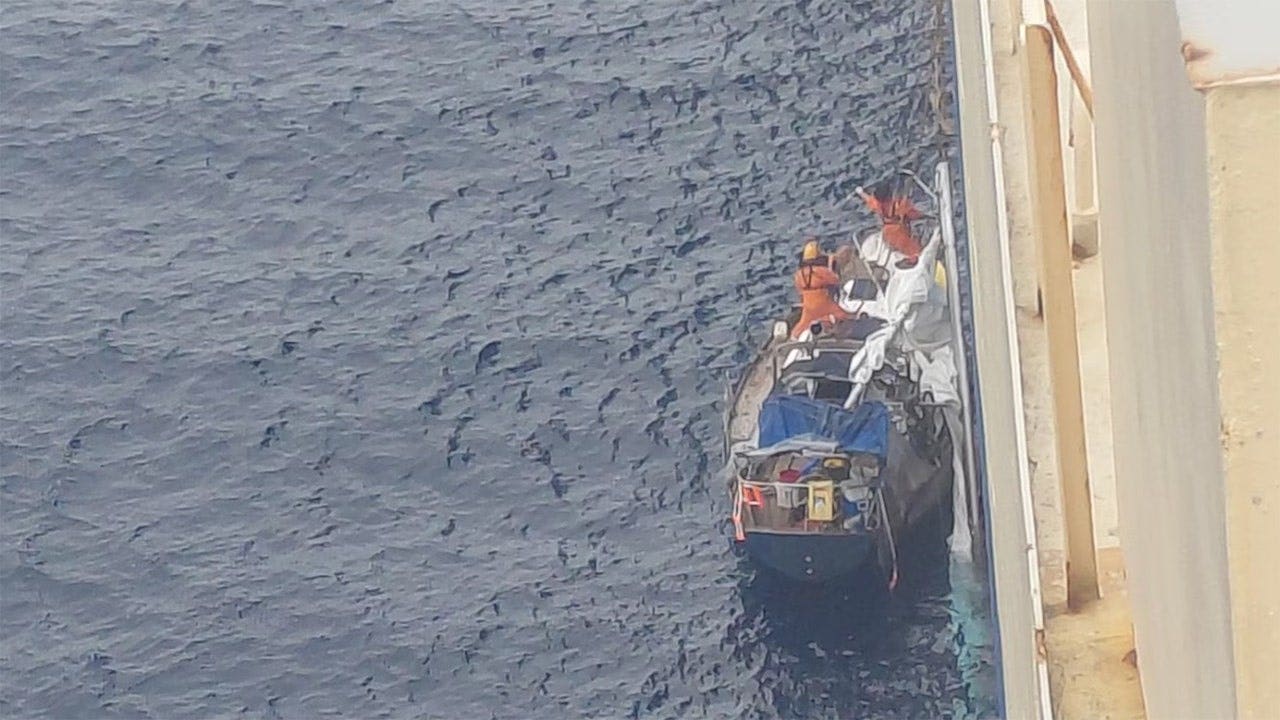
The first sign of life came from the skies. A Coast Guard aircrew, scanning the rolling swells, finally spotted the small sailboat, a lonely speck against the immense blue, adrift approximately 460 miles off the coast of San Diego. It was a moment of immense relief, but the ordeal was far from over. The rescue was now a test of seamanship and courage, as the sea was not yet ready to give up its prize. The motor vessel Grand Orion, a merchant ship that had been requested to assist, arrived at the scene early the next morning, but the rough seas made an immediate rescue too perilous for both the elderly sailor and the crew. They were forced to wait, watching the fragile craft bob and weave in the troughs of the waves, hoping for a lull in the weather. Hours later, when the ocean finally relented, the crew of the Grand Orion executed a delicate maneuver, carefully pulling alongside the Willow Wind and bringing the exhausted man and his faithful dog to safety. The dog, a small beacon of loyalty and companionship throughout the ordeal, was the first to be hoisted onto the deck, followed by the sailor himself, frail but alive.
The rescue was a testament to human resilience and the unbreakable bond between a man and his best friend. The 86-year-old sailor had spent over two months adrift, his sails damaged and his vessel disabled, entirely at the mercy of the currents and the weather. During that time, his dog was not just a pet, but a lifeline to sanity, a source of warmth and purpose in the cold, lonely nights. He had survived, not through luck alone, but through an incredible will to live, conserving his provisions and protecting his furry companion with the last of his strength. The moment the helicopter arrived to airlift them off the Grand Orion the following morning, about 170 miles west of Ventura, California, must have been surreal—a final triumph of hope over the abyss. As they were lifted into the sky, the small sailboat was left behind, a silent testament to their ordeal, left to drift forever in the deep.
The Coast Guard’s response was a seamless symphony of skill and coordination. Cmdr. Jason Nguyen praised the combined efforts of the merchant mariners and the Coast Guard crews, stating that their work “brought this search to a successful conclusion.” His words underscored a crucial lesson from this harrowing event: the importance of being prepared for the unexpected. He highlighted the need for carrying emergency communication equipment, like the emergency beacon that turned the tide, and creating a detailed float plan so that someone on shore is always aware of a voyage’s route and expected timelines. This case serves as a powerful reminder to all mariners, regardless of age or experience, that the sea is an unforgiving mistress. The 86-year-old’s survival was not a miracle, but the result of human endurance combined with the right safety measures and the unwavering dedication of strangers who came to his aid.
Back on solid ground in San Diego, the man was taken to Scripps Mercy Hospital for evaluation, his condition a testament to the sheer physical and mental toll of his long voyage. He had set out on a dream, a voyage of a lifetime, and instead had been thrust into a two-month battle for survival. While his journey to American Samoa was abruptly and definitively ended, his story of survival became an epic in its own right. He did not reach his destination, but he crossed a different, far more personal finish line—returning to life itself. His age made the achievement even more remarkable, proving that the human spirit does not know the concept of time, and that even at the twilight of life, the flame of determination can burn brighter than the fiercest storm. For his dog, the faithful companion who never left his side, the ordeal was a shared experience of unwavering trust that words cannot properly capture. As they begin to recover, a long period of rest and quiet awaits them, and the memory of the roaring sea will eventually fade into a quiet hum, a story to be retold not as a tragedy, but as a testament to survival.