


A Pitch Divided: War, Protest, and the Fractured Soul of Iranian Football at SoFi Stadium
By a Special Correspondent
The Paradox of the Pitch: Cheering for the Adversary
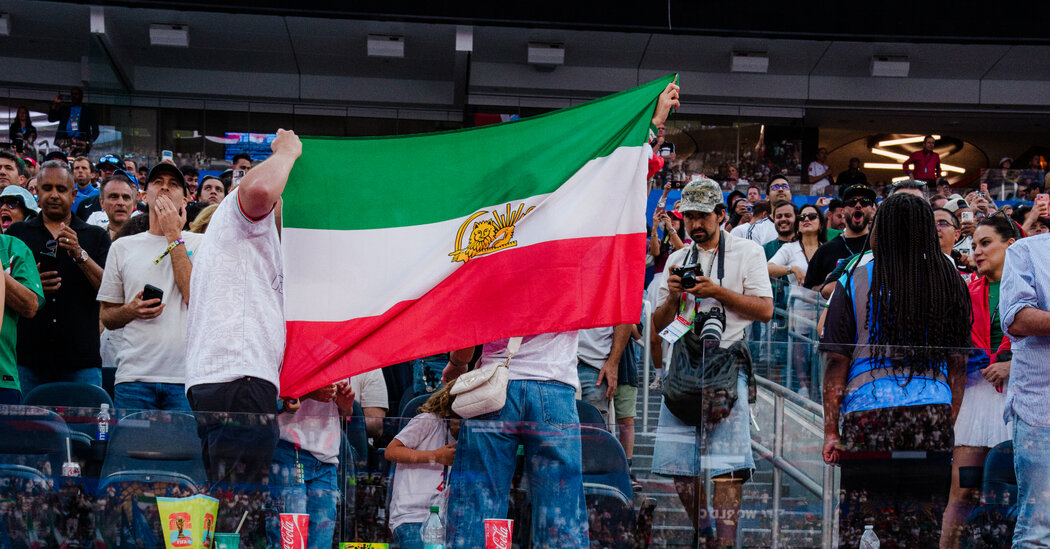
As the soccer ball curled past the outstretched arms of the goalkeeper and billowed into the back of the net, Sahand Vafadary erupted from his seat, hoisting a vintage Iranian flag above his head in a state of pure, ecstatic celebration. Yet, the goals prompting his jubilation did not belong to the nation of his birth; instead, Vafadary was celebrating New Zealand recapturing the lead in this highly charged World Cup opening match. For Vafadary, a physician who traveled from Phoenix, Arizona, and spent $300 on a ticket to sit inside the hyper-modern bowl of SoFi Stadium in Inglewood, California, this was an act of profound, deliberate protest against a team he feels no longer represents the soul of his homeland. “The reason we want New Zealand to win is because the Iranian team playing right now, whether intentionally or not, they are being used as propaganda by the regime,” explained Vafadary, whose Tehran roots have not diluted his fierce opposition to the current government. His solitary display was merely one current in a deeply turbulent ocean of emotion that washed over the stadium, rendering the evening one of the most politically charged and surreal atmospheres in the near-century-long history of the World Cup, as the Iranian national team took the pitch amidst a deafening cacophony of passionate cheers and vitriolic, localized jeers.
The Geopolitics of a Hostile Host: Soccer in the Shadow of War
┌─────────────────────────────────────────────────────────┐
│ GEOPOLITICAL TIMELINE │
├─────────────────────────────────────────────────────────┤
│ Late February: Joint US-Israeli strike on Iran │
│ May: Team exile begins (Turkey, Arizona, Tijuana) │
│ 10 Days to Kickoff: Restricted US visas granted │
│ Matchday: 2-2 Draw & secret framework peace agreement │
└─────────────────────────────────────────────────────────┘
This unprecedented sporting crisis unfolded against a backdrop of active geopolitical violence, making the Group Stage fixture look less like an athletic contest and more like an extension of international diplomacy. Ever since a joint military campaign was launched against Iran by the United States and Israel at the end of February, the players of the Iranian national team have had to perform under an unbearable weight of structural adjustments, logistical nightmares, and psychological distress. The fixture in Los Angeles was instantly flagged by international observers as a highly volatile political flashpoint; Southern California is home to the largest Iranian diaspora outside of the Middle East, serving as a historic, global epicenter of dissent against the clerical regime in Tehran. In a tournament that has historically prided itself on being a platform for global harmony, Iran made history under the most tragic circumstances: they became the first nation in the World Cup’s history to compete on the soil of a host nation with which they were actively engaged in armed conflict. Even as the match concluded in a dramatic 2-2 draw, the athletic display was overshadowed by news that Washington and Tehran had recently signed a fragile framework agreement to halt their months-long war, though the highly classified, unpublished nature of the text left fans and players alike suspended in a state of profound uncertainty.
The Battle of Southern California: Echoes of Empire and Revolution
Outside the concrete gates of SoFi Stadium, hours before the opening whistle, the concrete plazas of Inglewood transformed into a sprawling, chaotic theater of historical grievances and competing national narratives. Hundreds of anti-regime demonstrators—predominantly composed of vocal monarchists and supporters of the late Shah of Iran—gathered under the hot California sun to protest the regime, aiming their fury not just at the political leaders in Tehran, but at the players themselves. Armed with megaphones, banners, and driving electronic music, they shouted chants of “Mullah’s team is not my team” and demanded the complete overthrow of the Islamic Republic, creating a stark counter-narrative to those who came simply to celebrate Persian culture. This political theater, however, drew sharp condemnation from other Iranian-Americans like Hossein Shah of New York, who argued that hijacking the national team’s matches for royalist nostalgia was counterproductive and detached from the realities of modern Iran. In the midst of this ideological tug-of-war, protest organizer Arash Razi defied FIFA’s strict bans on political iconography by distributing thousands of T-shirts emblazoned with Iran’s pre-revolutionary Lion and Sun flag, leading to verbal clashes on the stadium concourse as security struggled to police the symbolic battlefield.
   STADIUM CONCOURSE: A CLASH OF SYMBOLS
   ┌─────────────────────────┐     ┌─────────────────────────┐
   │   PRE-REVOLUTIONARY     │     │    ISLAMIC REPUBLIC     │
   │   Lion & Sun Flag       │  vs │    Official Tricolor    │
   │   (Banned by FIFA but   │     │    (Regarded by many    │
   │    worn in defiance)    │     │    as regime propaganda)│
   └─────────────────────────┘     └─────────────────────────┘
A Caravan in Exile: The Psychological Toll on the Squad
For the twenty-six athletes representing Iran, the journey to the World Cup pitch was a grueling, nomadic odyssey that stripped them of their competitive edge long before they reached American soil. Because of the domestic devastation and international isolation brought on by the outbreak of war, most of the squad had not played a minute of competitive, professional club soccer for several months, rendering their preparation entirely disjointed. Since May, the team has lived out of suitcases, moving from a remote training camp in southern Turkey to a high-security base in Arizona, before being forced at the last minute to relocate across the southern border to Tijuana, Mexico, due to mounting diplomatic friction and visa security protocols. This prolonged state of displacement and heavy surveillance took an immense mental toll, creating a deep sense of alienation that resonated with members of the diaspora like dental surgeon Sahar Salajegheh, who reluctantly chose to boycott the matches altogether to avoid being caught in the crossfire of expatriate infighting. The tragedy of this campaign, as Salajegheh noted, is that the players have been thoroughly dehumanized by both sides of the political spectrum, viewed not as young men playing the game of their lives, but as symbolic pawns in a proxy war where they cannot even be sure if their own compatriots want them to succeed.
Visas, Sanctions, and Silent Benches: Bureaucratic Warfare
┌────────────────────────────────────────────────────────┐
│ THE TOURIST AND THE TOURNEY: │
│ UNITED STATES COLD WAR ON FOOTBALL │
├────────────────────────────────────────────────────────┤
│ • Players granted visas only 10 days before kickoff │
│ • Mandatory exit orders issued immediately post-match │
│ • Visas completely denied for 12+ federation officials │
│ • U.S. Treasury cancels 1,000 official Iranian tickets │
└────────────────────────────────────────────────────────┘
The hostile environment facing the Iranian squad was systematically reinforced by a web of bureaucratic restrictions and economic sanctions orchestrated by the United States government, which severely crippled the team’s operational capacity during the tournament. The State Department delayed granting entry visas to the team until a mere ten days before their first match, imposing unprecedented conditions that mandated the immediate evacuation of all players from U.S. soil directly following each of their three group-stage appearances. Furthermore, Washington flatly denied visas to more than a dozen key coaching staff and federation officials, including federation president Mehdi Taj, citing his past ties to the Islamic Revolutionary Guard Corps—a group classified as a terrorist organization by the United States. This politicization of the sporting arena extended to the stands, where FIFA was pressured by the U.S. Treasury Department to cancel approximately 1,000 tickets previously sold to the Iranian Football Federation due to strict compliance with international trade embargoes. Consequently, as the team took the pitch to represent their nation, Taj and his barred colleagues were reduced to watching the match on a television screen in a Tijuana hotel lobby, protesting what they deemed a flagrant violation of Olympic-style protocols and the fundamental spirit of international sport.
Damned If They Do, Damned If They Don’t: The Impossible Moral Crisis
Ultimately, the match at SoFi Stadium served as a stark, heart-wrenching illustration of the impossible moral tightrope that modern athletes are forced to walk when their homeland is consumed by war and revolution. During a highly strained pre-match press conference, team captain Mehdi Taremi and veteran coach Amir Ghalenoei made a desperate, futile attempt to frame the team as an apolitical, unifying force for all Iranians, only for Taremi to quietly admit that the pure joy of the World Cup had been entirely extinguished by the geopolitical circus. The tragedy of their position was felt deeply by fans like Dr. Sam Ghaffari of Cleveland, Ohio, whose family chose to paint over the official governmental emblem on their replica jerseys, observing that the players were doomed to face condemnation regardless of their public statements or silence. This existential crisis culminated in a chilling, unforgettable moment as the team stood shoulder-to-shoulder in the center circle: while the stadium loudspeaker blasted a FIFA anthem about global unity, the opening chords of the Iranian national anthem were instantly drowned out by a deafening, thunderous roar of boos from the very people who had gathered to watch them. In that singular, painful moment, the beautiful game was entirely stripped of its escapism, leaving twenty-six young men standing alone on a green field, caught in the cold, unyielding gears of history.