


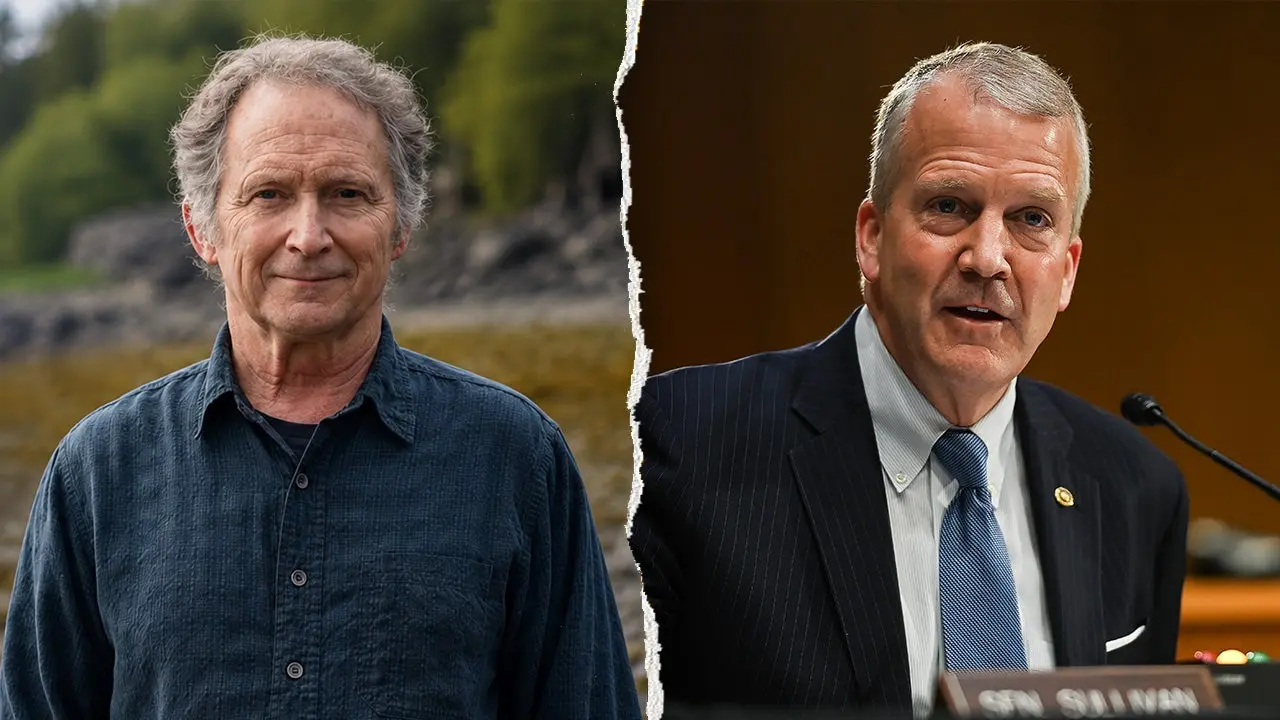
In the vast, rugged landscape of Alaska, where communities are tight-knit and political contests are deeply personal, a strange and unprecedented drama recently unfolded that captured the undivided attention of the entire nation, centering on a bizarre battle of identical names. At the heart of this saga was an extraordinary administrative decision by Carol Beecher, the Director of the Alaska Division of Elections, who officially disqualified a candidate from the state’s crucial U.S. Senate primary ballot. The disqualified individual, a retired schoolteacher named Dan J. Sullivan, shared an almost identical name with the sitting Republican incumbent, Senator Dan S. Sullivan. Beecher’s decisive action was delivered in a sharply formulated, formal letter, wherein she concluded that the retired educator’s eleventh-hour entry into the fiercely contested race was not a genuine, good-faith attempt to serve the public. Instead, she determined that his campaign was strategically engineered to mislead voters, sow deep confusion within the electorate, and ultimately compromise the essential fairness and neutrality of the state’s democratic process. For weeks, the local and national Republican parties had watched in mounting disbelief and anger as this namesake candidate threatened to turn a high-stakes legislative race into a confusing optical illusion on the voting ballot. Republican leaders argued that this unexpected political newcomer was actually a “sham” candidate recruited by underhanded progressive strategists to siphon votes away from the incumbent. Although the retired schoolteacher retains the legal right to appeal Beecher’s ruling, the immediate impact of his removal from the ballot was a dramatic sigh of relief for Alaska’s conservative establishment, which had feared that an identity crisis in the voting booth could cost them a critical seat in the upper chamber of Congress. This dramatic intervention highlighted the bizarre complexities of modern electoral politics, where a simple name can become a highly contested battleground.
To understand the sheer panic this situation caused within the Republican Party, one must look closely at Alaska’s unique and highly complex ranked-choice voting system, which operates very differently from traditional elections in most other states. Under this progressive system, the state publicizes a single nonpartisan primary ballot in August, and the top four vote-getters, regardless of their political party affiliation, advance to the general election in November. Had the retired schoolteacher, Dan J. Sullivan, been permitted to remain on the primary ballot alongside the incumbent, Senator Dan S. Sullivan, there was a very real mathematical probability that both individuals would have advanced to the final four-person contest. This scenario would have presented Alaskan voters with a deeply confusing general election ballot featuring two candidates named Dan Sullivan, splitting the conservative vote and potentially tipping the scales in favor of their opponents. This is particularly crucial because national Democrats have identified Alaska as a prime, high-stakes target for a political flip as they mount a fierce, long-shot bid to secure a majority in the U.S. Senate. The incumbent, Senator Dan S. Sullivan, is currently running for a hard-fought third term in office against former Democratic candidate and Representative Mary Peltola, a widely popular figure in the state who was personally recruited into this high-intensity battleground race by Senate Minority Leader Chuck Schumer. In such a razor-thin electoral environment, where every single vote counts, the presence of a second, unaffiliated Dan Sullivan on the ballot was viewed by the Republican camp not merely as an amusing coincidence, but as a highly calculated, existential threat to the senator’s political survival and the GOP’s national legislative ambitions.
In her official letter disqualifying the political newcomer, Division Director Carol Beecher laid out a meticulous, damning trail of evidence that shattered any notions of this being a harmless coincidence or a simple act of civic enthusiasm. Beecher pointed to several specific actions taken by the retired schoolteacher that indicated his campaign was launched with a deliberate intent to mislead the public. Most notably, although the candidate was officially registered to vote under his birth name, “Daniel J. Sullivan, Jr.,” he aggressively petitioned state election officials to have his name printed on the ballot simply as “Dan Sullivan,” which would have made it completely indistinguishable from the incumbent’s name. Furthermore, Beecher revealed that at one point during the registration phase, the challenger had even tried to submit his paperwork using the middle initial “S”—a letter that belongs exclusively to the sitting senator and bears absolutely no relation to the challenger’s own name. “‘S’ is Senator Sullivan’s middle initial, not yours,” Beecher wrote in a stern, direct rebuke that stripped away any pretense of an honest filing error. Additionally, Beecher pointed out that the retired schoolteacher had no history of being registered as a Republican prior to launching this sudden, high-profile Senate bid, and that his newly created campaign website utilized a color palette, aesthetic theme, and overall design scheme that were suspiciously similar to those of the incumbent senator’s official campaign materials, creating an active visual illusion designed to deceive casual voters.
Perhaps the most revealing piece of evidence in Beecher’s investigation, and the one that cemented the allegations of an organized political conspiracy, was the digital footprint left behind by the challenger’s campaign launch. Investigative efforts quickly uncovered that the metadata of the press release announcing the retired schoolteacher’s candidacy pointed directly to Amber Lee, a prominent Alaska-based progressive political consultant. Lee is well-known in local political circles for her active support of Democratic candidate Mary Peltola and other progressive causes in the state. While Beecher acknowledged in her letter that hiring a consultant is a standard, innocuous practice in isolation, she argued that when viewed alongside the candidate’s name manipulation and aesthetic copying, it suggested a coordinated and deliberate effort to exploit the similarity of his name to deceive voters. This digital “smoking gun” validated the worst fears of the Republican establishment, who argued that national progressive operatives were utilizing local proxies to execute a highly deceptive, under-the-radar operation. The revelation that a seasoned Democratic strategist was apparently instrumental in shaping the retired schoolteacher’s sudden Republican bid suggested that this was not a grassroots campaign, but rather a manufactured, astroturf effort designed to utilize Alaska’s ranked-choice voting architecture to engineer a pre-planned political outcome under the guise of an ordinary political campaign.
The administrative disqualification brought some measure of closure, but it has not quieted the fierce wave of anger and accusations of election-rigging echoing through the Republican ranks. Before the official ruling was handed down, incumbent Senator Dan S. Sullivan delivered a blistering critique of his same-name challenger, publicly labeling him a “far-left liberal” who was willfully participating in a corrupt, deceptive scheme orchestrated by national Democratic leaders. The senator openly wondered about the extent of the coordination behind this campaign, questioning whether high-profile figures like Chuck Schumer, Senator Kirsten Gillibrand, or the leadership of the Democratic Senatorial Campaign Committee (DSCC) were actively orchestrating what he described as a potentially massive national scandal. To the incumbent and his supporters, this was a direct assault on the democratic process, representing a cynical attempt to manipulate the system rather than winning a debate on the merits of policy and representation. While national Democrats have steadfastly denied any involvement or coordination with the retired schoolteacher’s short-lived campaign, the challenger himself has remained noticeably silent, failing to provide immediate public comments or explanations for his actions, which has only fueled further speculation among his critics about his true motives and the shadowy forces that may have nudged him into the national spotlight.
In the wake of Carol Beecher’s decisive ruling, the Republican political apparatus wasted no time in celebrating the decision as a massive victory for election integrity and a successful defense against partisan deception. The National Republican Senatorial Committee (NRSC), the primary campaign arm for Senate Republicans, took an aggressive victory lap, praising the decision and loudly accusing Chuck Schumer and Mary Peltola of attempting to trick and deceive the independent-minded voters of Alaska. Regional Press Secretary Nick Puglia issued a triumphant statement asserting that Alaskans saw right through these underhanded tactics, emphasizing that Senator Dan Sullivan’s record of delivering tangible results for his state would ultimately outshine what he termed as low-spirited tricks. This sentiment was echoed on a national scale by prominent conservative leaders, including Senate Republican Conference Chairman Tom Cotton of Arkansas, who publicly condemned the challenger’s candidacy as an outrageous attempt to rig the election, even by the standards of national Democratic leadership. As the dust begins to settle on this bizarre chapter, the voters of Alaska are left to contemplate a highly polarized and unpredictable political landscape where even a candidate’s name can be weaponized as a strategic asset. With the ballots now cleared of the secondary Dan Sullivan, the high-stakes Senate race will proceed on a clearer, more honest footing, ensuring that when Alaskans take to the booths, they can cast their ballots with full confidence in the identity of the leaders they are choosing to represent them in Washington.