



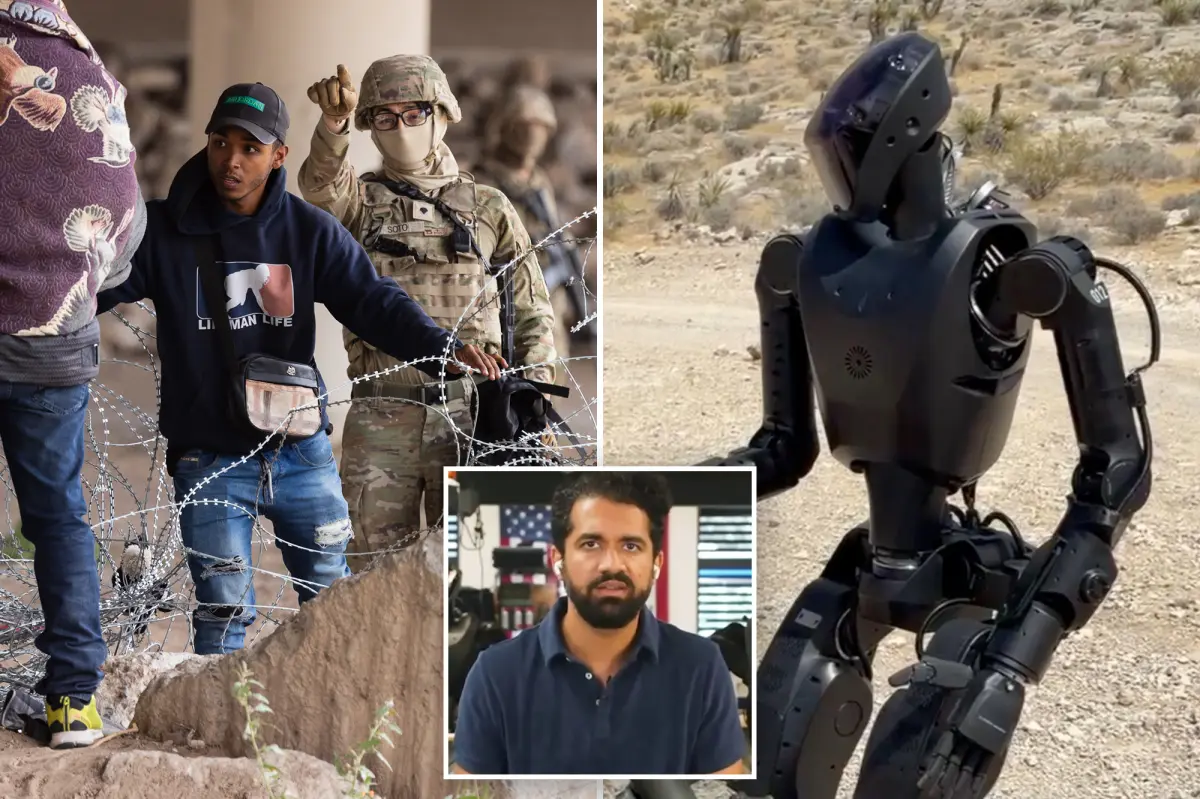
The idea of a humanoid robot standing watch over the desert border, its sensors scanning the dark for movement, used to feel like the kind of thing you might see in a sci-fi film. But that future is moving closer than many people realize. Foundation, a U.S.-based robotics company, has been in active conversations with several American national security agencies about deploying its humanoid robot, called Phantom, to help patrol the southern border. The company’s founder and CEO, Sankaet Pathak, recently explained that his team is talking with the Air Force, Navy, Army, and the Department of Homeland Security. These are not just polite introductory meetings anymore. Pathak says they are discussing specific applications and beginning to negotiate contracts. At the same time, a DHS spokesperson made it clear that the agency currently has no formal agreement with Foundation—no active contracts, no pilots, no non-contractual partnerships. That official distance is worth remembering. Still, the fact that such conversations are happening at all marks a shift in how border security might look in the very near future. It is no longer purely a question of whether robots will play a role, but how, where, and under what rules. The idea is both compelling and unsettling. For some, a robot like Phantom offers a way to reduce risks to human officers and to watch stretches of land that are nearly impossible to patrol constantly. For others, it raises fears of an automated border wall, a surveillance state that never sleeps, and machines involved in decisions that are deeply human. Pathak speaks about his machines with a practical optimism, focused on logistics, terrain, and safety. But the deeper questions linger on the edges: what does it mean to hand over the border’s watch to a robot, and at what point does assistance become authority?
Pathak’s central argument is simple: if the tools we already have were enough, we would not still need so many boots on the ground. Drones can fly over large areas, watchtowers can stare at specific stretches of land, and fixed cameras can record what happens directly in front of them. Yet the border remains a place where human agents are still essential, especially for tasks that require judgment, flexibility, and the ability to respond to the unexpected. Drones have limited flight times, cameras have blind spots, and vehicles cannot climb every ridge or cross every canyon. There are places along the border where a person on foot can move more easily than any wheeled machine. A humanoid robot, Pathak argues, can move like a person. It can climb over obstacles, steady itself on uneven ground, and carry sensors and tools in ways that are designed for the human body. That is the core of the case for Phantom. It is not meant to replace every camera or drone. It is meant to fill the gap between what our current technology can do and what the landscape demands. Pathak points out that despite all the money spent on surveillance infrastructure, people still cross the border, sometimes in remote areas where machines have trouble reaching. A humanoid could sit in those gaps, watching, listening, and mapping the terrain while human agents stay in safer positions. The goal, at least in this early vision, is not to automate every decision. It is to extend human reach into places where sending a person is risky and sending a drone is not enough. That is a subtle but important difference. The robot becomes a kind of tireless companion to the border patrol, not a replacement for it.
Phantom itself is built to be more than just a walking camera. According to Pathak, the robot is designed to distinguish between a person and other objects in the environment, such as animals or shifting brush. It can map its surroundings, remember paths, and traverse uneven, rugged terrain without constant remote control from a human operator. That is significant, because many border areas are not clean, predictable spaces. They are filled with rocks, dirt, vegetation, and sudden changes in elevation. A robot that constantly needs to be steered by a person is not much better than a drone with a joystick. The hope is that Phantom can move independently, quietly, and intelligently enough to handle the landscape on its own. The company also envisions a role for the robot in exploring tunnels along the border. Underground passageways are an ongoing concern for border security agencies, and sending people into them is dangerous. A humanoid robot could climb into narrow, dark spaces, map them, and relay images and data back to agents above ground. That kind of use could save lives and provide valuable intelligence. Pathak frames his whole approach around one key principle: keeping officers out of harm’s way while still maintaining a continuous watch over the border. A robot does not get tired, does not lose focus, and does not need to sleep. It can surveil twenty-four hours a day, seven days a week. When it notices something important, it can flag the activity and wait for a human to decide what happens next. This is the vision Pathak keeps returning to—not a robot making arrests, but a robot quietly taking on the dull, exhausting, and hazardous work of watching, so that human officers can save their energy for the moments that truly matter.
As with any new technology, there are practical limitations that need to be acknowledged. Pathak admits that the current version of Phantom is not yet fully equipped for every kind of weather. Rain, extreme heat, or prolonged exposure to harsh conditions can present challenges. But he says the next generation of the robot, expected to arrive in the coming months, is being designed with those problems in mind. The second-generation Phantom will be waterproof, dustproof, and generally more rugged, capable of handling the demanding environment of the border. That is important, because the southern border is not just hot desert. It includes mountains, rivers, and large stretches of wilderness, and the weather can be punishing. A robot that works only in perfect conditions would have limited value in the field. Pathak is careful not to oversell the current machine. Yet he is also confident about the timeline. When asked how soon this could actually be tested in a real operational setting, he suggested that a pilot could begin almost immediately. Within a few months, he believes, a much larger deployment could be possible. That kind of timeframe might seem aggressive, especially for a technology that still sounds futuristic to many people. But the pace of robotics development has been accelerating rapidly. What seemed impossible a decade ago is now coming out of laboratories and moving into the real world. The question is whether government agencies, and the public, are ready for it. There is also the matter of cost, maintenance, and reliability in extreme conditions, none of which are easy to solve. But Pathak is optimistic, and he believes humanoids will play an increasingly central role in national security, not because they are flashy, but because they are practical.
One of the most sensitive issues surrounding this technology is whether robots could eventually be armed. Pathak says that if the federal government asked Foundation to equip Phantom with weapons for border operations, the company would be willing to do so. That statement might sound alarming, but Pathak places important boundaries around it. He does not envision robots making enforcement decisions on their own, at least not in the near future. Instead, the robot would detect something, flag it, and then wait for a human to determine the appropriate response. The decision to intervene, to approach, or to use any kind of force would remain with a person. This distinction is crucial for public trust. After all, the idea of an armed robot patrolling the border, with the ability to identify and potentially engage people, raises deep ethical and legal concerns. Critics worry about algorithmic bias, mistaken identification, and the danger of normalizing violence carried out by machines. Supporters might argue that robots could be used to deter drug trafficking or protect agents from armed threats. Pathak seems aware of these concerns, and he tries to frame the robot as a support tool rather than a decision-maker. The machines are designed to observe, report, and perhaps take on dangerous physical tasks, but not to act on their own judgment. That might reassure some people. But as technology improves, the line between detection and decision can blur. If a robot can distinguish between a person and an animal, can it also distinguish between an unarmed migrant and a hostile cartel scout? And if it can, who is responsible when it is wrong? These are not just practical questions. They are questions about accountability, civilian oversight, and the kind of society we want to create.
In the end, the story of Foundation’s Phantom is really a story about choices. The technology is coming, and it will almost certainly be used in some form along the border, whether through this company or another. The question is how we guide it. Pathak’s vision is not a dystopian one. He speaks about protecting officers, filling gaps, and letting robots handle the dangerous, repetitive work that no one wants to do. It is easy to see the appeal. A robot that can climb a mountain, crawl through a tunnel, watch for hours without blinking, and calmly report what it sees could make border security safer and more effective. It could also reduce the strain on overworked agents and give them better information to work with. But there are real risks that cannot be ignored. The more we rely on autonomous systems, the more we need to be sure they are reliable, accountable, and subject to human control. The fact that DHS says there is no formal agreement yet is a reminder that this technology is still in its early stages. There is time to ask the hard questions, to test the robots carefully, and to decide what acceptable use looks like. The human element matters. A border is not just a line on a map; it is a place where people cross for countless reasons, some desperate, some dangerous. A robot cannot understand all of that context, and it should not be expected to. Instead, it should serve the people who are trying to do a difficult job, without replacing the human judgment that lies at the heart of it. The future of border patrol will likely involve a partnership between humans and machines, but it must be a partnership rooted in caution, transparency, and respect for human dignity. If handled with care, this technology could genuinely help. If handled without care, it could become a source of serious harm. The difference will be made by the decisions we make now.