



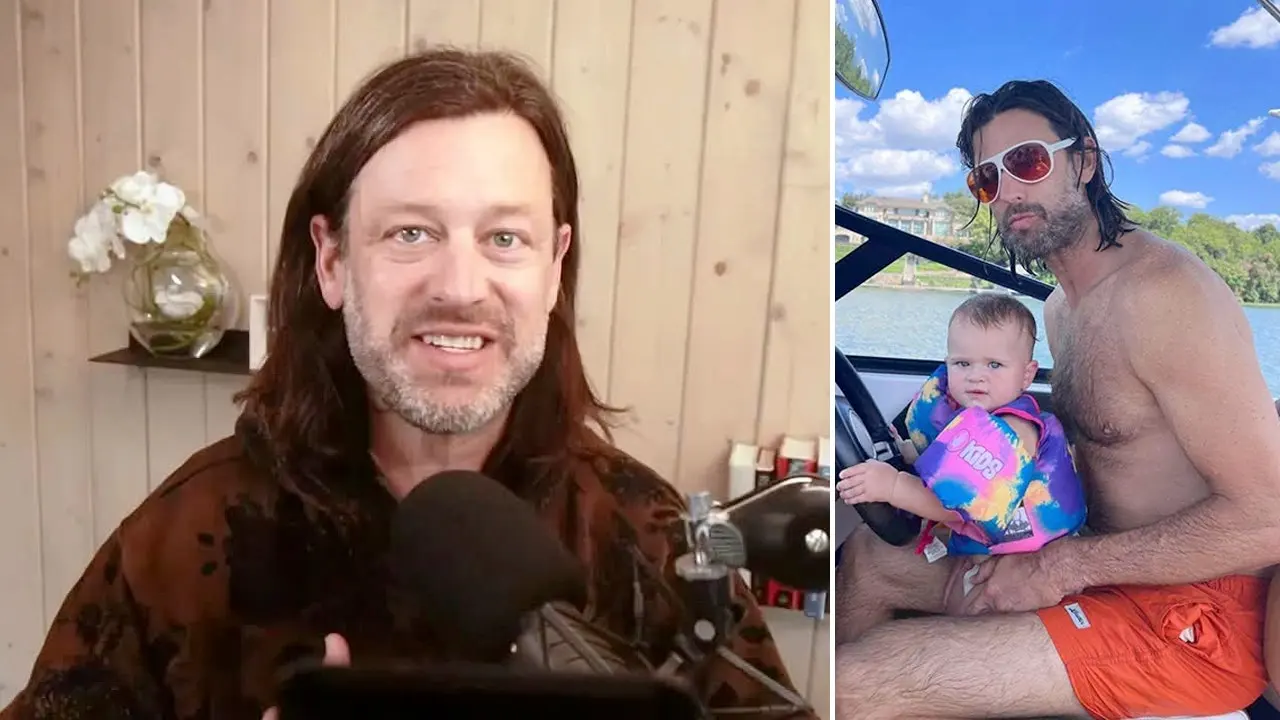
On a bright Sunday morning, Adam Robinson did what he often did: he shared his latest milestone with the world. The post on LinkedIn was upbeat, almost matter-of-fact, the kind of update that a founder posts when the numbers finally tell the story they have been chasing for months. “RB2B is $10m ARR with 1 FTE,” he wrote, a shorthand that would mean little to outsiders but everything to those who knew the relentless grind of building a startup. “MoltSets is almost $1m ARR.” For Robinson, a 45-year-old Austin tech founder, the words were not just metrics; they were proof that a small team, a bold vision, and an unshakable belief in the product could carry a company to the promised land. Just two months earlier, he had described the moment his company was closing in on $10 million in annual recurring revenue as something close to a dream. The dream had been realized. And on that same day, he and his family were heading out on what should have been the beginning of a beautiful chapter. His wife, Helen Sharp, 40, and their two young children, four-year-old Emma and two-year-old Charlie, were at his side. The family was traveling from Austin to the Bahamas aboard a private Learjet 60, a trip that promised sun, sand, and time together. But the flight never made it. The plane plunged into a quiet neighborhood in Palm Beach County, Florida, killing Robinson, Helen, the children, and five other souls on board. The world that knew Adam as a brilliant, outspoken leader was suddenly left to reconcile a man of boundless momentum with the horrifying finality of a fiery crash.
Robinson was not just any founder. He was the kind of builder who seemed to live inside his own imagination, constantly seeing the next opportunity before anyone else did. He was the CEO and co-founder of Retention.com, an Austin-based company that helps businesses identify the anonymous people who visit their websites and then turn those visits into meaningful marketing connections. But that was only the beginning. He also launched RB2B, a platform designed to help businesses figure out exactly who their potential customers are when they land on a page, pulling back the curtain on the mysterious, fleeting traffic that most companies never understand. And he led MoltSets, a data company that provides business contact information, including work emails and phone numbers, to help companies build pipelines and reach the right people at the right moment. Yet for all the complexity of his ventures, Robinson seemed most proud of the fact that he had built something substantial with almost no overhead. Reaching $10 million in annual recurring revenue with just one full-time employee was, to him, the purest expression of his philosophy. It was the promised land, not because of the money, but because it proved that lean, focused, and unapologetically unconventional thinking could outperform the bloated, overstaffed machines of the corporate world. His announcement was a celebration of efficiency, of audacity, and of the strange joy of building a business that did not grow for growth’s sake but because it solved a real problem for real people. And in the same breath, he seemed happy to share the near-success of MoltSets, almost as if he wanted to reassure his followers that he was not some one-hit wonder, but a serial creator with his hands in multiple fires, each one glowing with potential.
But there was another side to Adam Robinson that made him especially loved by those around him. He was not simply a numbers guy or a hard-charging CEO; he was a thinker, a debater, and a man who found joy in intellectual combat. In what would become his final LinkedIn post, Robinson opened the curtains on a friendly disagreement with his friend Jesse Ouellette. The two were locked in a spirited debate over whether RB2B and MoltSets should remain separate businesses or be combined into one unified operation. Ouellette, according to Robinson, believed that merging the products could reduce customer turnover and double revenue. That was the kind of logic most founders would have embraced immediately, yet Robinson saw it differently. He liked the products separate, perhaps because he appreciated the clarity and focus that came from specialization, or perhaps because he simply enjoyed doing things his own way. His response was pure Adam: “My question: WHY DO I NEED TO DO EITHER OF THOSE THINGS?” It was a challenge wrapped in humor and conviction, a refusal to accept that the only measure of success was more money and fewer leaks. And then came the line that, in hindsight, seems almost haunting. “Honestly, I’d be thrilled if RB2B never grew another dollar,” he wrote. It was the declaration of a man who was not chasing wealth or status, but who found his meaning in the work itself, in the people he worked with, in the thrill of building. He and Ouellette had agreed to settle their differences in a live debate scheduled for Tuesday on a show called “Claude Did What!!??” Robinson promised it would be worth watching. “There’s much more to his argument, but I’m saving it for Tuesday,” he wrote. “Grab some popcorn and pick a side.” The invitation was playful, full of the charm that made Robinson a magnetic presence in the tech community. But Tuesday never came for him.
The circumstances of the crash remain under investigation, but what is known paints a picture of rapid, terrifying final seconds. The Learjet departed Austin-Bergstrom International Airport at about 10:37 a.m. Sunday. On board were two crew members and seven passengers, all of whom would lose their lives. The flight was climbing normally when the crew reported encountering light clear ice and moderate turbulence at approximately 35,000 feet. They requested permission to climb to 37,000 feet, presumably to find smoother skies. The request was approved, but less than thirty seconds later, the crew reported that they were descending and issued a mayday call. There was no time, no gentle resolution, no chance to turn back. Federal investigators confirmed that weather was a major focus of the investigation, and they noted early indications that the aircraft began breaking apart before it ever hit the ground. The crash site was devastatingly close to a recognizable landmark, just a few miles from Mar-a-Lago, the famous Florida resort, and yet it might as well have been on another planet for the families waiting for word. Emergency responders arrived to a scene of wreckage and fire, a residential neighborhood transformed in an instant into a nightmare. For the friends and colleagues of Adam Robinson, the news was inconceivable. How could a man so alive, so forward-looking, have been on a plane that broke apart in the sky? How could a family of four, so full of promise, simply vanish on the way to a vacation? The answers may not come for a long time, but the questions themselves have become part of the grief.
In the aftermath, the tributes poured in, each one offering a small glimpse into the lives that were lost. The families of Adam and Helen released a joint statement that spoke of love, devotion, and the deep bond between a husband and wife. “Adam and Helen were devoted parents, and Emma, 4, and Charlie, 2, were the light of their lives,” the statement read. “Helen and Adam were the love affair that will last forever.” There is something profoundly heartbreaking in that phrase, the idea of a love affair that will last forever, because in the physical world it has been so cruelly cut short, yet in the hearts of those who loved them, it will indeed never end. The statement continued, “Their warmth, generosity and gift for making people feel welcome touched so many lives. Their loss will be felt deeply by all those who loved them and who they loved in return.” Those words were echoed by the companies Robinson helped build. Retention.com, RB2B, and MoltSets remembered him not only as a visionary founder but as “a friend, a mentor and a bold, outspoken leader who lived life to the fullest.” They spoke of his deep care for the people around him, the energy and conviction he brought to everything he built, and the enormous hole his loss leaves in the team and the broader tech community. There is a particular pain in losing a leader who has already begun to feel like part of the family, someone whose office door was always open, whose voice was never uncertain, whose enthusiasm was contagious. Adam Robinson was that person. He was not just the man behind the metrics; he was the human being who made those metrics feel meaningful.
As the investigation continues, the world is left to mourn not only the loss of a founder, a wife, two children, and the other passengers, but the loss of all the moments that should have been. There was a debate scheduled for Tuesday, a chance for two friends to argue about business in front of an audience, to laugh, to challenge each other, and to prove that ideas matter even when they are messy. There was a vacation to the Bahamas, the promise of children building sandcastles, of Helen and Adam watching Emma and Charlie discover the ocean. There was a milestone to celebrate, a $10 million mark that had been reached with just one full-time employee, a story that could have become a case study in how to build with intention and audacity. Instead, all of that now exists only in memory, frozen on a LinkedIn post that is both a triumph and a farewell. For those who were following Adam Robinson’s journey, his final caption has become something like a message from beyond, a reminder that life is fragile, that the plans we make for tomorrow are never guaranteed, and that the people we love deserve to know how much they mean to us today. The crash killed nine people, but it also shattered countless futures, altered the course of families, and left a tech community in stunned silence. The cause is still unknown, and perhaps nothing will ever fully explain why a perfect beginning turned into so devastating an end. But in the words that Adam left behind, we hear the voice of a man who was not finished, who had so much more to say, and who believed, right up to the final moment, that the best was still to come.