






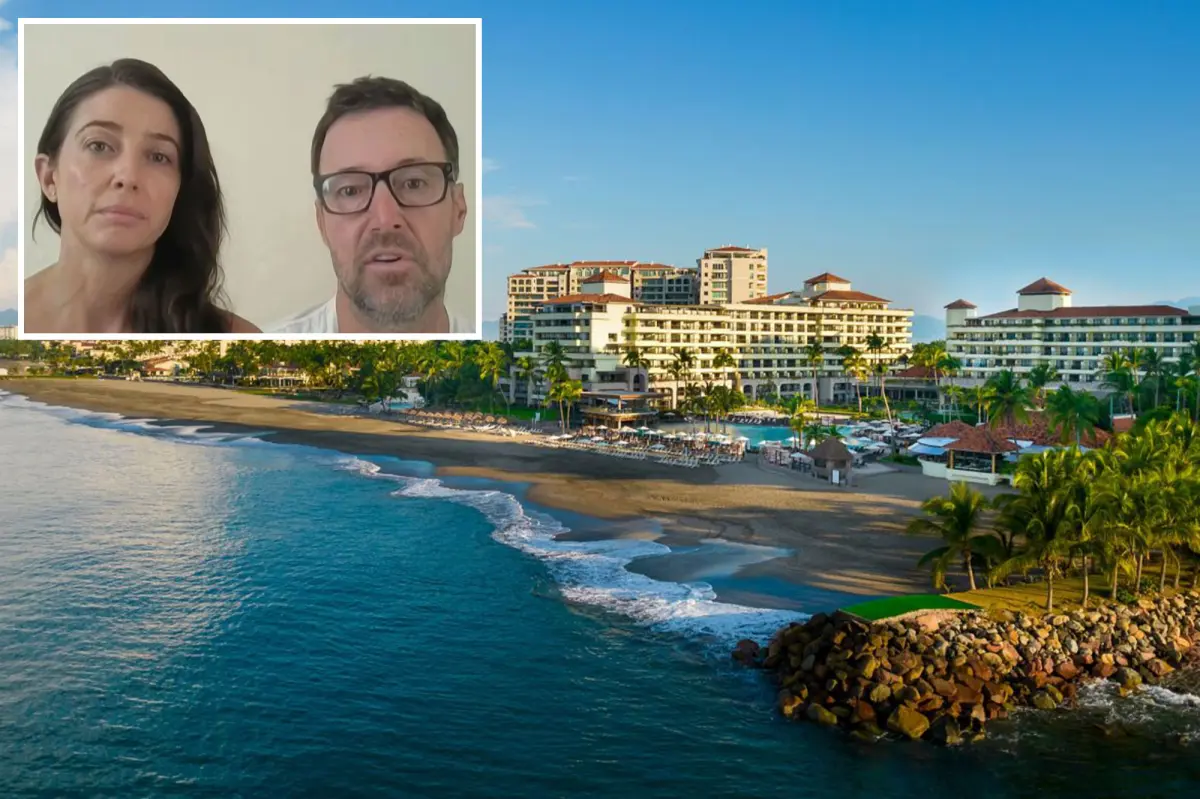
The golden hour in Puerto Vallarta is typically a time of ethereal, postcard-perfect beauty, where the warm Pacific sunset paints the Jalisco sky in rich, sweeping hues of amber, gold, and violet. For decades, this idyllic Mexican oceanfront has invited travelers from all corners of the globe to lose themselves in a tropical paradise, seeking a temporary escape from the stresses of their daily lives. However, on a seemingly ordinary Friday evening at around 6:30 p.m., this tranquil vacation atmosphere at the popular Marina Vallarta Beach was abruptly and violently shattered. Right near the sandy shoreline adjacent to the luxurious Marriott Puerto Vallarta Resort and Spa, a tragedy of primal and devastating proportions unfolded within mere seconds, leaving onlookers completely paralyzed by shock. A 28-year-old Mexican national, who had traveled to the bustling resort town not for leisure or relaxation, but rather to work and build a stable livelihood, found himself in a sudden, nightmarish struggle for survival. He was targeted and attacked by a massive crocodile, an apex predator lurking silently in the coastal waters where the region’s river estuaries naturally meet the ocean tide. What began as a routine, warm evening by the water quickly escalated into a desperate fight for life, drawing the attention of horrified witnesses who could scarcely comprehend the primeval horror unfolding before their eyes. The contrast between the manicured luxury of the vacation resort and the raw, untamed forces of nature could not have been more stark, as the young man’s final moments became a terrifying testament to the unpredictable and hidden dangers that lie just beneath the surface of paradise. As the sun began to dip below the horizon, casting long shadows across the beach, the atmosphere of joy was instantly replaced by a heavy, suffocating panic that would linger over the shoreline for days to come.
Just yards away from where the waves broke onto the sand, the Yetter and Bury family from San Clemente, California, were enjoying the quintessential Friday afternoon wind-down. Jamie Yetter, her fiancé Chris Bury, and her teenage daughter had traveled down from Orange County to escape their routines, relaxing by the resort’s pool as the tropical sun began its slow descent. The familiar, comforting sounds of children splashing, soft resort music, and distant ocean waves were suddenly pierced by a series of frantic, blood-curdling screams echoing from the beach. Instantly, the peaceful vacation haze evaporated, replaced by an urgent, gut-wrenching realization that someone was in extreme, life-threatening danger. In a resort setting where screams are often associated with playful children or joyful swimmers, the sheer terror in these cries was unmistakable and chilled them to the bone. Looking out toward the surf, Jamie and Chris saw a silhouette struggling violently in the water, initially believing that a swimmer had been caught in one of the ocean’s notorious, invisible rip currents that frequently plague this coastline. Driven by pure human empathy, adrenaline, and an instant refusal to stand by as passive bystanders to a tragedy, Chris took off sprinting toward the shoreline, with Jamie running close behind him, their hearts pounding against their chests as they raced against an unknown clock to reach the fading cries of a complete stranger who was running out of time.
Upon reaching the wet sand, Chris scanned the immediate area for any sort of lifeguard station, safety ring, or rescue board, only to find a desolate stretch of beach devoid of lifesaving equipment or official resort personnel. Spotting a solitary kayak resting on the shore, he dragged it toward the churning water with desperate energy, only to realize in deep frustration that there were no oars or paddle accessories anywhere in sight. Refusing to let the complete lack of proper equipment stop him from trying to save a human life, Chris made the split-second decision to jump into the paddle-less vessel, using his bare hands to fiercely claw at the incoming waves in a frantic attempt to navigate the rough surf. The sheer physical exertion of trying to steer a heavy plastic kayak through the breaking waves with nothing but his arms became a grueling, exhausting challenge, and the risk to his own safety grew with every stroke. Yet, his eyes remained locked on the tragic figure ahead, who was fighting a losing battle against an invisible force beneath the tide. Tragically, just as Chris managed to orient the kayak and draw closer to the victim, he witnessed the heartbreaking and horrifying moment the young man was violently pulled beneath the dark surface of the ocean by the crocodile, vanishing into the deep before any human intervention could reach him. The silence that followed was suffocating, leaving Chris helpless and stranded in the water, haunted by the memory of a hand disappearing beneath the waves, realizing he was mere seconds too late.
The subsequent search operation took on a somber, agonizing tone as night fell over the resort town, and local emergency crews began their grim task under the cover of darkness. Authorities from the Jalisco state police alongside local search and rescue teams combed the black waters for hours with searchlights, hoping against hope while deeply aware of the bleak reality of such predatory encounters. It was not until early Saturday morning, approximately twelve hours after the initial attack, that the young man’s body was finally recovered from the sea. The victim, identified only as a twenty-eight-year-old Mexican worker, had his life tragically cut short far from his home while trying to make a living in a town designed to pamper wealthy international tourists. This sharp division between those who visit the resort for luxury and those who labor there to make it possible added a layer of quiet heartbreak to the tragedy. His death left an indelible mark of grief on the local working community and the visitors who tried to save him, serving as a devastating reminder of the human cost that often goes unnoticed behind the polished, commercialized facade of major tourist destinations. For his family, the loss of a young man working to support his loved ones represents a lifetime of unfulfilled dreams and sudden, agonizing grief that no resort amenity could ever heal or compensate for.
In the aftermath of the attack, critical questions began to arise regarding the effectiveness of local safety protocols and wildlife awareness along the popular beach, pointing to a complicated relationship between nature and commercial tourism. Jamie Yetter later recalled seeing warning signs posted near the shoreline, which detailed dangers ranging from jellyfish and stingrays to crocodiles. However, the family noted a tragic design flaw or misunderstanding in the signage, explaining that they had initially mistook the stylized graphic representation of a crocodile for a harmless iguana—a common and celebrated local reptile often seen sunbathing around Mexican resorts. This confusion highlights the critical need for clearer, more urgent, and less ambiguous communication in areas where human tourist habitats overlap with the natural territory of dangerous predators. This was not an isolated ecological anomaly; the tragic event occurred near the exact site of a 2022 crocodile attack that had previously injured two tourists from Colorado, illustrating a recurring pattern of human-wildlife conflict that remains unresolved as the city’s tourism footprint continues to expand into native habitats. As developers push further into the natural wetlands and estuaries surrounding the Ameca River, crocodiles are increasingly forced into public beach areas, creating a perilous overlap between unsuspecting tourists and territorial predators.
Perhaps the most eerie and sobering aspect of the tragedy was how quickly the tide of normal resort life rushed back to cover the scars of the night before. By Saturday morning, less than a day after a young man had lost his life to a predator in those very waters, families and vacationers were seen swimming, splashing, and playing in the ocean, seemingly oblivious to the horrific event that had transpired hours earlier. The Marriott Puerto Vallarta Resort and Spa maintained a stark silence, offering no public comment or immediate updates on safety measures following the incident, as if to shield its guests from the unsettling reality of the region’s wild fauna and protect its commercial reputation. For the Yetter and Bury family, however, the vacation would never be the same, as they returned home to Southern California carrying the heavy psychological weight of a heroic effort that fell just short. Their experience serves as a profound and humbling reminder of the fragility of human life, the unpredictable wildness of the oceans we love to visit, and the quiet tragedies that persist just outside the bubble of our holiday dreams, leaving behind a family who will forever mourn a son, a brother, and a worker who never came home. This stark juxtaposition of vacation luxury and raw, indifferent nature leaves a haunting message for all who visit: paradise is never as tame as it seems, and safety is often an illusion we construct to keep our fears at bay.