




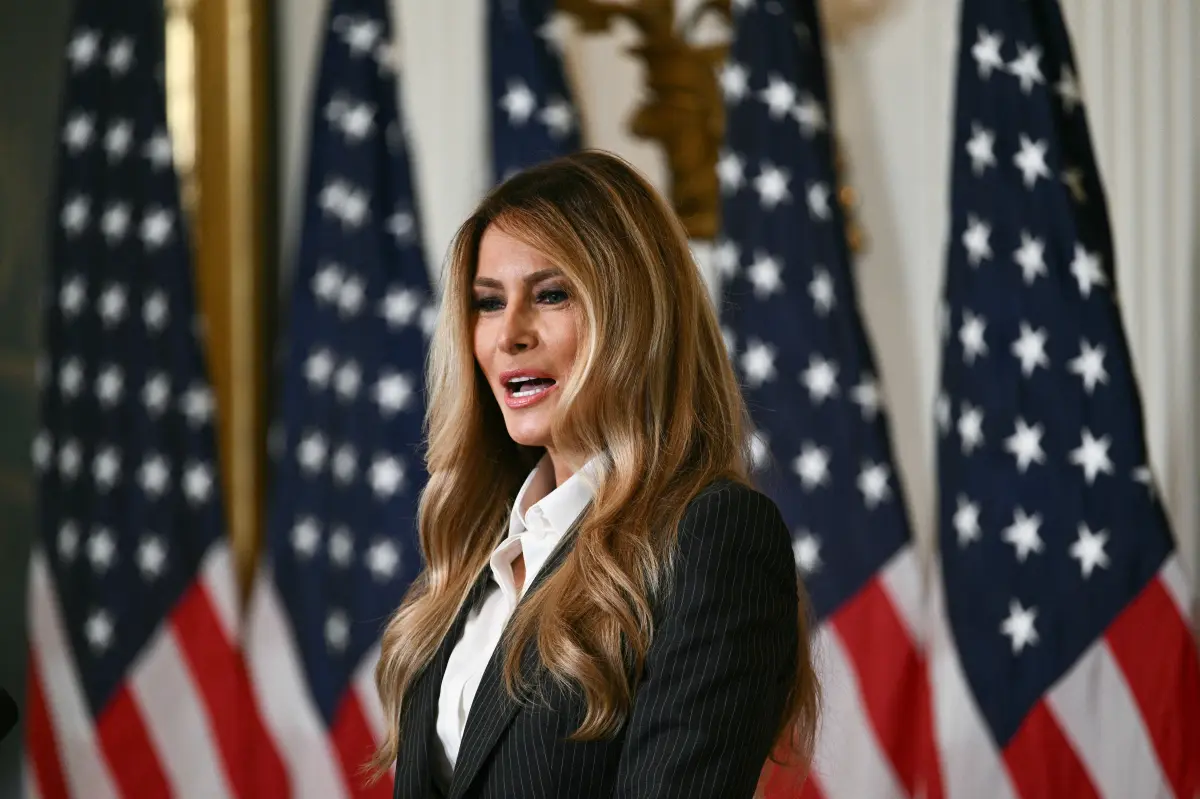
The quiet, deeply personal moments of family reunion stand in stark contrast to the deafening noise of artillery and geopolitics that has defined the European continent for the last four years. On a Thursday morning filled with a rare sense of hope, First Lady Melania Trump announced that five Ukrainian and Russian children, who had been forcibly separated from their families by the ongoing war, were finally returned to the arms of their loved ones. The Slovenia-born First Lady, drawing on her own perspective as a mother and an immigrant who understands the deep meaning of home, reminded the world that while traditional diplomacy and geopolitical negotiations are vital to global stability, they must ultimate yield to our shared moral duty to protect the innocent. She expressed a profound guiding philosophy: that our collective capacity to place children above international disputes is the ultimate measure of our humanity. In a poignant statement released through the White House, she noted that every single successful reunion is a vital reminder that even in the absolute darkest times of human history—such as the devastating crucible of militarized conflict—fundamental human values like compassion, dignity, and familial love possess the extraordinary power to transcend geopolitical divides. For these five families, raw grief has finally transitioned into the slow process of healing.
This latest breakthrough marks the fifth successful installment of an ongoing, highly sensitive humanitarian effort that operates quietly in the shadows of the most destructive and destabilizing military conflict Europe has witnessed since the Second World War. The foundation for this delicate rescue pipeline was laid this past October, when the First Lady announced that she had successfully established an “open channel” of direct communication with Russian President Vladimir Putin, specifically designated to address the welfare and repatriation of displaced children. In a global political landscape characterized by severed diplomatic relations, aggressive rhetoric, and near-total gridlock, this unique backchannel represents a rare, fragile bridge of functional communication. While traditional statecraft often stalls over territorial sovereignty and military strategy, this highly focused channel bypasses standard diplomatic posturing to target the immediate, tangible suffering of torn-apart families. As has been the pattern in previous iterations of these delicate operations, the official announcements intentionally omitted the exact breakdown of the children’s nationalities. This strategic silence is likely a protective measure, designed to shield the fragile families from intense public scrutiny and to maintain the delicate diplomatic equilibrium necessary to keep this critical lifeline open for future rescues.
The urgent necessity of such diplomatic lifelines is starkly underscored by the systematic displacement and uprooting of countless young lives since the outbreak of full-scale hostilities. Since the Russian federation launched its massive invasion of Ukraine in February 2022, thousands of children have been swept up from their familiar lives, separated from their parents, and removed from homes, state-run orphanages, and specialized boarding schools across occupied territories, only to be transported deep into Russian territory. For a child, the sudden transformation of their secure world into a chaotic environment of active bombardment, forced evacuations, and administrative relocation is an incomprehensible trauma. This massive displacement has shattered communities and left an open wound in the heart of Ukrainian society, where the sudden disappearance of a generation has traumatized survivors. For the parents and guardians left behind, local communities are haunted by empty classrooms and quiet playgrounds, while the psychological toll remains an agonizing, unending torment of wondering whether their children are safe, healthy, or even still alive.
The true scale of this humanitarian crisis is further highlighted by the sharp discrepancy between official international documentation and the harrowing estimates provided by the victims’ homeland. In March of this year, the United Nations human rights apparatus released a highly scrutinized report verifying the documented abduction and unauthorized transfer of more than 1,200 children from five distinct regions of Ukraine that have borne the brunt of the invasion. However, the government in Kyiv contends that this verified figure represents only the tip of a massive, devastating iceberg, asserting that the true number of illegally deported children could easily be as high as 20,000. This massive gap in statistics illustrates the profound difficulty of monitoring human rights abuses in an active war zone, where access to occupied territories is heavily restricted, documentation is easily destroyed or falsified, and families are frequently displaced themselves. Behind each of these figures—whether the conservative estimates of the United Nations or the tragic, larger numbers put forward by Ukrainian authorities—lies a specific child with an individual story, a distinct voice, and a family that is desperately searching for them.
This systematic removal of youth has drawn intense scrutiny and condemnation from international legal bodies, which challenge the official justifications presented by the occupying state. The United Nations Commission of Inquiry on Ukraine has thoroughly investigated these transfers, pointing out a critical contradiction in the argument presented by Russian authorities, who have consistently maintained that these children were evacuated solely for their own safety and physical protection from active combat zones. The commission pointedly noted that while temporary evacuation during active conflict is permissible under specific international treaties, the reality that over eighty percent of these children have remained separated from their families and unreturned after more than four years of protracted warfare strongly refutes any claims of a purely humanitarian motivation. Under international humanitarian law, particularly the Geneva Conventions, the unlawful deportation or transfer of civilians—especially children—is classified as a grave breach and a potential war crime, as it deprives children of their fundamental right to family preservation and identity. The long-term retention of these children suggests a systematic effort to assimilate them, cutting them off from their heritage and using them as demographic or political pawns in a broader conflict.
In the face of such overwhelming systemic injustice and historical tragedy, the reunion of these five children with their families provides a vital glimmer of hope and a profound reminder of the resilience of the human spirit. While rescuing five young souls may seem like a modest achievement when contrasted with the thousands who remain missing in the vastness of the conflict, each successful return represents an absolute, life-changing victory for the families restored to wholeness. It proves that even when the mechanisms of global governance fail and the drums of war drown out the voices of reason, the primal, universal bond between a parent and a child can still carve a path through the trenches of political hostility. The continued advocacy and diplomatic efforts of figures like Melania Trump, alongside dedicated humanitarian organizations on the ground, demonstrate that compassion must never be allowed to capitulate to geopolitical fatigue. As the war continues to exact its terrible toll, these reunions stand as a powerful moral mandate for the international community, reminding us that we must never become desensitized to the suffering of the innocent, and that our ultimate duty is to ensure that every single child displaced by this tragedy is eventually brought home to the safety, love, and dignity they so richly deserve.