




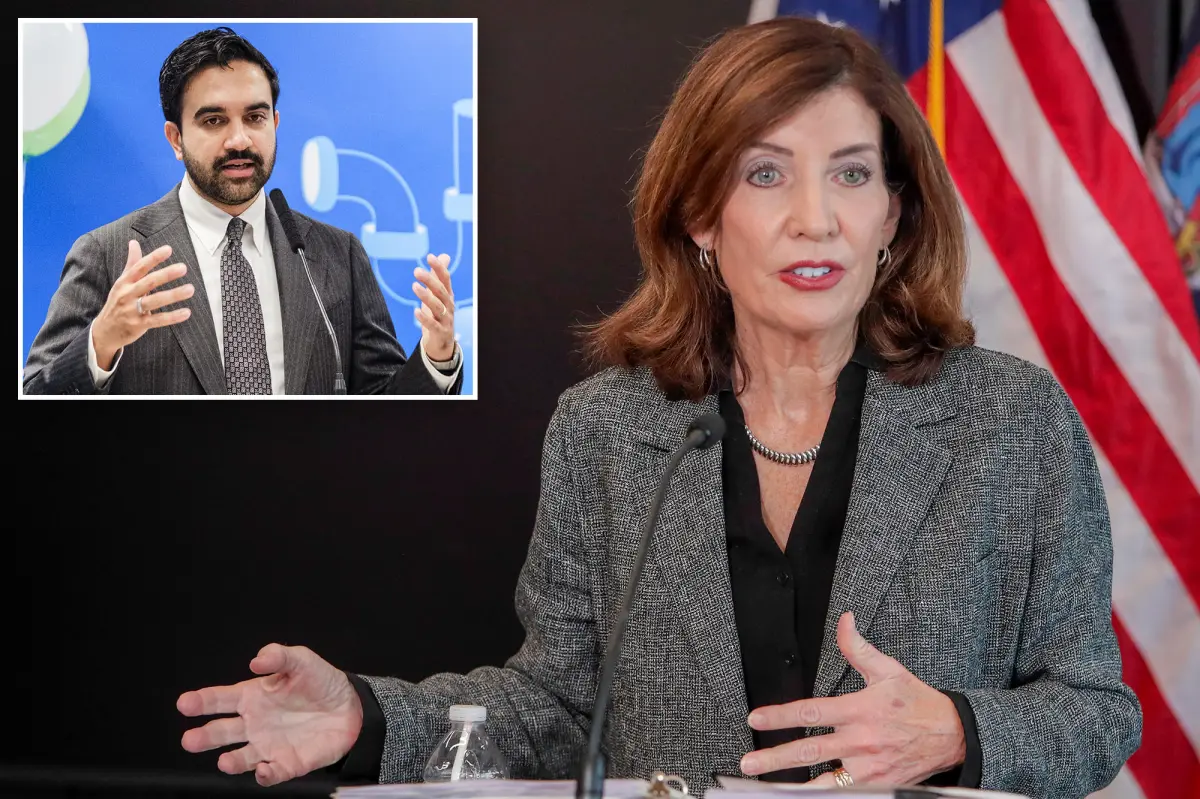
In the high-stakes political arena of New York, where every word is a weapon and every silence a statement, Governor Kathy Hochul is performing a delicate, and some would say dangerous, dance. The Democratic governor, currently fighting for her political survival in a tight reelection race, recently found herself cornered by a thorny issue that refuses to be neatly packaged: the city’s new strategic plan to combat antisemitism. The plan, spearheaded by Mayor Zohran Mamdani, has been met with a chorus of criticism from Jewish leaders and advocates who point to a glaring, almost deafening omission—it refuses to define the very term “antisemitism” and declines to recognize Zionism as a fundamental component of Jewish identity. When pressed on this perceived deficiency during a press conference, Hochul visibly shied away, opting for a strategy of deflection that left many observers feeling unsettled. Rather than engaging with the substantive critique, she offered a lukewarm endorsement of the administration’s efforts, suggesting that the public should simply “applaud” the steps being taken. It was a moment that encapsulated the profound discomfort of a politician caught between the progressive base she desperately needs to court and the established Jewish community that feels increasingly vulnerable and unheard in the current climate.
Hochul’s response, or lack thereof, was a masterclass in political evasion, but it also laid bare a troubling reality about the state of leadership on this issue. Claiming she was not familiar with the report’s contents, the governor deflected to a vague assertion that New York already has a “strong plan” and a definition in place. Yet, this assertion crumbles under closer scrutiny. The New York State Human Rights law, which is the primary legal framework for combating discrimination, does not actually contain a specific definition of antisemitism. The only semblance of a definition exists in a non-binding “proclamation” issued by Hochul herself back in 2022—a document that carries moral weight but absolutely zero legal teeth. This distinction is not merely academic; it is the difference between a symbolic gesture and a prosecutorial tool. To make matters worse, sources revealed that Hochul’s office had been briefed by City Hall on the plan just the evening prior, a briefing that explicitly discussed the omission of the definition. This revelation transforms her claim of ignorance from a mere oversight into a calculated choice. It suggests a governor who is fully aware of the controversy but chooses to look the other way, prioritizing political expediency over moral clarity, leaving Jewish New Yorkers to wonder if their safety is being traded for votes.
The crux of the matter lies in the battle over what definition should hold sway in the legal system. Proponents of a robust legal response to antisemitism have long championed the International Holocaust Remembrance Alliance (IHRA) working definition, which provides a comprehensive framework for identifying and prosecuting hate crimes against Jews. The IHRA definition describes antisemitism as “a certain perception of Jews, which may be expressed as hatred toward Jews,” and crucially, it includes contemporary manifestations of this hatred, specifically addressing the ways in which anti-Zionism can cross the line into antisemitism. This definition is seen as vital because it gives law enforcement and educational institutions the clarity needed to distinguish between legitimate political criticism of the state of Israel and outright bigotry that threatens the safety of Jewish students and citizens. State Assemblyman Sam Berger, an Orthodox Jewish Democrat from Queens, has become a vocal advocate for codifying this definition into law. He is sponsoring the HOPE Act, which would enshrine the IHRA definition into state statute, making it a legally binding standard. Berger’s frustration with Hochul’s stance is palpable; he expressed gratitude for her acknowledgment of a statewide definition but pointedly noted that “a non-legally binding document is not going to cut it.” His words echo the sentiment of a community that is tired of platitudes and desperate for actual protection.
The political tightrope that Hochul is walking is precarious, to say the least. With polls showing her within single digits of her Republican challenger, Nassau County Executive Bruce Blakeman, she is in a desperate scramble to consolidate her base. This has led her to court the progressive left, a demographic that Mamdani represents and that has shown increasing hostility toward traditional pro-Israel stances. Hochul’s attempts to bridge this gap have been clumsy and fraught with contradiction. She boasted plans to appear with Representative Alexandria Ocasio-Cortez in Ithaca, a move seen as a direct appeal to the progressive wing of the party, though the event was ultimately canceled due to inclement weather. However, the optics of that planned appearance were already damaged by reports that AOC’s supporters at a previous event had chanted the controversial pro-Palestinian slogan “from the river to the sea,” a phrase widely condemned as a call for the abolition of Israel and its people. By aligning herself with this faction while simultaneously refusing to condemn the omission of a definition that would protect Jewish students, Hochul is sending a mixed message that satisfies no one. She risks alienating the Jewish community, which has historically been a reliable voting bloc, while also failing to fully secure the trust of the far-left, who view her as a centrist interloper.
Mayor Mamdani, for his part, defends his plan by pointing to its tangible investments—additional Title IX coordinators to handle campus incidents, grants for nonprofits, and increased security funding for vulnerable institutions. He frames these measures as necessary to address the “scourge” of antisemitism, and on the surface, they are indeed commendable. However, critics argue that these investments are akin to building a fortress without knowing what enemy you are defending against. Without a clear definition of the hatred being targeted, how can these resources be effectively deployed? The data paints a grim picture: hate crimes have spiked by nearly 16% compared to the previous year, with Jewish-motivated crimes alone rising by 8%. These are not abstract statistics; they represent real fear in synagogues, on college campuses, and in neighborhoods across the city. Jewish students are hiding their yarmulkes, families are reconsidering their safety, and community centers are beefing up security. In this environment, the refusal to define the problem is not just a bureaucratic oversight—it is a dereliction of duty. It leaves law enforcement without clear guidelines, educators without a curriculum, and victims without the legal recourse they desperately need to feel that the state is on their side.
Ultimately, the controversy surrounding Hochul’s reaction to Mamdani’s plan is a microcosm of a larger, deeply human crisis. It is a story about the fear of political backlash overriding the moral imperative to protect the vulnerable. The governor’s evasion, her claim of ignorance, and her reliance on a toothless proclamation all point to a leader who is more concerned with keeping her seat than with standing up for what is right. The human cost of this ambiguity is immense. For a Jewish student facing harassment on a quad, a non-binding proclamation offers no comfort. For a family whose synagogue was vandalized, a grant for security cameras is cold comfort if the legal system cannot properly classify the crime as a hate crime. The IHRA definition is not a perfect document, and it is subject to debate, but it provides a starting point, a shared language that allows society to name the evil it seeks to eradicate. By refusing to adopt it, Hochul and Mamdani are leaving the door open for ambiguity to flourish, allowing hatred to hide behind the shield of political rhetoric. New York, a state that prides itself on being a beacon of progress and tolerance, is stumbling in the dark on this issue. The people of New York deserve leadership that is brave enough to define the problem, bold enough to stand against hatred, and compassionate enough to understand that the safety of a community cannot be sacrificed on the altar of political expediency. Until that happens, the rising tide of hate will continue to wash over the state, leaving behind a trail of fear and a profound sense of betrayal among those who look to their leaders for protection.