




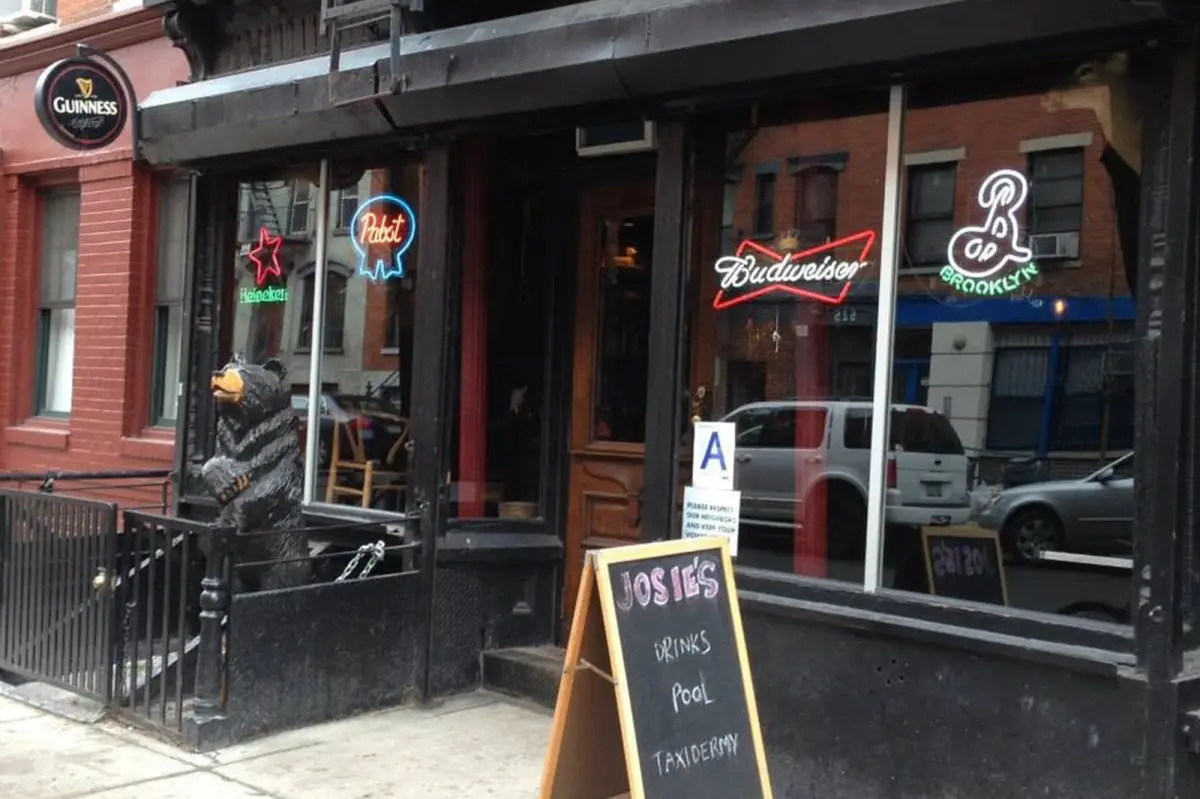
In the dim hours after a night out, when the city usually feels like it is suspended between one world and the next, a quiet stretch of the East Village became the scene of a sudden and brutal robbery. It was around 3:20 a.m. on Tuesday, and the area near East 6th Street and Avenue A was mostly empty, with only the low, familiar hum of a neighborhood that never completely goes to sleep. Outside Josie’s Bar, a no-frills dive bar that has watched over that corner for decades, a man was simply there, perhaps stepping out for a cigarette, checking his phone, or trying to find his way home after a late night. The victim did not know the two people who approached him. There was no heated argument, no previous acquaintance, no warning that anything was wrong. The pair, strangers with no connection to him, walked up and immediately yanked on the fanny pack strapped around his waist. That small bag, worn for convenience or perhaps for safety, turned him into a target. What happened next was not a quiet pickpocketing or a quick demand for valuables. It was violence, raw and sudden, in the middle of a city street. One of the two pulled out a gun and did not simply point it. He used it as a bludgeon, striking the man in the head over and over, the heavy metal cracking against the skull with horrifying force. Blood spilled down the victim’s face, staining his shirt, his hands, the sidewalk. In the space of a few terrifying seconds, the simple act of standing outside a bar became a nightmare, and the quiet street was no longer a safe retreat but a trap.
The shock of the attack must have been overwhelming. The body goes into a strange state during violence, the mind struggling to make sense of what is happening even as the blows keep landing. The victim had no chance to run, no way to defend himself against a weapon already swinging at his head. He was bleeding and dazed, likely stumbling backward, uncertain whether the next moment would bring another blow or a bullet. His attackers did not pause. They grabbed what they could and fled, leaving him on the ground near Josie’s, hurt and broken. It was a calculated, heartless robbery: two people saw a man, decided he was vulnerable, and attacked with a level of cruelty far beyond what was needed to steal his belongings. They took cash, an unknown amount that may never be fully counted, and they took his watch, a Timex T-Cell, not the kind of expensive luxury watch that would normally make headlines, but something personal, something strapped to his wrist perhaps as a daily companion or a gift with its own quiet meaning. They also took his passport. That detail is especially chilling because a passport is more than just identification. It is a piece of a person’s history, a document that holds their name, their photo, their travels, their identity. To have it stolen is to feel erased in a strange way, to lose a part of the record of one’s own life. In the chaos of the assault, the assailants didn’t know or care what they took. They simply wanted what they could carry, and they were willing to leave behind a bleeding, traumatized person to get it.
When the attack was finally over and help arrived, the victim was taken to Bellevue Hospital, the same institution that has served New Yorkers for centuries, a place that sees the worst wounds of the city and tries to stitch them back together. There, doctors and nurses treated the gashes on his head, cleaned the wounds, and monitored his condition. Police said he was listed in stable condition, which is the kind of phrase that sounds reassuring until you remember what it means: a human being lying in a hospital bed, bruised, scraped, probably concussed, with no watch on his wrist, no passport in his pocket, and the memory of gun metal striking his forehead replaying behind his eyes. Stable is a word the system uses to say he will live. It does not capture the fear, the pain, the humiliation, or the long road of recovering from an assault. It does not capture the nervousness he will feel the next time he walks past a stranger on a quiet street, or the way his stomach will tighten every time he hears footsteps behind him. The physical injuries may heal, but the invisible ones often take much longer. He is one of many people who wake up in hospitals every day because someone else decided to take what did not belong to them. And while the medical staff at Bellevue did their best to ease his suffering, the deeper loss of safety, of personal peace, of the ability to feel at home in his own neighborhood, is not something a bandage can fix.
The two suspects fled the scene in a white vehicle, and hours later, police were still searching for them. It is hard not to wonder where they went after the attack. Did they drive away with a sense of triumph, counting the cash they had stolen? Did they toss the passport into a gutter or abandon the watch in a dark corner of a stolen car? Or did they simply become nameless faces in the blur of the city, disappearing into the early morning traffic while the victim lay bleeding on the pavement? Police in the NYPD’s 9th Precinct, which covers the East Village and parts of the Lower East Side, responded to the scene and began piecing together what happened. They likely reviewed surveillance footage from nearby cameras, looked for witnesses, and followed the thread of the white vehicle as it vanished into the pre-dawn darkness. The case is now part of a larger pattern of urban crime, one that statistics try to measure but never fully explain. According to data last updated Sunday, robberies in the 9th Precinct are down by about 37 percent so far this year. The numbers show fifty-eight robberies reported within the precinct’s boundaries in that period, compared to ninety-two during the same stretch a year earlier. On paper, the neighborhood appears safer. The trend is moving in the right direction, and community members can take some comfort in knowing that the police are working to keep the area secure. But none of that mattered to the man who was attacked outside Josie’s Bar. Statistics are cold things. They do not feel the impact of a gun against the skull. They do not feel the panic of being ambushed in the middle of the night. They do not feel the indignity of watching someone run away with your passport and your watch and the cash you needed for whatever small purpose.
There is a strange tension in a city like New York between the numbers that measure crime and the lived experience of the people on the streets. A decline in robberies is a thing to celebrate, a sign that police work and community efforts are making a difference, but for the victim, the attack is a 100 percent personal reality. His robbery was not part of a statistic; it was a violent, intimate violation that happened on a specific street, at a specific hour, in front of a bar he might have walked past many times before. The East Village has long been a neighborhood of contradictions. It is famous for its artistic history, its punk rock roots, its crowded bars and late-night pizza joints, but it has also always carried an edge, a reminder that the city can be unpredictable and unforgiving. Josie’s Bar, with its unpretentious facade and sticky floors, is exactly the kind of place where people go to forget their troubles, to unwind after work, to laugh with friends over cheap drinks. No one who walks into that bar expects to leave in an ambulance. No one expects that a fanny pack around their waist will turn them into a target. But the city’s edge is still there, lurking beneath the surface, showing up at 3:20 in the morning when the streets are empty and the light is low. The attack outside Josie’s is a reminder that safety is not guaranteed, even in a neighborhood that appears to be improving. It is a reminder that crime can happen anywhere, anytime, to anyone.
And yet, for all the fear and anger that such an attack inspires, there is also a stubborn resilience that defines the city and its people. The East Village will wake up the next morning, and Josie’s Bar will open its doors again. The street will be washed clean, bloodstains fading into the pavement, and pedestrians will walk by without ever knowing what happened there hours earlier. The victim will leave Bellevue Hospital and try to put his life back together, perhaps replacing his watch, reapplying for his passport, and slowly learning to trust the city again. The police will continue their investigation, hoping that someone recognizes the two suspects from a description or a security camera image, hoping to bring some measure of justice to a man who was hurt for nothing more than the contents of his pockets. But the deeper story here is not just about a robbery or a steep decline in statistics. It is about the fragility of everyday life and the way a single moment can change everything. It is about the two strangers who made a choice to hurt another person, and the consequences they will eventually have to face. It is about a community that must balance its affection for the vibrant, messy streets of the East Village with a commitment to keeping people safe. The numbers force a certain optimism, but the man outside Josie’s Bar reminds us that behind every number is a person with a beating heart, a head that can be wounded, a body that can bleed. His story deserves to be told not just as a report of a crime, but as a human experience, one that will stay with him long after the bruises fade and the headline disappears. In the end, the city continues, the bar opens, the streets fill with people again, and somehow life moves forward, even for those who have been hurt. But the memory of the attack lingers, a quiet shadow on a familiar corner, waiting to be outrun.