






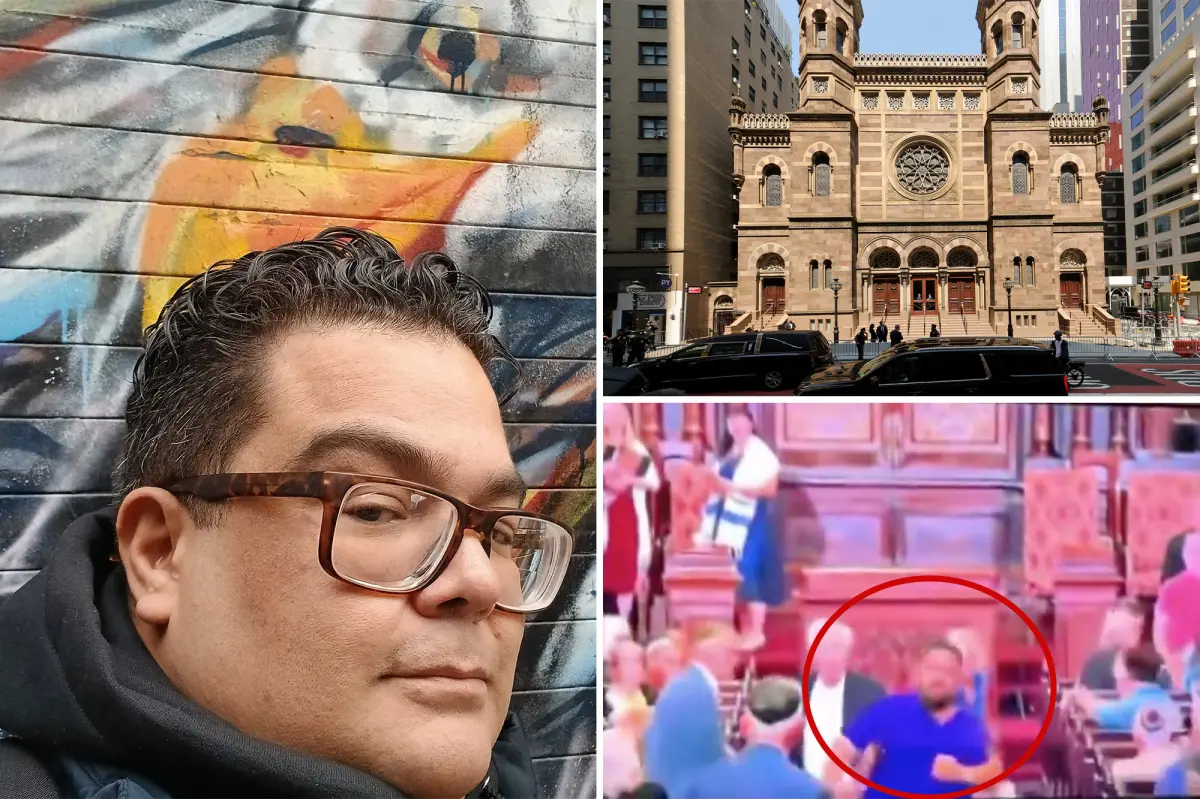
On an ordinary Friday evening, the Central Synagogue on Lexington Avenue should have been filled with the quiet rhythms of Shabbat—the soft murmur of prayers, the glow of candlelight, the familiar comfort of a community gathered in faith. Instead, that sacred space became the stage for a sudden, violent rupture. Larry Montes, a 46-year-old Bronx native, allegedly burst through the doors during the service and unleashed a chaotic assault that left congregants shaken, a woman injured, a security guard bloodied, and a house of worship damaged. By late Saturday night, Montes stood before a judge in Manhattan Criminal Court, charged with hate crimes, as prosecutors laid out a disturbing portrait of a man who, by his own admission, was driven by religious hatred. Judge Janice Chan set bail at $10,000 cash and $30,000 in bonds—a figure significantly lower than the $50,000 cash and $150,000 in bonds requested by the Manhattan District Attorney’s office. The decision underscored the fraught balancing act of the justice system, but for those in the synagogue that evening, the numbers felt abstract against the very real terror they had just endured.
The violence was swift and deeply personal. According to prosecutors, Montes allegedly struck a 63-year-old female congregant, sending shockwaves through the room where worshippers had come to find peace. He then turned on a 65-year-old security guard, headbutting him and spitting on him—a brutal violation of a man whose role was to protect others. In the midst of the chaos, Montes also damaged two religious candles valued at $20,000, objects that likely held deep symbolic meaning for the congregation. As witnesses tried to intervene, he allegedly shouted “f–k the Jews,” a phrase that transformed a physical assault into an attack on an entire community. The scene must have been terrifying: a sanctuary, meant to be a refuge from the outside world, suddenly invaded by rage and hatred. For the congregants, the Shabbat service—traditionally a time of rest, reflection, and connection—became a moment of survival. The security guard, the woman, and others who witnessed the attack will likely carry the psychological weight of that evening for a long time, even as they try to return to the rituals that once felt safe.
What emerged in court painted an even darker picture of the accused’s mindset. Assistant District Attorney Ali Fazal told the judge that Montes admitted to police that his actions were religiously motivated. He allegedly called the worshippers “swine” and “fake Jews,” words that echo centuries of antisemitic rhetoric. But the hatred did not stop there. Fazal noted that Montes also admitted to having “racial animus towards black people,” revealing a broader pattern of prejudice and hostility. When asked about his actions, Montes reportedly said he was acting “on instinct” and that “he was mad.” Those chillingly simple explanations offer little comfort to those seeking to understand why someone would cross the threshold of a synagogue and attack strangers at prayer. The criminal charges—two counts of assault as a hate crime and one count of criminal mischief as a hate crime—reflect the legal system’s recognition that such acts are not merely interpersonal violence but offenses against entire communities. The term “hate crime” carries weight, acknowledging that the trauma extends far beyond the immediate victims, rippling outward to every person who shares that faith, that race, or that identity.
The courtroom proceeding, held just before midnight, was fraught with tension. Judge Chan issued orders of protection for both the congregant and the security guard, as well as for an employee and a security officer from the synagogue who had tried to protect the candles and help escort Montes out of the building. These protective orders are a small but significant measure, meant to shield those most directly affected from further contact with their alleged assailant. Yet for many, the bail decision felt inadequate. The District Attorney’s office had pushed for much higher bail, arguing that Montes posed a danger to the community. But the judge, bound by legal standards and perhaps mindful of Montes’s status as a “known emotionally disturbed person,” chose a lower amount. Montes, who has at least two prior arrests for violent robberies in 2019 and 2023, is no stranger to the criminal justice system. His history, combined with Friday’s alleged actions, raises difficult questions about how to balance public safety with mental health and due process. For the victims, the lower bail may feel like a betrayal, a signal that their suffering is not being taken seriously enough. For advocates, it may highlight the need for better interventions before rage spirals into violence.
In the aftermath, the community response has been one of sorrow, anger, and resolve. The Simon Wiesenthal Center, a global human rights organization dedicated to confronting antisemitism and extremism, issued a powerful statement. “This is not just a crime; it is a chilling reminder of the vulnerability that has shadowed Jewish life for generations,” the statement read. “For Jews in New York, the sanctuary of the synagogue is meant to be a refuge, not a place where faith and fear are forced into uneasy proximity.” Those words resonate deeply in a city that is home to one of the largest Jewish populations in the world, a city where synagogues have historically been targets of violence. The attack at Central Synagogue is not an isolated incident; it is part of a troubling pattern of rising antisemitism that has been documented across the United States. Synagogues, like all houses of worship, should be safe havens, places where people can shed the armor they wear in the outside world and simply be present with their community. When that sacred trust is broken, the damage is profound. It forces congregations to reconsider their security measures, to think about exits and panic buttons even as they sing prayers of peace.
And yet, even in the face of such hatred, there is resilience. The people who gathered at Central Synagogue that Friday evening did not let the violence define their faith. They came to pray, and they will come again. The candles that were broken can be replaced, though the memory of their destruction will linger. The wounds, both physical and emotional, will take time to heal. As Montes awaits his next court appearance, scheduled for August 20, the justice system will do its work, but the true work of repair belongs to the community. It is a time for compassion—for the victims who must reclaim their sense of safety, for the witnesses who cannot shake the image of violence in a holy place, and even for the accused, who may be trapped in a web of mental illness and rage that he cannot escape. To humanize this story is not to excuse the attack, but to recognize the complexity of the human condition. Hatred is real, and its consequences are devastating. But so too is the capacity for solidarity, for healing, and for refusing to let fear win. In the days and weeks ahead, New Yorkers will hold their loved ones a little closer, and they will look at their places of worship with new eyes. May that awareness lead not to paranoia, but to greater understanding, and may the community of Central Synagogue find strength in the very faith that was attacked.