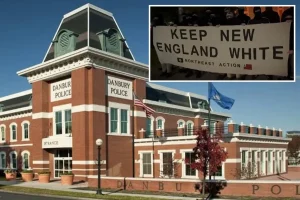





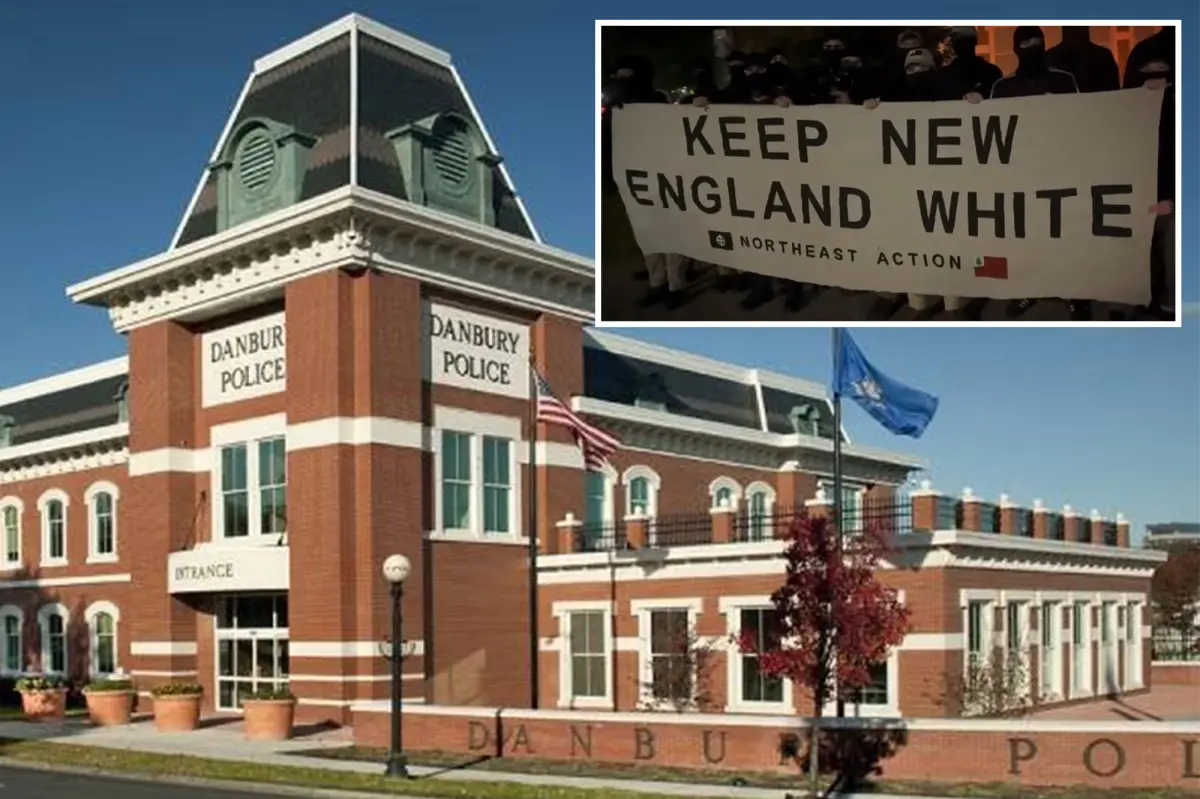
On a Saturday night that should have been quiet, the city of Danbury, Connecticut, found itself the unwilling backdrop for a disturbing display of hate. A small but brazen group of white supremacists gathered outside the Danbury police headquarters, their faces masked, their anger aimed at a local political decision that had nothing to do with violence or crime and everything to do with opportunity and belonging. Video captured from a passing car shows the group holding a large sign that read “Keep New England White” while throwing Nazi salutes in the cold night air. They began a call-and-response chant of “white power,” their voices sharp and ugly, but they were immediately met with resistance: passengers inside the car screamed back at them, refusing to let the hateful words hang unanswered in the night. The footage, shared on Reddit and later confirmed by local news, spread quickly, leaving many residents shocked that such a scene could unfold in their city. The demonstrators carried a banner identifying them as “Northeast Action,” though the group appears to have little to no online presence, making their origins and intentions all the more unsettling. What is clear is that the rally was not random. It was a direct, angry response to Danbury’s recent decision to allow certain noncitizen immigrants, including permanent legal residents and DACA recipients, to become police officers. For the protesters, that decision represented something to be feared. For many in Danbury, it represented something to be proud of — a community choosing inclusion over exclusion, service over suspicion, and hope over hate.
The decision that sparked the protest was made by the Danbury City Council the previous Tuesday. In a vote that carried real civic weight, the council approved a measure allowing permanent legal residents and Deferred Action for Childhood Arrival (DACA) recipients, often called Dreamers, to be hired as members of the Danbury Police Department. This was not a reckless or radical act; it was a thoughtful policy change designed to reflect the community the police serve. Danbury is a city where nearly half the population identifies as Hispanic, a vibrant mix of families, workers, students, and small business owners who have helped shape the city’s identity. Many of these residents were born elsewhere, some came as children, and some have spent most of their lives in Danbury, attending its schools, paying taxes, and contributing to its neighborhoods. To allow them to serve in uniform is to acknowledge that public safety is stronger when officers understand the people they protect. The white supremacist group, however, saw the vote as an outrage. In a screenshot of their apparent Telegram channel, shared by Mayor Roberto Alves, the group railed against Danbury, calling attention to the city’s large Hispanic population and using the inflammatory phrase “many of them illegal” to frame the community as a threat. Their words were not just racist; they were also deeply out of step with the reality of Danbury, a city that has long welcomed immigrants and recognized their contributions. The juxtaposition was stark: one group celebrating diversity and opportunity, another gathering in the dark to chant that diversity itself is a crime.
Danbury’s leaders were quick to respond, and their words carried a clarity and conviction that the demonstrators lacked. Mayor Roberto Alves confirmed the authenticity of the video and shared the group’s Telegram post, not to amplify their message, but to expose it for what it was: a cowardly attempt to intimidate a community that refuses to be intimidated. In a Facebook post, Alves wrote that there is no place for hate, racism, or white supremacy in Danbury. He spoke directly about the city’s identity, noting that it is home to people who came from across the country and around the world. “That diversity is not something that divides us,” he said. “It is part of who we are, and it is one of Danbury’s greatest strengths.” Those words were echoed by Police Chief Patrick Ridenhour, who made it clear that the demonstrators had nothing to do with his department. The chief stated that the officers of the Danbury Police Department do not support or condone the actions of any group that promotes hate or exclusion, and he reaffirmed that the department exists to protect and serve everyone within its jurisdiction. The police department itself said it had been unaware of the protest until after it was over, which meant there were no officers on the scene to engage with the demonstrators. That detail is perhaps telling: the group’s presence was so removed from the real life of the city that even the police — the very target of their protest — did not notice until it had already faded into the night.
What makes this incident so troubling is not just the hateful words and gestures, but the intent behind them. White supremacist groups do not gather to start conversations. They gather to intimidate, to remind people they consider “other” that they are not welcome. They choose locations and moments that they hope will attract attention, using symbols and slogans designed to provoke fear. The decision to stand outside a police station with Nazi salutes and a banner reading “Keep New England White” was a deliberate attempt to inject racial terror into a community that has largely rejected that worldview. But what the group may not have anticipated was the response. The people in the passing car did not stay silent. The mayor did not stay silent. Residents, community leaders, and local officials all spoke out, refusing to let the evening’s ugliness define their city. That reaction is the antidote to hate: not just condemnation, but a public, unapologetic embrace of the values the haters reject. Danbury is not a city that pretends its diversity is invisible. It is a city where immigrants are neighbors, classmates, coworkers, and friends. It is a city where the school system includes children from dozens of countries, where small businesses display signs in multiple languages, where cultural festivals draw crowds of every background. To be told that such a place should be made “white” again is not just offensive; it is absurd. The city’s richness comes precisely from the fact that it is not closed, not homogeneous, not afraid of difference.
Beyond the symbolism, there is also the practical reality of the policy that provoked the protest. Allowing permanent legal residents and DACA recipients to serve as police officers is a meaningful step toward building trust between law enforcement and immigrant communities. For years, a major barrier to public safety has been fear: fear among immigrants that contacting police could lead to deportation, detention, or family separation. That fear makes people reluctant to report crimes, cooperate with investigations, or serve as witnesses. When officers come from the same communities they serve, when they share language, culture, and lived experience, that fear begins to break down. A Dreamer who grew up in Danbury, who studied in its schools and dreamed of a career in public service, now has a path to wear the uniform and protect the city they love. A permanent legal resident who has paid taxes, volunteered in local organizations, and raised a family in the community now has the opportunity to give back in a deeply meaningful way. These are not threats to public safety. They are assets to it. The police department itself recognized this, and the city council’s vote reflected a commitment to the idea that the people who protect a community should look like that community and understand it. The white supremacists who gathered outside the police station saw this policy as a failure. But for those who believe in justice and belonging, it is a sign of progress.
In the end, the image of a dozen masked people shouting “white power” outside a police station in a welcoming city is not a story about the strength of hate, but about the fragility of it. Hate groups are loud because they are small. They are aggressive because they sense that their worldview is fading. They chant “Keep New England White” in a city where the future is already being written by people of every race, language, and faith. They threw Nazi salutes in front of a police department that has declined to support or condone their actions. They came to sow division, and in response, the city came together. Mayor Alves called the diversity of Danbury one of its greatest strengths, and the moment itself proved his point. The protesters were there, but so were the voices against them — from the passengers in the car who shouted over their chants, to the officials who condemned them, to the residents who refused to let fear take root. The group’s name may be “Northeast Action,” but their action accomplished little more than reminding everyone watching that white supremacy still exists, and that it must be confronted wherever it appears. Danbury did not flinch. It did not retreat. It recommitted itself to the belief that everyone belongs, that immigrants are not the enemy, and that the greatest strength of a community is its openness. The hateful signs have been taken down, the chants have faded, and the masks are gone. But the response to that night lingers: a reminder that love of community, not hatred of others, will always have the last word.