






The Alpine Charm Offensive: How European Leaders Mastered the Art of the Transactional G7
The Charm Offensive in the Alps: Europe’s Strategic Realignment at the G7
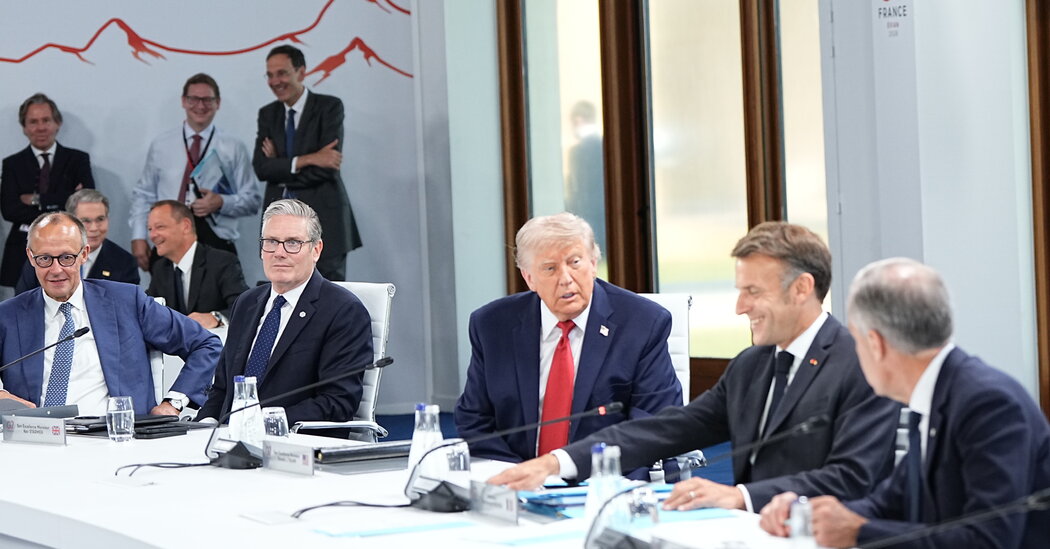
Under the crisp, pristine skies of a French Alpine spa town, the opening session of the Group of 7 summit bore witness to a piece of political theater as meticulously choreographed as it was revealing of the modern geopolitical landscape. When German Chancellor Friedrich Merz stepped forward to present President Donald J. Trump with a custom soccer jersey emblazoned with the number 47, the gesture was immediate in its symbolism—flattering, emollient, and calculated to soothe an notoriously tempestuous relationship. To seasoned onlookers, it was a move ripped directly from the diplomatic playbook of Trump’s previous term, a time when foreign leaders quickly learned that personal flattery was often the most effective currency in Washington. Yet, what made this presentation so remarkable was the dark shadow of recent history looming over the exchange, coming as it did on the heels of a deeply rancorous stretch during which Merz and his continental peers had openly condemned the administration’s aggressive posturing toward Iran, sparking a retaliatory threat from Washington to withdraw thousands of American troops from European soil. Despite these deep, structural fractures, the first full day of the summit made one thing abundantly clear: Europe’s leaders, representing the world’s most advanced industrialized democracies, have chosen to swallow their institutional pride, mask their profound anxieties about the future of the transatlantic alliance, and meet the unpredictable American president with broad smiles, polite handshakes, and a coordinated charm offensive designed to protect their own economic and national security interests in an increasingly volatile world.
The Pivot from Rancor to Pragmatism: Why Europe Cannot Wait Out Washington
This sudden pivot from mutual recrimination to calculated cordiality represents a fundamental and sober realization among European policymakers: the paradigm shift in American foreign policy is not a temporary aberration to be waited out, but rather a permanent structural reality that requires active management. Only weeks ago, such a harmonious gathering would have been deemed virtually impossible, given the bitter continental split over the administration’s hawkish stance toward Iran, the president’s bizarre geopolitical overtures to purchase Greenland, and his relentless, public berating of Europe’s centrist prime ministers and presidents. These escalations had previously pushed several European capitals to the sobering conclusion that the United States could no longer be relied upon as a primary security guarantor, and might even pose an existential threat to the rules-based international order. However, the prevailing view in Brussels, Berlin, and Paris has shifted from indignation to a flinty, survivalist pragmatism, as diplomats recognize that they have no viable alternative to engaging with the world’s largest economy and preeminent military power, particularly as they desperately seek American cooperation on critical regional crises, most notably the grinding conflict in Ukraine. As Jeremy Shapiro of the European Council on Foreign Relations astutely noted, European leaders have privately accepted that the traditional foundations of the transatlantic relationship have shifted irrevocably; without a credible “Plan B,” their only logical path forward is to play nice, soothe executive egos, and attempt to steer the American colossus through personal rapport rather than legalistic agreements.
A Fragile Thaw: The Iran Framework and its Economic Lifeline
The immediate catalyst for this diplomatic detente was the president’s dramatic, eleventh-hour announcement of a tentative peace framework with Tehran on the very eve of the Alpine summit, a move that fundamentally altered the summit’s calculus and handed European economies a potential lifeline. For three agonizing months, European leaders had found themselves trapped in a diplomatic vice, caught between an American president who berated them for failing to support his maximum-pressure campaign and domestic populations that were overwhelmingly opposed to another Middle Eastern conflict and increasingly furious over the soaring energy prices and trade disruptions caused by the crisis. The sudden prospect of a definitive diplomatic settlement, which Ursula von der Leyen, the President of the European Commission, enthusiastically praised as a triumph of transactional diplomacy, promised to reopen the vital shipping lanes of the Strait of Hormuz, drive down global oil prices, and potentially put a verifiable cap on Iran’s nuclear ambitions. By presenting the G7 with a fait accompli that directly addressed Europe’s acute economic vulnerabilities, the American president successfully decoupled his European allies from their theoretical objections to his methods, prompting key leaders like French President Emmanuel Macron and British Prime Minister Keir Starmer to quickly pledge their own naval assets—particularly in critical areas like marine demining—to secure the Gulf waterways once a cease-fire is solidified, thus demonstrating their utility to Washington while eager to reap the stabilizing economic rewards of cheaper crude.
The Versailles Playbook: How Macron Decoded the Trumpian Aesthetic
No leader at the summit demonstrated a more sophisticated understanding of this personalized diplomacy than the host, French President Emmanuel Macron, who revived his proven strategy of treating the American president to grand, historical pageantry by inviting him to a lavish, gilded dinner at the Palace of Versailles to commemorate the 250th anniversary of American independence. This high-stakes dinner, held within the legendary halls of France’s absolute monarchs, was a deliberate echo of Macron’s first-term strategy, when he successfully courted the president with a Bastille Day military parade on the Champs-Élysées, proving that appeals to American national pride and personal grandeur could yield significant diplomatic dividends. By choosing Versailles—a venue saturated with historical weight and literally dripping with the gold leaf that matches the American president’s well-known architectural aesthetic—Macron bypassed traditional bureaucratic channels to build a direct, personal channel of communication that appealed directly to his guest’s appreciation for power, scale, and tangible luxury. The strategy hit its mark perfectly, with the president visibly charmed by the opulence of the French state dinner, marvelling to reporters that Versailles was “the real deal” and praising Macron as a “very nice man,” demonstrating once again that in the current era of personalized geopolitics, the aesthetic of power can be just as influential as the substance of policy when negotiating with a leader who views the world through a transactional lens.
Cold Realism on Kiev: The Persistent Limits of Transatlantic Influence
Yet, beneath the glittering chandeliers of Versailles and the polite smiles of the official G7 family photo, the limits of this charm offensive remained starkly visible, particularly regarding the existential security challenge of the war in Ukraine. Despite the warmth of the public exchanges, there was absolutely no indication that the European leaders had succeeded in shifting the president’s deeply entrenched skepticism toward American involvement in European security, as he flatly reiterated to reporters his long-standing view that the conflict in Ukraine is fundamentally a European problem rather than an American one. The president’s transactional worldview was on full display as he characterized the U.S. role in the conflict as merely that of a lucrative arms supplier, pointing out that the U.S. is thousands of miles away and suffers no direct impact, a stance that stands in stark, chilling contrast to the existential dread felt in Berlin, Warsaw, and Paris. This underlying tension was further mirrored in the subtle diplomatic choreography of the summit, where the president pointedly bypassed a formal one-on-one meeting with British Prime Minister Keir Starmer, while simultaneously lavishing warmth, praise, and private diplomatic attention on the leaders of the United Arab Emirates and Qatar, whom he publicly thanked for their support in the Iran crisis while celebrating their multi-billion-dollar investments in the American economy.
The Art of the Persian Deal: Trump’s Unilateralism and the Future of Global Security
As the summit drew to a close, the president fiercely defended the enigmatic details of his unilateral Iran agreement, using his platform to shape the global narrative while warning Tehran of catastrophic retribution should they deviate from the agreed path. Dismissing widespread media reports that Washington had promised a staggering $300 billion financial package to Iran, the president declared that the United States had assumed zero financial obligations, framing the pact purely as a security-oriented triumph that permanently blocks Iran’s path to a nuclear weapon—a long-declared Iranian position that the president has now codified under threat of “unbelievable consequences” if violated. Ultimately, the G7 gathering in France served as a stark preview of a new era of global governance, one in which traditional alliances are depreciated in favor of highly transactional, bilateral deals driven by executive strength and personal rapport. While European leaders may have succeeded in maintaining a veneer of unity and preventing the summit from collapsing into open hostility, the reality remains that the geopolitical tectonic plates have shifted, leaving Europe to navigate an increasingly volatile world where survival requires mastering the delicate art of the charm offensive while quietly preparing for a future where they must carry their own security burdens.