






The Southern Sierra Nevada mountains of California have long stood as a breathtaking testament to the sheer majesty of the American wilderness, attracting millions of visitors each year who seek to immerse themselves in the quiet solitude of nature, hike through ancient forests, and marvel at the raw, dramatic beauty of the landscape. Traversing this rugged terrain is the iconic, fast-flowing Kern River, an aquatic artery that has carved stunning canyons and valleys over millennia, drawing whitewater enthusiasts, families, and solo adventurers to its banks to enjoy its cool waters and picturesque scenery. Yet, the river’s enchanting splendor hides a deceptive and ferocious power, turning what was meant to be a peaceful day of outdoor recreation into a sudden, heart-stopping struggle for survival for one unsuspected visitor. Without warning, a woman slipped and fell directly into the raging rapids, her immediate surroundings transforming from a tranquil sanctuary into an overwhelming vortex of churning, ice-cold water that instantly claimed her agency. The shock of hitting the water was immediate and agonizing, as the river’s immense volume, fueled by mountain runoff, seized her body and swept her downstream at a terrifying velocity. In those first chaotic moments, the human instinct for survival ran headfirst into the merciless physics of nature, as she was tossed and spun through the white foam, unable to find a foothold or fight against the relentless momentum. Those watching from the shore could only look on in absolute horror as the fast-moving current carried her further away, highlighting just how quickly an ordinary afternoon can descend into a life-and-death emergency when one is caught in the grip of a wild river. The terrifying speed of the transformation from a casual hiker to a helpless victim of a natural disaster underscores the fragile relationship between humanity and the untamed wilderness. This tragic potential is a constant reality. We must permanently remain fully aware that our modern comforts cannot easily shield us humans from the massive primordial power of these swift, churning mountain waterways.
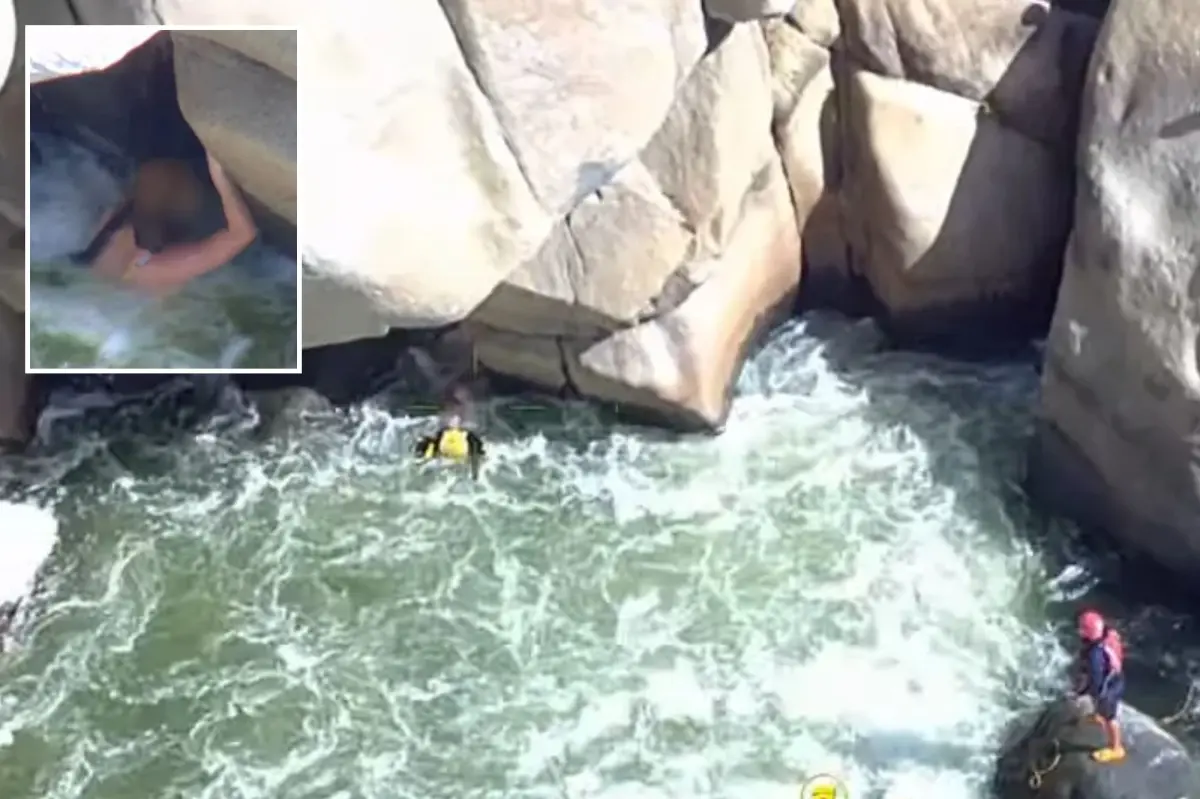
As the current battered her body against submerged rocks and threatened to pull her under, the woman’s fight for life became a testament to the extraordinary resilience of the human spirit when faced with imminent mortality. Miraculously, amidst the roaring chaos and blinding spray of the rapids, she was swept toward the base of a towering, steep cliff where a large rock outcropping offered a fleeting chance at survival. Summoning every ounce of her remaining physical strength, she managed to grab hold of the underside of the massive rock, desperately clinging to its rough, wet surface while her body remained partially submerged in the bone-chilling, swift-moving water. Clinging to that slippery stone became her entire world, a singular, intensely focused struggle where a single slip of her hands would mean being swept back into the deadly main channel of the river. The water surrounding her was incredibly cold, a product of fresh mountain snowmelt designed to slowly drain her energy, trigger muscle fatigue, and induce hypothermia within mere minutes. Every second she spent holding onto that rock was an agonizing trial of physical endurance and mental fortitude, as the freezing temperatures of the waters seeped deep into her limbs, threatening to numb her fingers and break her resolve. She was trapped in a highly precarious position, suspended between a vertical stone cliff that was impossible to climb and a raging torrent that she knew would likely kill her if she let go. In this state of suspended terror, she could do nothing but hold on with a desperate, white-knuckled grip, hoping that rescue was on the way before her frozen muscles finally gave out and forced her to let go. To lose focus for even a brief fraction of a second would mean conceding defeat to the river, a grim reality that kept her survival instincts firing on all cylinders despite the overwhelming exhaustion and paralyzing cold that continuously threatened to completely numb her physical senses and break her fragile earthly hold on survival.
Fortunately her desperate plight had not gone unnoticed, and the emergency response system swung into action with incredible speed and coordination. Recognizing the high-stakes nature of a dangerous swift-water rescue in such rugged terrain, emergency dispatchers immediately deployed the Kern County Sheriff’s Office Air Support Unit, a dedicated team of highly trained professionals who regularly risk their lives to save others in the county’s most dangerous landscapes. From high above, the roar of the helicopter’s rotors began to echo through the deep canyon, a sound that surely brought a wave of profound hope to the exhausted woman clinging to the rock far below. Locating a single human being in the middle of a roaring, foaming river corridor is an incredibly difficult task, requiring sharp eyes, specialized equipment, and calculated navigation through turbulent mountain air currents. As the aircrew hovered over the treacherous canyon walls, they spotted her small figure huddled against the sheer cliffside, partially submerged and enveloped by the white water. The dramatic footage captured by the helicopter’s onboard cameras revealed the immense scale of the challenge: a steep vertical cliff looming overhead, a roaring river below, and a fragile human life hanging in the balance at the center of it all. The helicopter crew had to maintain an incredibly precise hover in the narrow canyon, navigating the unforgiving wind shears and the constant spray from the river to position themselves safely for a rescue. It was a masterclass in aerial precision and tactical execution, demonstrating the deep commitment and bravery of the search and rescue teams who serve as a safety net for those lost or trapped in the county’s vast wilderness. Their rapid mobilization and steady nerves in the face of such extreme environmental hazards highlight why these elite first responders are so vital to the community. Without their fast intervention, the outcome could have been drastically different, illustrating how critical prepared emergency personnel are when natural beauty suddenly becomes extremely dangerous for those who are seeking outdoor recreation nearby.
With the helicopter stabilized in the sky above, the rescue team initiated a carefully coordinated tactical plan to extract the woman from her perilous position without putting additional lives at risk. Because of the extreme turbulence of the water and the vertical orientation of the cliff, a direct physical extraction by a swimmer was exceptionally dangerous, prompting the crew to utilize specialized flotation and retrieval equipment. Leaning out of the aircraft, rescuers first managed to toss a bright orange life jacket down to the freezing woman, providing her with immediate buoyancy and a vital psychological boost in her darkest hour. Following the life jacket, the crew carefully lowered a specialized flotation device attached to a high-strength rescue rope, aiming it precisely so that she could reach it without losing her grip on the rock. In a moment of supreme tension captured vividly on camera, the woman had to let go of her life-saving rock for a fraction of a second to grab hold of the rescue line, a leap of faith that required immense courage. Thankfully, she successfully seized the flotation device and clung to it with the last remnants of her fading strength as the rescue team began the delicate process of pulling her clear of the raging rapids. The rope served as a physical and symbolic lifeline, bridging the gap between certain death and survival as she was carefully guided through the turbulent water toward safe ground. Watching her emerge from the white foam of the river, cradled by the rescue gear, was a deeply emotional moment that highlighted the triumph of human ingenuity, teamwork, and courage over the indifferent brutality of the natural world. This triumphant demonstration of skill not only saved a physical life but also reinforced the powerful social contract of rescue and care that binds humanity together in times of crisis. Their ability to coordinate such a dangerous effort exemplifies the height of selfless public service, turning an almost guaranteed tragedy into a verified miracle of survival today.
Once pulled from the freezing waters of the Kern River, the unidentified woman was immediately transferred to the care of waiting emergency medical personnel on the shore, who were prepared to address the physical trauma of her ordeal. The physiological toll of spending prolonged periods in snowmelt-driven water is severe; hypothermia can set in rapidly, causing shivering, confusion, heart strain, and a loss of motor control, while the physical trauma of being battered against river rocks can leave deep bruises, cuts, and internal injuries. Medical teams immediately wrapped her in warm blankets, initiated thermal recovery protocols to slowly raise her core body temperature, and conducted a thorough evaluation of her physical condition to ensure she had suffered no life-threatening trauma during her terrifying journey downstream. While her physical wounds would begin the healing process, the psychological impact of such a near-death experience is often much more profound, leaving a lasting imprint on the mind of the survivor that can take months or even years to fully process. The anonymity of this survivor serves as a powerful reminder of our shared human vulnerability; she can be anyone to those who love her, reminding us that nature does not discriminate when it asserts its dominance. In the aftermath of the event, the rescue team itself took a moment to reflect on the successful outcome, expressing deep relief that their training, readiness, and bravery had successfully translated into a life saved. This successful rescue is a testament to the seamless cooperation between airborne rescuers, ground medical crews, and local emergency services, who stand ready to answer the call when tragedy strikes. Through their actions, a life was preserved, allowing this survivor the chance to return home to her loved ones after an experience that easily could have claimed her future. The profound relief shared by her family, her friends, and the wider community is immeasurable, validating the tireless hours of rigorous preparation these emergency workers undergo to face the unpredictable, chaotic challenges of backcountry medical rescues.
Following the dramatic rescue, the Kern County Sheriff’s Office issued a stern and highly compassionate warning to the public, reminding visitors of the extreme hazards associated with the Kern River, which is affectionately but soberingly nicknamed the “Killer Kern” by locals due to its high historical frequency of drownings. The river is incredibly dangerous even for the most experienced and athletic swimmers, as its fast-moving currents, freezing temperatures, and hidden underwater hazards like rocks, logs, and debris create a trap that can overwhelm a human body in a matter of seconds. During seasons of heavy mountain snowmelt, the river’s volume swells dramatically, turning what looks like a beautiful water feature into a hydraulic machine that can easily trap swimmers beneath the surface and hold them down against their will. Officials urge everyone visiting the area to treat the river with the utmost respect, planning their trips with safety as the primary goal and, crucially, always wearing a coast-guard-approved life jacket when anywhere near or in the water. A simple life jacket can mean the difference between a minor slip and a fatal drowning, providing the necessary buoyancy to keep a person’s head above water until rescuers can arrive. Nature offers us incredible beauty, solace, and recreation, but it also demands a profound humility and preparation from those who choose to step into its domain. Ultimately, this woman’s miraculous survival stands as a powerful reminder of both the fragility of human life in the wild and the incredible heights of human bravery that emerge when we work together to protect one another from the elements. As we continue to seek adventure in California’s gorgeous wilderness, let this extraordinary event stand as a vital guide on how to safely appreciate the majestic world around us while cherishing the fragile gift of life. Let us respect the wild, prepare diligently for its unpredictable challenges, and never assume that we are stronger than the great, primeval forces of nature that have beautifully shaped our planet’s magnificent terrain.