






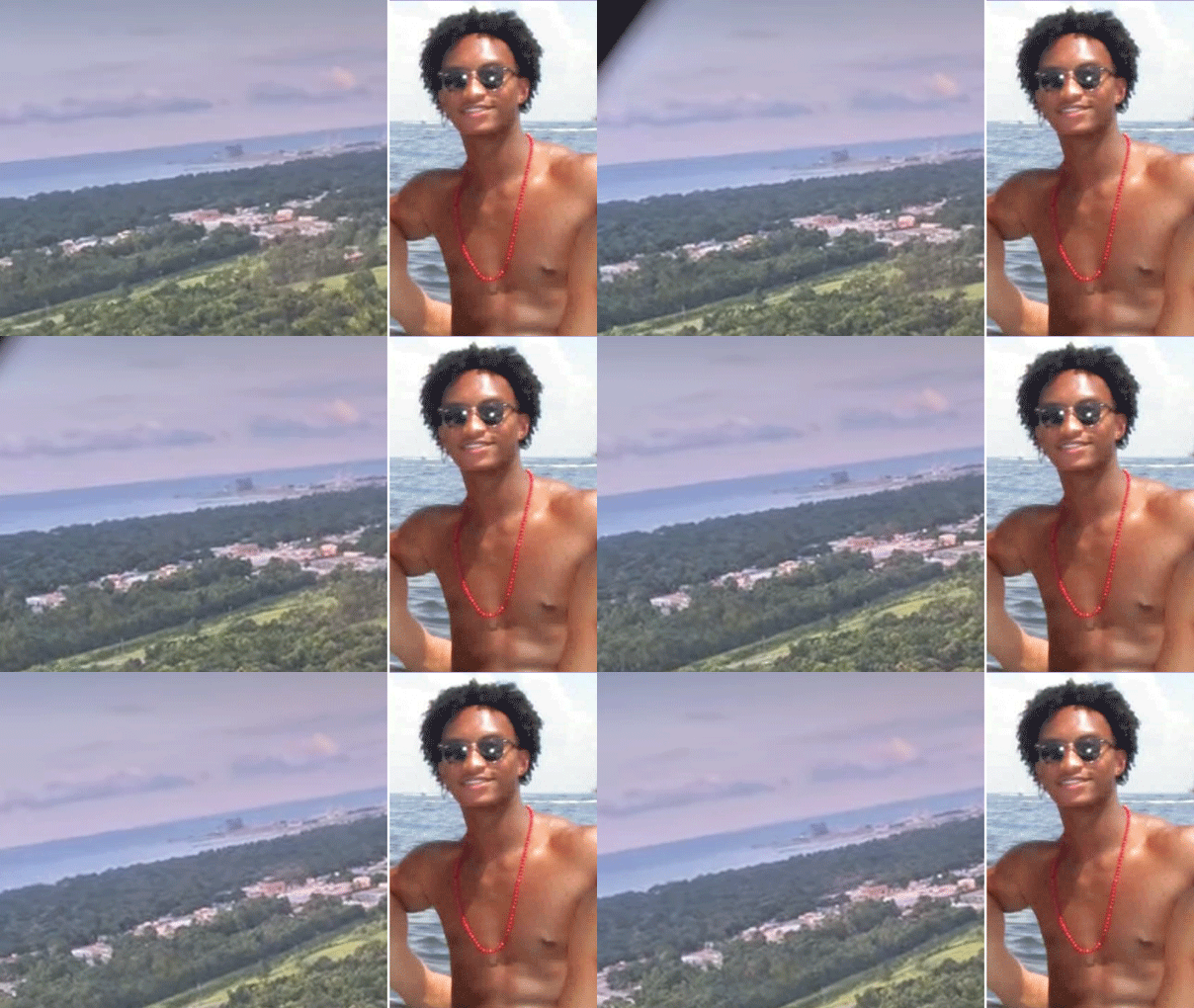
The summer after graduating high school is traditionally a time of boundless optimism, a golden threshold where childhood friendships are celebrated one last time before the adventures of university life begin. For eighteen year old Nolan Wells, an eager and bright incoming freshman at the University of Mississippi, which is affectionately known as Ole Miss, this transition was supposed to be marked by laughter, sunshine, and the gentle lapping of the Gulf Coast waves. Hailing from Jackson, Mississippi, Nolan was a young man whose future stretched out before him like the open southern horizon, a beloved son and friend whose warmth left an indelible impact on everyone fortunate enough to cross his path. However, what was meant to be a joyous holiday weekend with close friends on the picturesque shores of Horn Island quickly disintegrated into an unimaginable nightmare that has left a family shattered and a community searching for answers. Horn Island, a secluded and beautiful strip of wilderness off the Mississippi coast, became the backdrop for a sudden and terrifying disappearance that mobilized multiple rescue agencies in a desperate race against the clock. For days, the anxiety was palpable as the search stretched across the water, with loved ones clinging to the desperate hope that Nolan would be found safe, perhaps disoriented but ultimately unharmed on the sandy expanses. Tragically, those hopes were permanently extinguished on July sixth, when rescue teams recovered his lifeless body from the water, turning a frantic rescue mission into a solemn recovery effort. The sudden loss of a young person on the cusp of adulthood is a grief of the profoundest order, a heavy and suffocating silence that settled over Jackson and the wider state as the reality of Nolan’s passing began to sink in, leaving behind a devastating void that no passage of time can ever truly fill for those who loved him and cherished his beautiful soul. He was a boy who left deep memories in the hearts of everyone who knew him so well.
In the painful aftermath of such a devastating loss, the arrival of new and unexpected information can often reopen healing wounds, especially when it introduces bureaucratic coldness into an intensely personal tragedy. Recently obtained documents have cast a raw and complicated light on the critical hours when search and rescue teams were scanning the Gulf waters for any sign of the missing teenager. A newly revealed email dated July fifth, sent by the Mississippi Department of Marine Resources Marine Patrol to the United States Coast Guard during the active search, contained a stark and troubling note regarding Nolan’s state prior to his disappearance. Alongside standard physical descriptions, clothing markers, and his last known geographic coordinates on Horn Island, the official communication explicitly characterized the young man’s alcohol intake prior to vanishing as heavy. For a grieving family still grappling with the sheer physical shock of their son’s absence, seeing such a clinical, potentially damaging label applied to their boy in official correspondence is a deeply painful experience that risks shifting the public narrative from one of profound tragedy to one of reckless behavior. Crucially, the email fails to disclose the source of this highly specific information, leaving it entirely unclear whether the detail was gleaned from bystander interviews, hearsay among peers, or merely administrative assumption during the chaotic early hours of the multi agency emergency response. This unsubstantiated detail has added a layer of frustration and confusion to an already agonizing situation, highlighting how quickly the identity of a vibrant young human being can be reduced to detached, speculative bullet points on an official agency checklist while his family is left to defend his memory in the absence of definitive medical proof or contextual clarity. In their eyes, he was not a statistic or a reckless youth, but a cherished person whose integrity was compromised during a time of ultimate vulnerability, leaving those who loved him with an even heavier weight of sorrow to carry as they seek the truth of that fateful day.
When the immediate shock of a sudden death begins to crystallize into the long and grueling search for systemic truth, families often find themselves forced into the role of active investigators to ensure their loved one’s story is not quietly swept aside. Faced with agonizing delays from official state entities, Nolan’s family made the difficult decision to take matters into their own hands, securing the legal representation of renowned civil rights attorney Ben Crump to help navigate the complex, often opaque waters of the institutional death investigation system. Recognizing that waiting passively for government bureaucracy to move can be an agonizing process, the family also commissioned an independent, private autopsy to look for clues that might otherwise be overlooked or underreported. This private postmortem examination was conducted by Doctor Roger Mitchell, a highly respected former medical examiner who brought decades of forensic expertise to a case that was rapidly capturing national attention. During a highly charged and emotional press conference held on July twenty second, Crump spoke alongside the family, delivering the preliminary findings of this independent review to a public increasingly eager for clarity. The private autopsy ultimately concluded that both the exact cause and the definitive manner of Nolan’s death remained officially undetermined pending further investigation, a frustratingly clinical phrase that offered no immediate comfort or resolution to a mother and father desperate to know exactly how his son spent his final moments on earth. This inconclusive result did not mean there was nothing to find; rather, it underscored the immense difficulty of piecing together a narrative from a body reclaimed by the sea, leaving the family in a painful state of suspension where they must continue to advocate for their son while waiting for the official state toxicology and autopsy reports to be finalized by state medical examination experts. They are determined to prevent the system from reducing Nolan to another cold case, ensuring that his life is treated with the maximum degree of respect and professional detail standard during forensic investigations.
The clinical findings revealed during the independent autopsy, while legally inconclusive, introduced a series of baffling physical details that have only served to deepen the mystery and heighten the family’s anxieties about what truly transpired on that island. Doctor Mitchell’s physical examination of Nolan’s body revealed a localized area of red discoloration situated on the back of the young man’s head, a physical mark that immediately raised red flags for forensic investigators and commentators alike. On her national television program, seasoned legal analyst and investigative host Nancy Grace dedicated significant airtime to dissecting this specific finding, drawing public attention to the presence of deep, red, subcutaneous tissue directly beneath the skin at the back of Nolan’s skull. Grace, known for her sharp analytical eye in criminal matters, pointed out that this localized discoloration appeared distinct from the typical, widespread pooling of blood that naturally occurs throughout a body postmortem, suggesting instead the possibility of localized trauma or impact prior to or around the time of death. Adding a further layer of bewilderment to an already complex medical puzzle, Grace revealed a startling administrative discrepancy: the independent pathologist did not receive Nolan’s lungs or throat tissue when the state transferred his remains for the second autopsy, an omission that placed significant limitations on Doctor Mitchell’s ability to thoroughly evaluate classic signs of drowning or asphyxiation. While Grace was careful to emphasize that she could not draw definitive conclusions and that numerous accidental possibilities remained entirely plausible, these missing biological pieces and localized physical marks have cast a long shadow of doubt over the physical circumstances of Nolan’s final hours. For the grieving family, these details feel like massive gaps in the narrative, preventing them from achieving the closure they so desperately need while leaving them to wonder if key elements of the investigation were handled with appropriate professional care. Indeed, navigating these inconsistencies only redoubles their agony, forcing them to confront the chilling possibility that they may never obtain a complete picture of his demise.
As public scrutiny intensified and media outlets began to actively dissect the irregularities surrounding the investigation, local authorities found themselves under mounting pressure to justify their methods and protect the integrity of their ongoing inquiry. In response to the growing wave of public skepticism and national media attention, the Jackson County District Attorney took the step of publicly defending the state’s handling of the case, urging the anxious community and the media to exercise patience while the official processes ran their course. The District Attorney emphasized that law enforcement agencies and medical examiners are strictly bound by standard forensic protocols that cannot and should not be rushed to satisfy the immediate demands of a hungry twenty four hour news cycle. According to local officials, making premature declarations regarding foul play or accidental death before the Mississippi State Medical Examiner’s Office releases its final autopsy and comprehensive toxicology results would be highly irresponsible and could potentially jeopardize any future legal proceedings should criminal charges eventually be warranted. Despite these official reassurances, the tension between the slow, methodical pace of institutional science and the urgent, human demand for justice remains deeply strained, as weeks turn into months without a definitive answer. For the public watching from afar, and especially for those who knew Nolan personally, the silence from official channels feels less like academic caution and more like an agonizing delay that stalls the healing process, leaving a community suspended in a state of collective unease as they wonder whether the systems designed to protect and serve are capable of delivering a transparent and truthful accounting of a young life cut tragically short. This ongoing standoff between administrative protocol and raw human emotion highlights the systemic divide that often occurs in high profile cases where the public’s thirst for answers collides directly with bureaucratic processes. Consequently, the community remains in a protective watch, refusing to allow Nolan’s light to be snuffed out by clinical silence or by the standard, indifferent passage of time as they patiently wait.
Behind the legal maneuvers, the forensic debates, the clinical autopsy reports, and the sensationalized television segments lies the inescapable, deeply human truth that a family is grieving the loss of a boy who represented their hopes, their dreams, and their future. Nolan Wells was not merely a subject of a coastal search, a name on a heavily scrutinized Marine Patrol email, or a collection of medical anomalies discussed by television pundits; he was a young man who deserved to experience the independence of college life, to walk the beautiful campus of Ole Miss, and to grow old surrounded by the love of his family and friends. To humanize Nolan is to remember the sound of his laughter, the promise in his eyes as he looked forward to his freshman year, and the profound emptiness that now occupies his bedroom back home in Jackson. As his loved ones navigate this unbearable landscape of grief, they are forced to carry the double burden of mourning their son while fighting a relentless battle for basic clarity and systemic accountability. The ultimate resolution of this case will not bring Nolan back, nor will it erase the pain of that devastating July weekend on Horn Island, but a thoroughly honest and transparent investigation is the bare minimum that a civilized society owes to a grieving family and a lost young soul. In the quiet moments away from the cameras and the courtrooms, the hope remains that the truth of what happened to Nolan Wells will finally come to light, providing his family with the peace of understanding, honoring his memory with the dignity he so richly deserves, and ensuring that his name is remembered not for the mystery of his death, but for the beauty and light of the life he lived, a life that touched so many hearts and will continue to inspire those left behind. His story serves as a reminder of the preciousness of youth and the eternal bond of family love which never fades.