




The discovery sliced through the stillness of the high desert like a raw wound, turning an ordinary patch of Lancaster into a sprawling crime scene and leaving an entire community holding its breath. In a city where the Mojave sun beats down on wide, empty streets and the silence can feel almost permanent, the sudden swarm of helicopters, deputies, and forensic teams was impossible to ignore. The Los Angeles County Sheriff’s Department confirmed Tuesday that human remains belonging to two people had been found, and that the circumstances surrounding their deaths were grim enough to warrant a full homicide investigation. The location—near 50th Street East and Avenue F—was just a short distance from where 61-year-old Ricky Allen Phillips had vanished two weeks earlier, a coincidence that hung in the air like a question no one dared to ask out loud. Yet authorities were careful, almost painfully careful, not to link the two. They did not say the remains belonged to Phillips. They did not say his disappearance was related. But for those watching from behind the yellow tape, the mind naturally wandered to the worst possibilities. The victims, whose identities were withheld, were not just case numbers or evidence markers. They were someone’s family member, someone’s friend, someone who had a life full of ordinary moments—morning coffee, a phone call, a hope for tomorrow. Now their remains were being pulled from the earth, and the desert that had kept their secret for however long was being forced to give it back.
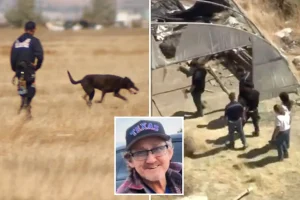
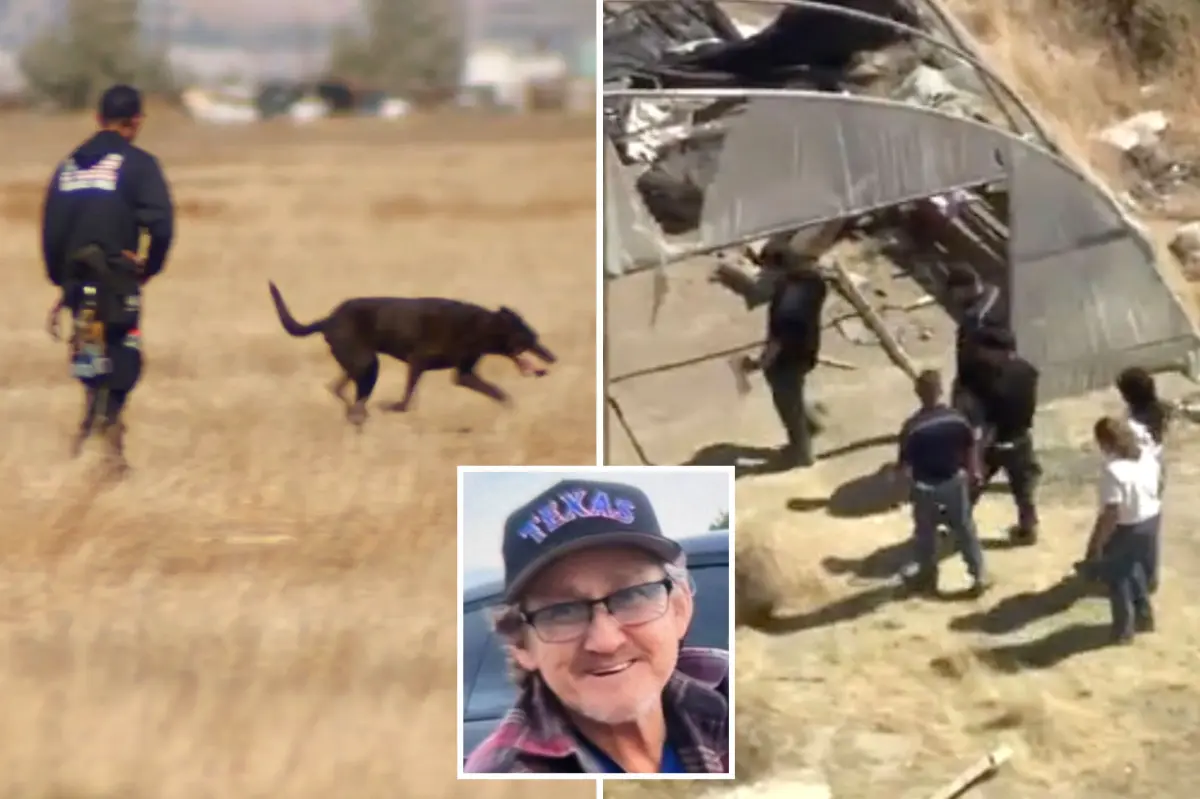
The scene itself was a study in grim, methodical labor. Aerial footage showed investigators digging into the sandy ground, their shovels moving with deliberate care as evidence markers dotted the property like small flags planted in a battlefield of sorrow. The land was cluttered with debris, old RVs that had long since surrendered to the elements, and what appeared to be the skeletal remains of a greenhouse—a place that might once have held life and growth, now reduced to a backdrop for death and investigation. A canopy had been erected, and under its shade, investigators collected photographs and other apparent evidence, each object a potential thread in a tangled story. Witnesses reported seeing cadaver dogs working the area, their noses trained to find the scent of human decomposition, a skill that is both extraordinary and heartbreaking. The hole dug by investigators was large enough to make the gravity of the moment undeniable. Every shovelful of dirt was a step closer to the truth, but also a reminder that behind the forensic procedures were two lives that had ended violently. For the residents of this remote corner of Lancaster, the spectacle was surreal. This was not the kind of place where such things were supposed to happen. Yet there it was, unfolding in the daylight, with neighbors standing on porches and watching from a distance, trying to make sense of a scene that made no sense at all. The debris and decay suggested a property that had been neglected for years, perhaps a haven for transients or a hoarder’s sanctuary. Now it was the focus of a homicide investigation, and the questions were multiplying faster than the evidence markers.
The official response from the sheriff’s office was concise, measured, and chilling. “Based on the circumstances surrounding the discovery, the case is now being investigated as a homicide,” the statement read. “Homicide investigators are in the early stages of investigating the scene.” That was it. No names. No cause of death. No timeline. No answer to the most obvious question: who were these two people, and how did they end up here? Officials said they were withholding the identities of the dead and details surrounding their deaths “to protect the integrity of the ongoing investigation.” It is a standard phrase, repeated in countless cases, but one that carries real weight. It means that somewhere in this mess of debris and desert dust, there is a puzzle being assembled piece by piece, and the investigators are holding their cards close. It means that someone’s family may not yet know, or may be waiting in agonizing suspense. It means that the public is being given just enough information to be concerned, but not enough to understand. The lack of detail can feel frustrating, even cold, but it is also a sign that the investigation is being taken seriously. Homicide detectives are not impulsive; they are methodical. They know that every word released too early can compromise a case, every assumption can lead down the wrong path. And so they dug, and sifted, and photographed, and waited, letting the evidence speak before anyone else did. For the community, the silence from law enforcement only amplified the tension. What did the circumstances involve? Was this a single incident or two separate deaths? Had the remains been there for days, weeks, months? The questions swirled, but the answers were locked behind a wall of professional caution.
Amid this storm of uncertainty, the name Ricky Allen Phillips has become another layer of heartbreak. The 61-year-old man was last seen on Sunday, August 30, 2026, on the 44900 block of 10th Street W in Lancaster, according to a missing-person bulletin from the sheriff’s department. He was classified as an “at-risk missing person,” a designation that suggests his disappearance was out of character and his family was deeply frightened. They described him as 5 feet 7 inches tall, weighing 230 pounds, with black hair and green eyes. For two weeks, his family had been waiting, searching, fearing. They had probably posted flyers, made phone calls, and spent sleepless nights staring at the ceiling. Then the news of a discovery just blocks away arrived like a punch to the gut. The proximity was impossible to ignore, and yet authorities were careful not to suggest a connection. No indication, they said, that Phillips was one of the people found. No public evidence tying his disappearance to the homicide investigation. In some ways, that ambiguity might offer a sliver of hope—maybe he was still out there somewhere. But hope and grief are strange companions, and in the absence of information, the mind tends to fill in the blanks with the darkest possibilities. For Phillips’s family, every hour that passes is a struggle between wanting answers and dreading what those answers might be. They are not alone in that feeling. The victims in the desert each had their own circle of people who are now caught in the same awful limbo. They may not be identified publicly yet, but somewhere, there are people who love them, who are waiting by a phone, who are dreading a knock on the door. The investigation is not just about evidence and legal proceedings; it is about bringing them clarity, even if that clarity comes in the form of devastating news.
In Lancaster, a city often overlooked in the shadow of Los Angeles, the discovery has reverberated through everyday life. The high desert can feel removed from the chaos of the city, a place of quiet sunsets and open skies. But that quiet can also hide things. The property at the center of the investigation was described as cluttered and neglected, with RVs and debris scattered across the land. It is the kind of place that might have gone unnoticed by most people, a forgotten pocket of a forgotten stretch of desert. Now it has become the center of a dark and complex story. Residents are left to wonder not only what happened, but who else might have known. Was the property frequented by others? Did anyone hear or see something unusual? The investigation is in its early stages, and detectives will likely spend weeks combing through the scene, interviewing witnesses, and trying to establish a timeline. Autopsies will be performed, evidence will be analyzed, and records will be checked. It is a slow, deliberate process, and it can be agonizing for a community that wants immediate answers. But justice rarely moves quickly. In the meantime, the presence of cadaver dogs and forensic teams has sparked conversations among neighbors, some of whom may have information without realizing it. The sheriff’s department will likely appeal for tips, reminding the public that even the smallest detail can be significant. For now, the focus remains on the two people whose lives were cut short and the circumstances that led them to this lonely patch of desert. They deserve more than to be a headline or a statistic. They deserve the truth to be uncovered, and they deserve to be remembered as human beings, not just remains.
Ultimately, this case is a reminder that behind every crime scene are people—not just the victims, but also the families who mourn them, the investigators who seek justice for them, and the communities that are shaken by their loss. The discovery in Lancaster is still wrapped in mystery. The identities of the two deceased have not been released, and the details of their deaths remain locked in the minds of detectives. The connection, if any, to Ricky Allen Phillips is unknown, and authorities have made it clear that it would be premature to draw conclusions. What is known is that two people died, and someone—or something—is responsible. What is also known is that an entire community is watching, waiting, and hoping that the truth will emerge from the desert dust. For the families involved, there can be no closure without answers. For the investigators, there can be no justice without evidence. And for all of us, there can be no understanding without patience. The human heart can only bear so much uncertainty, but it is often the only thing that gets us through. As the investigation unfolds, the public can play a role by remaining aware, sharing tips, and keeping the victims and their families in their thoughts. The desert may keep its secrets for a while longer, but with every shovelful of earth, with every piece of evidence, with every careful step forward, the truth is slowly being brought into the light. And when it finally is, perhaps the people of Lancaster—and all of us—will find a way to honor those whose lives were taken, to support those who are left behind, and to remember that even in the loneliest corners of the world, no one should become invisible.