





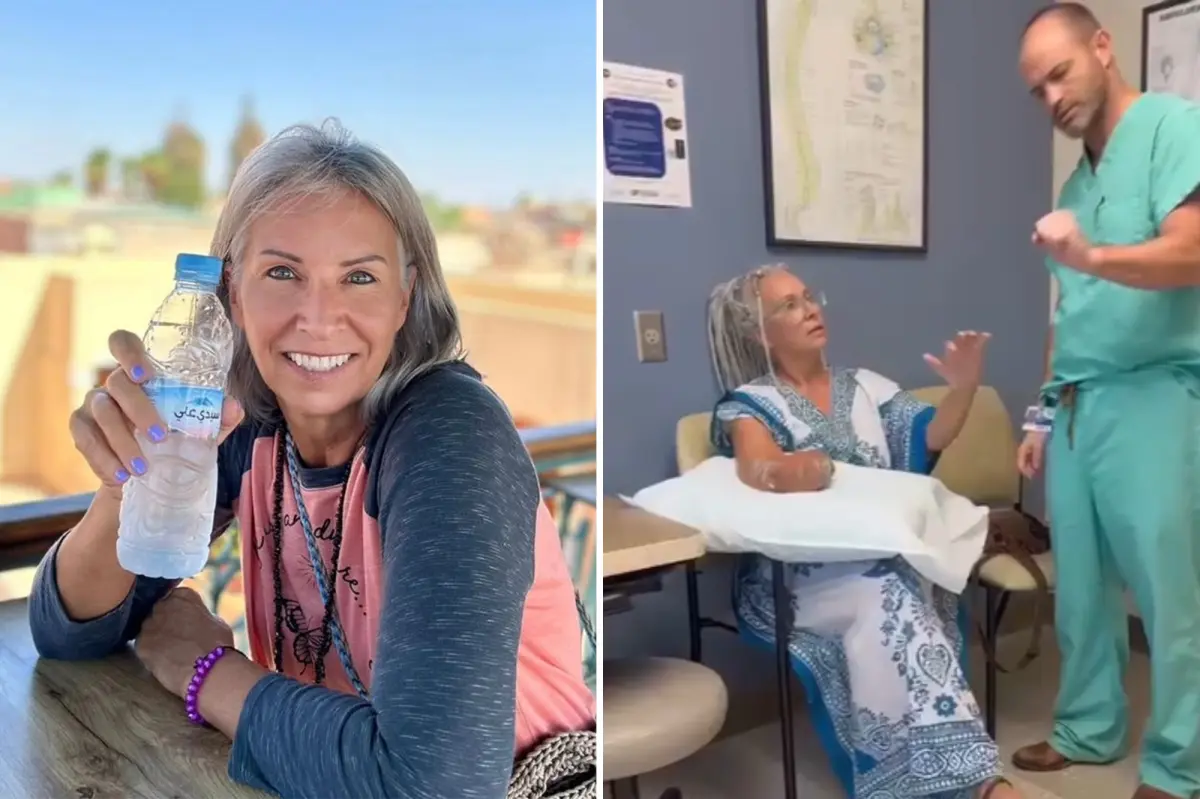
On a warm August afternoon, what began as a relaxed family boating trip along Florida’s Silver River turned into a sudden and violent fight for survival. Dina Spann, 58, a retired mother from Florida, had been floating in the water with relatives when an alligator attacked without warning. The vicious encounter, near Marion County’s famous spring-fed river, left her with devastating injuries to her right arm and left hand. In the days that followed, as she lay in a hospital bed, Spann refused to let fear or anger define the story. Instead, she shared a simple, powerful message with the world: “The gator got a piece of me. It didn’t get the best of me.” That sentence, posted alongside a video of her wounds being treated, captured the mix of raw honesty and quiet strength that has made her an inspiration to people far beyond Florida. It also served as a reminder that wildlife can be unpredictable and dangerous, even in beloved natural spaces. The attack on Aug. 8 was sudden and brutal, leaving her with medical challenges that will require long months of healing and rehabilitation. Yet Spann’s tone has not been one of despair. She has focused on gratitude, on the strangers who saved her, on the medical team caring for her, and on the family who never left her side. In an age when misfortune often becomes a spectacle, her account offers something more profound: ordinary courage. The image she shared was not glamorous or sanitized. It showed a woman in a hospital gown, bandaged and bruised, but alive and determined. That rawness is what resonated with so many people. She did not hide the difficult parts. She showed them, and through that vulnerability, she became a voice of resilience. As her story spread, readers learned that Spann’s injuries were even more severe than they first appeared. Her right arm was amputated below the elbow, and she lost half of the ring finger on her left hand. The road ahead will be long, but if her earliest statements are any indication, she will walk it with grace and humor.
The video Spann posted on social media last Friday gave a closer look at the wounds she now carries. In the footage, she is seen in a hospital setting, her right arm heavily bandaged as a medical professional carefully tends to the injury. It is not an easy image to watch. But it is her spirit that stays with the viewer. “Recovery isn’t always pretty,” she wrote, “but I’m learning to laugh through the hard parts and celebrate every little victory.” Those words turned a moment of pain into a lesson for anyone going through hardship. Her son, Zach Guerrina, had earlier given a more graphic account of the attack, describing how his mother’s arm was left “hanging by a thread” after the alligator latched on. According to Guerrina, Spann did not freeze in terror. She fought back with her bare hands, even losing part of her left ring finger while trying to pry herself free. She tried to hold the creature’s mouth shut and fought to reach the surface for air, worried the alligator would drag her down or go for her legs. “She wasn’t just letting it happen,” he said. “She was trying to make sure it didn’t get to her legs.” That determination, family and friends say, is exactly who Spann is. She has always been the calmest person in a crisis, the one who takes charge while others panic. The attack tested every ounce of that composure, and somehow she held onto it. The physical scars are severe, but the emotional aftermath could have been just as devastating. Instead, Spann seems determined to focus on what she gained rather than what she lost. Her social media posts have become a kind of diary, chronicling small progress and reminding herself that every healing step matters. Each day brings a new challenge: learning to adjust, managing pain, and accepting help. But as her son said, she remains “calm as a cucumber” even when the moment is terrifying. That ability to find peace in chaos is what helped her survive the attack, and it is what will carry her through recovery.
The attack unfolded with horrifying speed. Guerrina, 38, a carpenter and father of five, had been on the boat with his mother and several others. At one point, he said, his mother floated in the river with two teenage relatives and his brother’s girlfriend. Minutes later, the gator struck. The water erupted in splashing and screaming, and Spann was suddenly locked in the jaws of a 9-foot, 8-inch alligator. Bystanders on nearby boats rushed toward the scene, and two men in particular, Mike Head and John Gamache, became heroes by pulling her to safety. Seeing the severity of the wounds, they knew they had to act quickly to stop the bleeding. Using whatever they had on hand, they tied a tourniquet around her right arm with her own bikini top and an anchor rope. Guerrina later recalled how his mother remained unbelievably composed through the ordeal. “They tied up the arm with an anchor rope as well, so it had her bathing suit top and an anchor rope on her right arm, and she was just as calm as a cucumber,” he said. “It was a crazy situation and she was the calmest one there, with her arm hanging off by a thread.” The rescue was not just about removing her from the water; it was about keeping her alive until paramedics arrived. The quick thinking of those strangers likely saved her life. Meanwhile, authorities with the Florida Fish and Wildlife Conservation Commission moved in to deal with the alligator. Trappers captured and removed the animal the next day, measuring it at just under ten feet long. The river was then reopened to the public. For Spann, though, the chapter is far from closed. She faces multiple surgeries, rehabilitation, and the long process of adapting to a changed body. But she also has a story of survival to tell, and she appears ready to tell it with honesty, humor, and hope.
Spann’s attack did not happen in a vacuum. It came during a summer when Florida’s human-wildlife encounters made headlines again and again. In late June, hiker Brittany Clark was killed by a massive 13-foot alligator while swimming in the Econlockhatchee River at Little Big Econ State Forest. Just one day before Clark’s death, on June 27, an 11-year-old boy named Brodie Terry from Pennsylvania was attacked in Marion County while fishing with his father. An 8-foot, 7-inch gator bit down on his hand just as he was about to release a fish, and the boy ultimately lost his hand. The timing and proximity of these incidents have raised questions about human behavior around alligators, as well as the animals’ growing tolerance for people. Swimming is already banned in the Silver River, where Spann was attacked, but that did not stop the gator from striking. Spann’s son, Guerrina, has been outspoken about the need for visitors to respect wildlife and keep their distance. He blamed some tourists and river-goers for getting too close to alligators, sometimes even petting them or feeding them, which can erode the animals’ natural fear of people. “The gator got a piece of me. It didn’t get the best of me” could serve as a personal mantra, but the broader lesson is that these creatures are not pets or attractions. They are ancient predators, and any interaction carries risk. Florida is home to more than a million alligators, and as development continues to encroach on their habitat, encounters are inevitable. But many attacks are preventable. Wildlife officials urge people to swim only in designated areas, to keep pets and children away from the water’s edge, and never to feed or provoke alligators. Spann’s ordeal is a stark reminder that in the wild, the boundary between peaceful recreation and sudden danger is fragile. Her family hopes that sharing her story might make someone else think twice before approaching an animal that belongs in its natural habitat. They do not want her suffering to be in vain; they want it to spark change in how people view and behave around Florida’s most dangerous residents.
Recovery, as Spann has admitted, is not always pretty. There are painful dressing changes, frustrating physical therapy sessions, and moments when the reality of losing her limb sinks in all over again. There are also quiet moments in the middle of the night when the memory of the attack comes rushing back. Yet Spann has chosen to meet these challenges with laughter whenever she can. She celebrates the small wins: a few extra degrees of movement, a less painful day, a moment when she can joke about her situation. That attitude may seem surprising, but those who know her say it is simply who she is. Her son described her as unusually calm in the face of a nightmare, and that same steadiness now anchors her recovery. She is also learning to accept the help of others, which can be harder than facing the pain alone. Friends, family, and even strangers have reached out with prayers, encouragement, and offers of support. Messages have poured in from across the country. In the hospital, Spann has become known not just for her injuries, but for her bright spirit. She laughs with nurses, reassures loved ones, and seems determined to find meaning in what happened. She has said that she wants to show people that life does not end when your body changes. It continues, in a different form, with new lessons and a deepened appreciation for the things that truly matter: family, friends, love, and the stubborn human desire to keep going. The attack took a piece of her arm and a piece of her finger, but it did not take her voice, her humor, or her courage. In sharing her journey so openly, she has turned a deeply personal trauma into a source of inspiration for others dealing with loss, injury, or fear.
Now, as Spann begins the long road ahead, her family is holding onto the hope that she will regain as much independence as possible. Her son, her family, and her closest friends have rallied around her, forming a circle of love that she can lean on when the pain feels too heavy. They are also telling her story in their own words, not to sensationalize the attack, but to honor the woman who refused to give up. There is something deeply human about the way Spann has handled this tragedy. She does not pretend to be unbroken. She acknowledges that her body has been permanently changed and that the path forward will not be simple. But she also refuses to play the role of a victim. Instead, she speaks of being grateful to be alive, of being surrounded by people she loves, and of learning to laugh through the hard parts. That is not denial; it is resilience. It is the ability to hold pain in one hand and hope in the other, and to keep moving forward anyway. In a world that often expects people to hide their wounds, Spann has chosen honesty. She has let the world see her in a hospital bed, with bandages and scars, and she has shown that there is still joy to be found. “The gator got a piece of me,” she repeated, “It didn’t get the best of me.” Those words are more than a caption. They are a declaration that the story of her life is not defined by the moment of the attack, but by everything that comes after it. Dina Spann has a long recovery ahead, but she has already proven something essential: courage is not about being unafraid. It is about being afraid, hurt, and broken, and choosing to keep going. That is the message she leaves with anyone who reads her story. And it is why, even with her injuries, she is not just a survivor. She is a fighter.