





Hooded and Beaten: Witnesses Say Equatorial Guinea Abuses Tied to Trump’s Deportation Program
A Disturbing Report Emerges from Equatorial Guinea
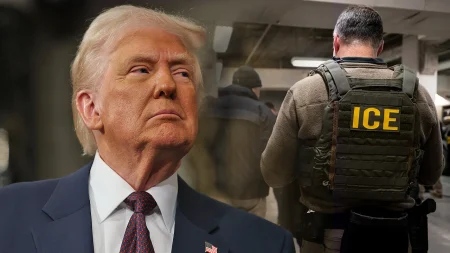
It was supposed to be a routine deportation flight. But according to witnesses, what happened on the tarmac in Equatorial Guinea was anything but routine. Men arrived hooded, their heads covered, their bodies tense with fear. Within moments, they were surrounded by security personnel. The beating began quickly, and the sounds of the struggle were unmistakable. Witnesses describe a scene of brutality that many believed could never happen in a country cooperating with the United States on immigration enforcement. The men were hooded, they said, and beaten by government forces in a display of raw power meant to terrorize, humiliate, and silence. The location was Equatorial Guinea, a small, oil-rich Central African nation ruled by one of the world’s longest-serving autocrats. The plane had arrived from the United States. And the partnership that brought it there is now under renewed scrutiny, as human rights concerns collide with President Trump’s deportation program. The witnesses’ accounts are deeply troubling, not merely because of the violence they describe, but because of what they reveal about the lengths to which the Trump administration may be willing to go to enforce its immigration agenda. In the coming months, the question will not simply be whether these allegations can be confirmed. It will be whether the United States is prepared to confront the ugly reality of who is helping it carry out deportations and what happens after the planes land.
For years, Equatorial Guinea has existed in the margins of global attention. It is a country of fewer than two million people, a former Spanish colony that has rarely been celebrated for its democratic institutions. Since seizing power in a 1979 coup, President Teodoro Obiang Nguema Mbasogo has governed with an iron fist. His regime has been accused of routine torture, arbitrary detention, political repression, and endemic corruption. The country’s oil and gas wealth has generated enormous revenues, but much of the population continues to live in poverty, often relying on subsistence farming and informal labor. Meanwhile, the elite in Malabo, the capital, enjoys the benefits of a petrostate economy that has made Obiang one of the world’s wealthiest leaders. International human rights organizations have documented abuses for decades, detailing cases of forced disappearances, violent crackdowns on dissent, and the systematic silencing of journalists and opposition figures. The United Nations has expressed serious concerns about the rule of law in Equatorial Guinea, and the U.S. State Department’s own human rights reports have repeatedly noted the regime’s failure to uphold basic standards. And yet, despite this record, Equatorial Guinea has become a partner in President Trump’s deportation program. That partnership raises uncomfortable questions. Equatorial Guinea is not a major source of undocumented immigrants to the United States. Its diaspora is relatively small compared to countries like Mexico, Guatemala, or Honduras. But its symbolic importance is significant. It signals that the Trump administration is willing to work with governments that many regard as pariahs if they agree to accept returning citizens. It also suggests that diplomatic convenience, not human rights, is driving the selection of deportation partners. For those who have long warned about the moral implications of the Trump administration’s approach, the new allegations are evidence that the deportation system has crossed a dangerous line.
What the Witnesses Describe
The details of what witnesses saw are still emerging, and the accounts have yet to be independently verified. But the consistency of the descriptions is hard to ignore. Witnesses say men were hooded and beaten in Equatorial Guinea after being returned from the United States. The use of hoods is particularly alarming to human rights experts. Hooding is not a standard security procedure. It is a technique commonly associated with torture and interrogation, designed to disorient the victim and heighten fear. Combined with physical beating, it creates a psychological ordeal intended to break a person’s sense of agency and security. Witnesses described scenes of men being dragged, shoved, and struck by security forces in what appeared to be a coordinated operation. Some of the men were reportedly crying out in pain. Others were silent, perhaps too terrified to speak. The exact locations and times of these abuses remain unclear, but the implications are profound. If the accounts are true, the United States may have delivered people into the custody of a government with a documented history of torture and abuse. That is not merely a diplomatic embarrassment. It is a potential violation of international law. Under the Convention Against Torture and other human rights instruments, countries are prohibited from returning individuals to places where they face a real risk of being tortured. This principle, known as non-refoulement, is a cornerstone of international refugee and human rights law. The U.S. government has long claimed to uphold these obligations. But the witnesses’ accounts raise the question of whether the Trump administration has done so in practice, or whether it has quietly turned a blind eye to the treatment of deportees in Equatorial Guinea.
Inside the U.S.-Equatorial Guinea Deportation Partnership
The deportation arrangement itself remains shrouded in secrecy. In general, deportation flights to countries around the world are coordinated through diplomatic channels, often with little public oversight. The Trump administration has made immigration enforcement a top priority, promising to carry out mass deportations at unprecedented scale. To do that, the administration needs the cooperation of foreign governments. Every country must be willing to accept the return of its nationals, and some countries have been reluctant to do so. Equatorial Guinea, according to reports, has been more cooperative. That cooperation has practical benefits for Washington. It allows U.S. immigration authorities to remove individuals more quickly, reducing the burden on detention centers and advancing the administration’s goal of increasing the number of deportations. But it also creates a moral hazard. By partnering with an autocratic government, the Trump administration risks empowering a regime that has little respect for human dignity. Critics argue that the arrangement provides diplomatic legitimacy to the Obiang government while ignoring its brutal record. The United States has increasingly relied on other nations to help enforce its immigration laws, and in some cases, this has meant working with governments that have poor human rights records. Equatorial Guinea, however, stands out because of the severity of the abuses documented inside its borders. The new witness accounts suggest that the consequences of this partnership are no longer theoretical. They are human, physical, and deeply disturbing.
Human Rights and Legal Accountability
The legal and political fallout from these allegations could be significant. Human rights lawyers and advocacy groups have long warned that deportation policies that ignore the treatment of deportees abroad are not just ineffective but dangerous. If a government sends someone to a country where they are likely to face torture, that government can be held accountable under both domestic and international law. In the United States, individuals facing removal have the right to raise a claim under the Convention Against Torture. But those protections often depend on evidence being available and on immigration judges being willing to consider it. In many cases, deportees are removed before their claims can be fully examined. The witnesses’ accounts from Equatorial Guinea could open the door to legal challenges from others who fear returning to the country. They could also prompt lawsuits against U.S. officials who approved the removals. But litigation is not the only issue at stake. There is also a question of political accountability. Members of Congress, including Democrats and some Republicans, have expressed concerns about the Trump administration’s deportation tactics. The idea that the administration is cooperating with Equatorial Guinea’s autocratic government is likely to fuel further criticism. It may force the White House to explain why it chose to partner with a regime that has been sanctioned by human rights organizations. It may also lead to demands for transparency about the conditions deportees face after they land. The U.S. government has not released detailed information about its deportation arrangements with Equatorial Guinea, and it remains unclear whether U.S. officials have conducted any monitoring of deportees’ treatment. Without such monitoring, the United States cannot honestly claim that it is fulfilling its human rights obligations.
A Test for American Credibility
The broader implications of this story extend far beyond one country in Central Africa. They touch on the very nature of the Trump administration’s mass deportation project. From the start, that project has been controversial. Supporters argue that enforcing immigration law is essential to maintaining order, protecting national security, and ensuring fairness. Opponents argue that the administration’s approach has been harsh, unnecessary, and disproportionately harmful to marginalized communities. The Equatorial Guinea allegations take that criticism to another level. They suggest that the deportation program is not merely aggressive but dangerous. If the United States is sending people into situations where they are hooded and beaten, then the program is not just enforcing the law. It is enabling brutality. This is not the first time that deportation agreements have raised human rights concerns. Similar issues have surfaced with flights to Guatemala, Honduras, and other countries where returnees have faced violence. But Equatorial Guinea is different because its government is so openly authoritarian. The partnership that developed with Malabo was not the result of shared democratic values. It was a practical arrangement, born from the administration’s desire to show results on deportation numbers. The human consequences, however, are impossible to ignore. Men were hooded and beaten. Those are not statistics. They are people. And the world is watching to see how the United States responds.
What Happens Next
There are no easy answers. But there are clear steps that should be taken. First, the Trump administration must provide a full accounting of its deportation arrangements with Equatorial Guinea. That includes explaining what safeguards were put in place before any individual was sent to the country and what monitoring has occurred after their arrival. Second, the United States should investigate the witnesses’ allegations and, if necessary, suspend deportations to Equatorial Guinea until the situation is clarified. Third, U.S. officials must ensure that no future deportation flight is sent to a country where there is a substantial risk of torture or abuse. These steps are not radical. They are consistent with the obligations the United States has long accepted under international law. They are also necessary if the Trump administration wants to maintain any claim to moral authority on the global stage. The witnesses who have come forward deserve more than silence. They deserve to be heard. The men they described were hooded and beaten, but they were not invisible. They were someone’s sons, brothers, and fathers. The United States has a responsibility to confront what happened to them. If it does not, it risks becoming complicit in the very abuses it claims to stand against. In the end, this story is not just about deportation policy. It is about the kind of country the United States chooses to be. The world is watching. And the witnesses are speaking. The only question that matters now is whether Washington is brave enough to listen.