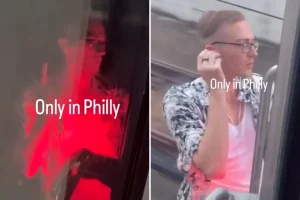






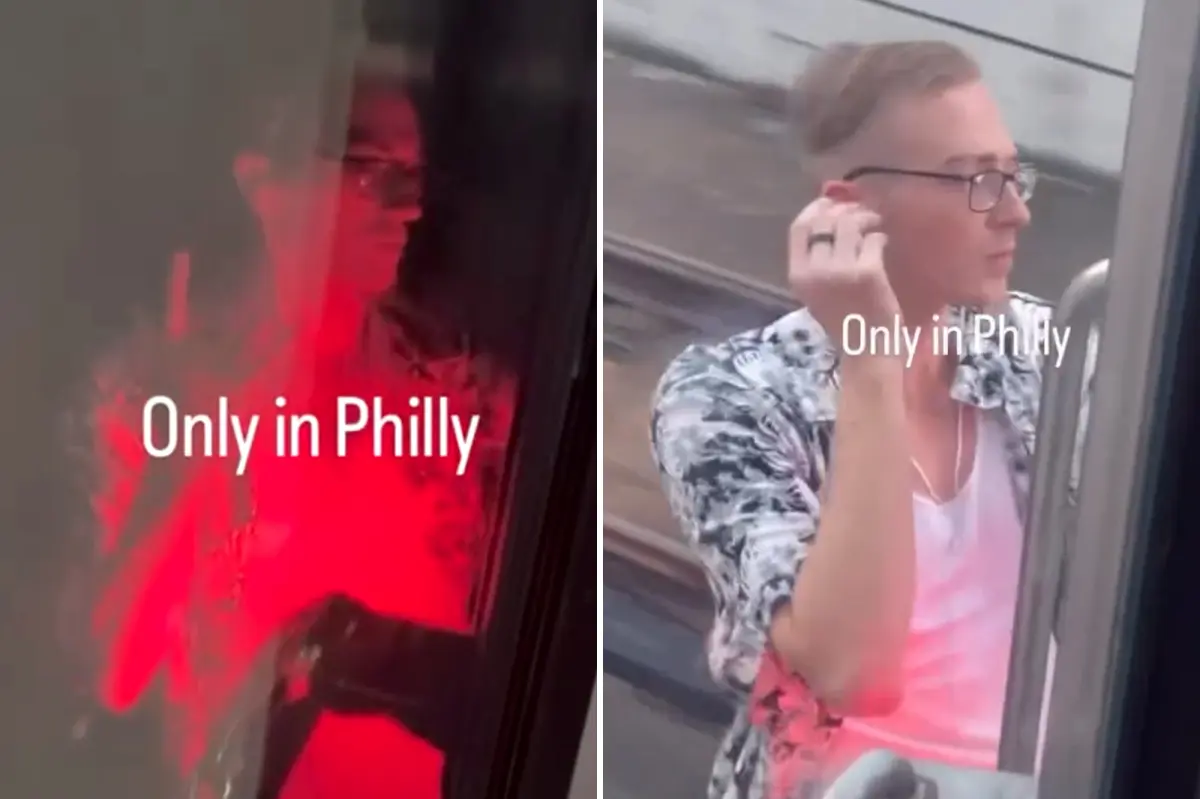
Human beings are strange creatures, capable of extraordinary kindness and equally extraordinary recklessness. On any given day, in any city, someone does something that makes the rest of us pause and wonder: why? That question hung in the air on Tuesday when a video began circulating online, showing a man in Philadelphia riding on the outside of a moving SEPTA train. The footage had been recorded by passengers inside the train car, and it was as baffling as it was frightening. The man wore a Hawaiian shirt and a single earbud, and he crouched low on the back of the train as it traveled between the 40th Street and 46th Street stations, his body swaying with every twist and bump of the rails. He was not harnessed, not protected, not performing for a crowd. He was just there, holding on with his hands, treating the side of a speeding train as if it were a carnival ride. The passengers who captured the moment did not know what else to do, so they filmed it, and someone later added the Spider-Man theme tune to the clip. The choice of music was darkly ironic. Spider-Man is a hero who can cling to walls and leap between buildings without fear, but this man was no superhero. He was a mortal person with no safety net, and the tracks below him were made of steel and electricity. The caption that accompanied the post—”Only in Philly”—seemed to capture a strange mix of pride and despair, a city recognizing that its streets produce stories unlike anywhere else. But for all the internet humor, the video was not a joke. It was a portrait of a man putting his life at risk for reasons that remain unclear, and it has now triggered a formal investigation by SEPTA, the agency that operates the train. The clip spread quickly, and with it, a mixture of laughter, outrage, and genuine fear. Some viewers laughed because they could not process the danger. Others felt a knot in their stomachs, imagining what could have happened if the train had lurched just a little more, if the man’s hand had slipped, if a gust of wind or a signal arm had caught him. The people closest to the moment, the passengers who watched him through the windows, had the most honest reaction: they simply could not believe what they were seeing. It seemed to them less like a stunt and more like a slow-motion tragedy that had not yet found its ending. And behind the viral video and the online commentary is a real person, someone with a family, a history, and a future that nearly came to an abrupt and violent stop on the rails of Philadelphia. The investigation will try to find him, but for now he remains a mysterious figure, frozen in a few seconds of footage that raises more questions than it answers.
Among the people who saw the incident unfold, the disbelief was visible and vocal. Edquardo Chinnell, a passenger from Germantown, told WPVI that he had never seen anything like it in his life. His words, “Never seen nothing like that, that’s madness,” were simple but powerful. They spoke to the collective shock of everyone on that train, and to the deeper truth that dangerous behavior often arrives without warning, leaving bystanders caught between concern and confusion. Another passenger, Cody Langley, offered a more sober reflection. “You are dancing on a thin line of life and death,” he said, “because anything could happen.” That phrase, “thin line,” is exactly right. When a person clings to the outside of a moving train, every second is a negotiation with chance. A slight change in speed, a sudden stop, a moment of lost balance—any of these could convert a shocking video into a tragedy. The man in the Hawaiian shirt may have believed he was in control, but control is an illusion in that situation. The train does not care who is riding it. The rails do not care about human confidence. The people watching from inside understood this instinctively. They did not applaud. They did not cheer. They recorded the moment, perhaps because they were too stunned to do anything else, and then they shared it with the world, perhaps hoping someone else would explain what they could not. The social media response was typical of our time: quick jokes, shared outrage, and a caption that tried to turn a near-death experience into local color. “Only in Philly” is the kind of phrase that brings a city together in laughter, but it also reveals a troubling tendency to normalize behavior that should never become normal. The man’s decision was not a quirk of local character. It was a reckless choice that endangered his life and could have traumatized every person who witnessed it. There is no version of this story that ends well. Even if he survived, which he did, the image of him crouched on the back of that train is a reminder that some people are willing to gamble everything for a moment of excitement, for attention, for reasons that may not make sense even to them. It also raises a difficult question: what makes a person value their life so little, or so differently, that they would risk it in this way? We may never know the answer, but the question deserves our attention, not just our judgment.
The authorities, of course, had a more immediate and practical response. SEPTA police captain Marc Pasquarella did not hide his frustration or his alarm. “I don’t understand what makes people want to do something this dangerous,” he said. “It’s insane. It’s extremely dangerous. Obviously, falling off the train, seriously injured or killed.” His words are blunt, and they should be. The man in the video is not a character in a movie. He is a real person who could have died in front of a train full of passengers. Pasquarella’s greatest fear, beyond the immediate danger to the man himself, is that the video will inspire copycats. In an age when viral fame is often mistaken for achievement, there is a real risk that other people, especially younger viewers, will see this clip and think they can do the same thing. They might not realize that the man was lucky, not skilled. They might not see the instability in his crouch, the way his body swayed, the fact that he was one slip away from becoming another statistic. They might only see the Spider-Man music and the caption that turned a brush with death into a joke. SEPTA spokesperson Andrew Busch confirmed that no injuries were reported, which is a relief, but the investigation is ongoing. Investigators are working to identify the man in the clip, hoping to speak with him, to understand what happened, and to prevent it from happening again. Whether they will be able to do so is unclear. The man may come forward, or he may remain anonymous, fading back into the city as if nothing had happened. But the rest of us are left to think about what we just saw. The response from SEPTA is not just about one man’s mistake. It is about the safety of everyone who uses the transit system, and about the responsibility we all share to discourage behavior that puts lives at risk. When a video like this goes viral, it becomes part of a larger conversation about risk, reward, and the strange ways we seek meaning in our lives. The captain’s words remind us that the people who investigate these incidents are not immune to the emotional weight of what they encounter. They see the aftermath of bad decisions every day, and they know that the difference between a shocking video and a funeral or a hospital bed is often only a matter of inches and seconds.
Subway surfing, as this behavior is often called, is not a new phenomenon, but it has taken on a darker edge in recent years as social media has made it easier to share and glorify. The man in Philadelphia is part of a sad and dangerous tradition that has already claimed too many lives. In July, a 16-year-old girl was riding on top of a southbound A train pulling into the Broad Channel station in Queens when she suddenly rammed into a beam overhead during an afternoon stunt. She survived, but the incident was a stark reminder that subway surfing is not a game. Two months earlier, a 14-year-old boy died while riding on top of a subway on the Williamsburg Bridge. He was a child. He had a future, a family, and a life that ended because he climbed onto a train and lost the gamble. These stories are heartbreaking, and they are also instructive. They show that the danger is not theoretical. It is real, it is immediate, and it does not discriminate based on age, confidence, or experience. The people who die or are injured in these incidents are often young, often seeking thrills, often influenced by what they have seen online. They do not expect to be the ones who fall. They do not expect the train to lurch, the wind to shift, or the overhead beam to appear out of nowhere. But those things happen, and when they do, there is no second chance. The man in the Philadelphia video is older, perhaps, than some of the teenagers who have lost their lives to subway surfing, but the principle is the same. He was not invincible. He was not protected. He was a human being with a body that would break just as easily as anyone else’s if it hit the tracks at speed. The fact that he walked away should not be seen as proof that such stunts are possible. It should be seen as proof that luck can be cruel, that it can favor some and abandon others, and that the difference between survival and tragedy is often invisible until it is too late. Every new video of this kind brings fresh grief to families who have already lost loved ones, and it sends a message to young people that the risk is worth taking. It is not.
There are hazards beyond the obvious ones, and they make the man’s gamble even harder to understand. Some train tracks are electrified, which means that a rider who falls near the wrong rail could be electrocuted before they even have time to feel the pain of impact. The surfaces on the outside of trains are not designed for human hands or feet. They can be slippery from moisture, unstable from motion, or covered in dirt and grease that make it impossible to get a secure grip. Trains travel at high speeds, which means that even a minor slip can result in catastrophic injuries. The man in the video was crouched on the back of the train, holding on with his hands, his body exposed to the wind and the elements. He had one earbud in his ear, which means he may not have even heard the sounds around him clearly—the warning signals, the shouted instructions, the approach of another train. His vision may have been obscured by the position of his body. His balance was constantly tested by the movement of the vehicle. In those circumstances, the margin for error is almost zero. A single distraction, a single moment of inattention, a single unexpected jerk of the train, and he would have been thrown into the gap between the cars or onto the tracks below. It is difficult to imagine what goes through a person’s mind in those moments. Perhaps he felt an adrenaline rush, a sense of freedom, a break from the monotony of ordinary life. Perhaps he was trying to prove something to himself or to others. Perhaps he did not think at all. But the people who watched him from inside the train saw something else: a man dancing with death, unaware or indifferent to the possibility that he might not come back. The consequences of such a fall are not limited to the person who falls. The operator of the train would have to live with the memory of seeing a body on the tracks. The passengers who recorded the video would have to live with the knowledge that they watched someone put themselves in danger without intervening. The first responders would have to handle the aftermath, and the family would have to receive the terrible news. In other words, the man’s decision was not a private risk. It was a public act that could have rippled outward, causing pain and trauma for dozens, perhaps hundreds, of people.
At the end of the day, this story is not just about a man in a Hawaiian shirt hanging from a train in Philadelphia. It is about the human condition, about the strange and sometimes self-destructive ways we seek meaning, excitement, and connection in a world that often feels numb and overwhelming. It is about the power of social media to transform dangerous behavior into entertainment, and the responsibility that comes with holding a smartphone. It is about the authorities who work to keep us safe, even when we refuse to protect ourselves. It is also about the rest of us, the passengers, the viewers, the citizens, who must decide what we want our culture to celebrate. Do we want to reward reckless stunts with virality and jokes, or do we want to respond with compassion and a clear-eyed understanding of the risks? The man in the video may be struggling with something we cannot see. He may be in crisis, or he may simply be a thrill-seeker who made a terrible decision. We do not know his story, and unless he is identified and comes forward, we may never know. But we do know that he is alive, that he has been given another chance, and that the people around him were profoundly shaken by what they witnessed. The best response to this moment is not mockery or judgment, but awareness. We need to talk about the dangers of subway surfing, about the pressure to go viral, about the reasons why young people, especially, might feel compelled to risk everything for a few seconds of attention. We need to remind ourselves that every person on a train is a human being with a life, a family, and a future, and that no video is worth a single one of those lives. The SEPTA investigation may or may not find the man, but whether it does or not, the image of him clinging to the back of that train should stay with us as a reminder of how close we all are to the edge, and how important it is to choose life, over and over again.