




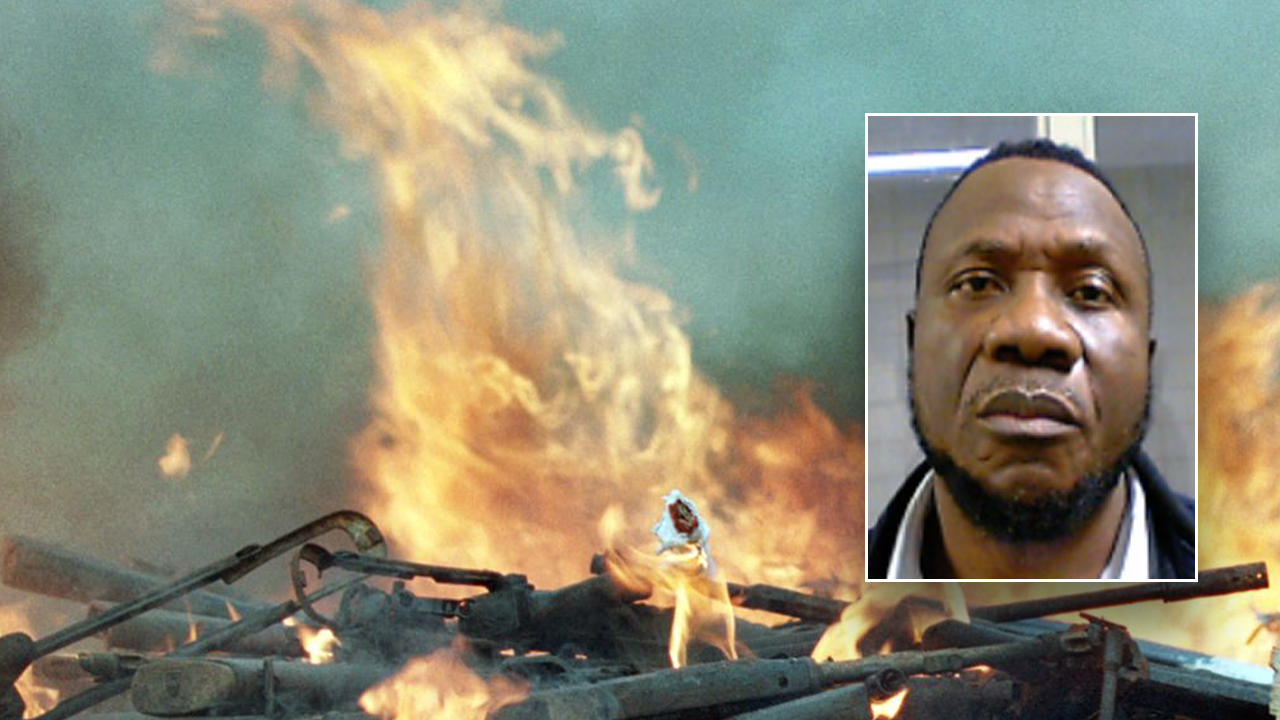
The Long Arm of Justice: A War Criminal’s Fall From America’s Shadows
In the quiet aftermath of a humid Maryland summer, federal agents moved with the kind of deliberate precision that speaks to years of patient investigation. Their target was not a gang leader or a drug cartel operative, but a man whose alleged crimes had been committed decades earlier and thousands of miles away, in the blood-soaked forests and shattered villages of West Africa. On August 11, U.S. Immigration and Customs Enforcement finally achieved what had eluded them for years: the deportation of Amos Sheik Massaquoi, a 55-year-old Liberian national believed to have been a central figure in some of the most horrifying atrocities of Liberia’s brutal civil wars. Massaquoi, who had spent nearly two decades living on American soil, was removed from the country and returned to Liberia, where the ghosts of his past awaited him. But the story is not merely one of bureaucratic enforcement; it is a testament to the determination of investigators who refused to let a suspected war criminal find comfortable refuge in a nation built on the promise of justice.
Massaquoi’s alleged role in Liberia’s nightmare was not that of a peripheral figure or a reluctant conscript. According to ICE officials, he served as chief bodyguard to Maj. Gen. Daniel Chea, a prominent military leader within Charles Taylor’s National Patriotic Front of Liberia. In that capacity, Massaquoi is believed to have personally ordered and participated in extrajudicial killings, acts of torture, arbitrary arrests and detentions, forced labor, and the systematic recruitment of child soldiers. These are not abstract legal terms; they translate to unimaginable human suffering—families torn apart, children stolen from their homes and forced to carry weapons, prisoners subjected to unspeakable cruelty, and communities living under the constant shadow of terror. The Liberian civil wars, which raged from 1989 to 2003, claimed the lives of nearly 250,000 people, most of them civilians who simply wanted to live in peace. That Massaquoi was able to walk free in American suburbs for years, perhaps shopping at grocery stores and watching his children grow up, while the families of his alleged victims still mourn, is a stark reminder of how fragile the threads of accountability can be.
The path of Massaquoi’s time in America is a frustrating saga of legal loopholes and missed opportunities. He legally entered the United States in August 2006, but his authorization to remain expired on November 6 of that same year—a mere three months after his arrival. Rather than leaving, he simply stayed, disappearing into the vast landscape of undocumented immigrants who slip through the cracks of an overburdened system. For years, he lived in Maryland, likely believing that the passage of time would protect him from scrutiny. But the past has a way of catching up, and in August 2019, agents from Homeland Security Investigations arrested him for being illegally present in the country. Yet in a decision that must have felt devastating to advocates for victims’ justice, an immigration judge granted him bond less than two months later, and he was released back into the community. It was a temporary reprieve, but not a permanent one. On April 1, 2025, ICE Baltimore officers took him back into custody after officials determined he had failed to comply with the conditions of his release. A month later, an immigration judge ordered his removal. The wheels of justice turn slowly, but they do turn.
To understand the gravity of Massaquoi’s alleged crimes, one must understand the hellscape that was Liberia during its civil wars. This was not a conventional conflict with clear battle lines; it was a savage struggle for power marked by unimaginable brutality. Charles Taylor, the rebel leader who would eventually become Liberia’s president, built his movement on a foundation of terror, using child soldiers, drugged fighters, and ruthless tactics that horrified the international community. Massaquoi, according to investigators, was a key instrument of that terror machine. Even after the second civil war ended in 2003, Massaquoi received specialized military training at an academy in China in 2004, suggesting he remained deeply connected to the networks of power and violence that had defined his adult life. Taylor himself was eventually brought to justice, convicted by the Residual Special Court for Sierra Leone of aiding and abetting crimes committed by rebel forces in neighboring Sierra Leone, and sentenced to 50 years in prison. His conviction was a landmark moment in international justice, but it did not automatically sweep up all of his alleged accomplices. Many, like Massaquoi, scattered across the globe, seeking new lives far from the wreckage they left behind.
The deportation of Massaquoi is part of a much larger, often invisible campaign by U.S. authorities to ensure that America does not become a sanctuary for those who have committed atrocities abroad. The investigation was supported by ICE’s Human Rights Violators and War Crimes Center, a specialized unit dedicated to tracking suspected perpetrators of genocide, torture, war crimes, and other human rights abuses who attempt to enter or remain in the United States. The results of this effort are staggering in their scope: since 2003, ICE has arrested more than 520 individuals for human rights-related violations and removed 1,178 known or suspected human rights violators from the country. Additionally, the center has blocked more than 415 suspected human rights violators and war crimes suspects from entering the United States in the first place. These numbers represent real people—some famous, most unknown—who believed they could escape their pasts by crossing an ocean. They represent victims who may never receive a formal apology but can at least find some solace in knowing that their tormentors will not live comfortable lives in a nation that values freedom and human dignity.
Ultimately, the story of Amos Sheik Massaquoi is a story about the meaning of accountability and the refusal to forget. It is a reminder that the horrors of war do not simply end when the guns fall silent; they live on in the memories of survivors, in the trauma of former child soldiers who must somehow rebuild their lives, and in the empty chairs at dinner tables where loved ones once sat. For nearly two decades, Massaquoi lived in the United States, a country that has often served as a beacon of hope for those fleeing persecution. But hope has a condition: those who come must not themselves be persecutors. ICE Chicago Field Office Director Frank Padula delivered that message with unmistakable clarity, declaring that those who believe they can hide in the United States are mistaken. Akil Baldwin, the HSI Maryland Special Agent in Charge, echoed the sentiment, noting that anyone confirmed to have engaged in such bloodshed anywhere in the world has no place in America. As Massaquoi now faces the country of his birth, where memories of the civil wars remain painfully fresh, the message to other suspected human rights violators is clear: the shadows are not as safe as they seem, and justice, however slow, does not sleep. Anyone with information about suspected human rights violators in the United States can contact ICE’s tip line at 866-DHS-2-ICE or submit a tip online—because every call could be the one that brings a victim one step closer to peace.