



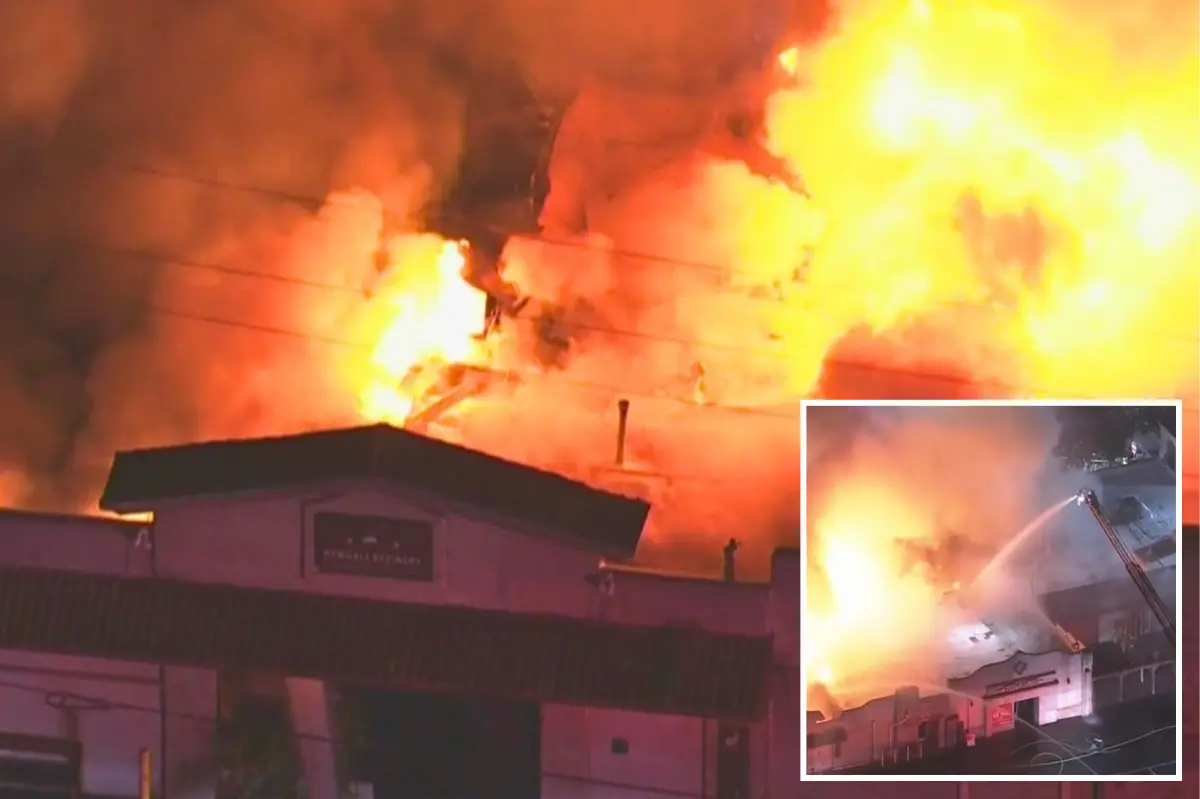
It was a night that shattered the stillness of Santa Clarita’s Main Street. Just before the dawn, when the world is at its quietest, an ordinary Monday tipped into a scene of fire and smoke that would leave a permanent mark on this close-knit Southern California community. At the heart of it all was the Newhall Refinery, a beloved restaurant known for rusty-chic décor, dinners with friends, and the kind of warm neighborhood glow that made Main Street feel like the set of a small-town movie. But by the time the first flames licked the sky, the familiar was twisted into something monstrous. The fire, which erupted at approximately 3 a.m., wasn’t content to stay within a single structure; it leaped across the commercial row, devouring the night, forcing firefighters into a herculean effort to stop it. As residents slept, the sky above turned a hellish orange, and the choking smoke carried with it the unmistakable smell of destruction. The first calls, later pieced together by responders, were fragmented and panicked – a crackle in the distance, a growing roar, then rolling words about flames spreading from the restaurant to the community theater next door, The MAIN.
If there was ever a moment when a threat becomes a twisting reality, it was watching that fire crawl. The flames, not satisfied with the interior of Newhall Refinery, began an eager advance into The MAIN, a beloved performance centre that had hosted everything from illicit comedy nights to avant-garde theatre productions that spoke to the soul of that community. The video shot from across the street shows a beast of fire, an impressive profusion of orange and scarlet, consuming the structure with seemingly uncontrollable hunger. Firefighters arrived quickly, in that weirdly efficient and yet frighteningly immediate way, and soon the night was filled with the sound of water against flame, and the unmistakable crackle of a building giving up. They came with multiple hoses, aimed at the ever-rising blaze, but the fire seemed to laugh at them, spreading behind the lines, igniting toward the roof of a row of slumberous shopfronts: a sneaker shop, a boutique, an empty storefront. For hours, over the horizon, the firefighters bowed, pulling at hoses, reassessing, coordinating with the LA County Fire Department, all while the orange glow illuminated the street signs, casting long shadows that danced like ghosts. In the morning, the battle was still not over – smoke pillared up into a sky that had turned from night to a shear grey, and the air was thick with an acrid scent that stuck to the throat. The uncertainty had settled in, and no one could say when the last hiss of steam would sear the air.
But the true impact of a fire lies not merely in the blackened lumber and melted marquees; it lies in the fragile membrane of the community’s heart. The MAIN theater is not just a building; it’s a vessel of memories. It is where a generation of actors learned to trust their voices, where the town’s youth first performed three-act plays, and where an audience gathered at holiday eve to hear choir harmonies over creaky chairs. For a few terrified hours, those memories hung on the verge of being consumed by ashes. Vera, a retired schoolteacher who has lived in Santa perhaps for forty years, spoke with shaking hands as she watched the smoke from her porch. “I brought my grandchildren to see some of their first plays,” she said. “We’d go to Newhall Refinery after, to share fries and milkshakes. And now look at this.” The restaurant, too, was a landmark. It wasn’t just the architectural charm of varnished wood, or the tall glasses of brew, or the locally sourced burger. It was the place where engagements were slipped into dessert spoons, where high school reunions came to life, where the weekly trivia night forged rivalries between families. In its kitchen, countless plates had been served with love, and today that kitchen is mute, charred, and silent. The loss to the building is provisional, but the loss to the soul of the community is a deep, sucking wound that will not seal in news updates. The exact number of businesses affected is still unknown – the Los Angeles County Fire Department has not yet released a tally – but already, a heartbreaking silhouette of vacated store fronts looms, each with its own story of ambition, untold hours of work, and individual dreams built plaster and mortar.
As the morning dragged on, firefighters held their ground, remaining stubbornly present to beat down the remnants of the flames and to prevent any flare across the busy street. The cause of the fire remains a blank, an infernal question mark. In a day of dread, the officials have said nothing concrete, only that it is “under investigation.” For the small-business owners who have difficulty sleeping, every hour without answers is a slow torture. But what makes the story of a small town move is not the fact of the emergency, but the uprising of the human spirit. A local pastor opened the doors of his church, a few blocks away, to act as an emergency warming space. A coffee from a nearby café mobilized a rolling barrel of cold water for the exhausted firefighters, and a neighbor with a pickup truck helped stranded employees retrieve belongings and debit card machines. On the street, separated by crimson tape, a sense of solidarity began to creep in amongst strangers, the cautious look of shared loss. Someone has sprayed a message on a plyboard wall: “Santa Clara stands together.” It’s a cliché, but when the ceiling beams have fallen, that’s all the shelter you have. Underneath the chaos, a motif continues: the small, ordinary #ThingsThatmatter, the local craft, the successful theatre, the fragile glory of a bright street, all under usual besiege, but not defeated – yet.
As the day dragged toward evening, the fire crews began to rotate, with a skeleton crew staying to monitor the rubble. The retina-burn of the inferno had left a small alley of ghost shapes, empty mannequin limbs and blackened metal ribs. For certain, the owners of the restaurant and the theater are facing a draining period of insurance forms, evaluations, and, probably, a long and winding path to rebuild. It’s a path that you can’t understand without touching a scar. But in the chatter of people clustering at the barricades, there is a deep, unspoken, calming thought: that this is not the end. Santa Clarita is a strong community, with a stubborn identity etched in the fabric of its Main Street. After the fires of the past – in the wider region – they have seen how a place can pull itself from the ash, with the help of stubby, wobbly hands of volunteers. Neighbors are already planning benefit shows at a makeshift venue, while a loan of equipment has been offered for other struggling business. These are the gestures of a community who know that the light of its main street is not only in the physical structures, but in the fragile, hopeful pool of human connection, which fires cannot extinguish. It would be naive to say everything has transformed into a complete poem of resilience, because the ashes are still hot, the smoke still rises, and a few storefronts still have no electricity. But as the sun breaks over the next day, it will rise for everyone, not just the buildings.
The road to recovery will be jagged and long, with many unknown turns. For the immediate future, the broken glass will be swept, the scaffolding will go up, and the path of Main Street may be temporarily quieter. But the Memphis in the community is not an object; it is the ability to convene, to share, and to bear the silence of a momentary pause. Already, there is a kinship among the small town business owners, the theater board, and the firefighters, a bond forged in the face of flames. This fire has torn down walls, but it has also bulldozed old distances; it has forced us to look at our neighbors and acknowledge the fragility of a shared morning. In the coming weeks, that answer about the cause will come, but eventually it will be dropped. For now, the silence is heavy with a sweet odor, bittersweet. And still, across the block, the restaurant and the theatre have offered a resistance, a memory, a bounty of stories waiting to be retold. The town approaches the future with a tempered, clear-eyed hope, not naive to the hardship, but intimately aware that a community’s true character is not in its bricks, but in the courage to face the morning, measure the soot, and then dare to cook and play once more.