


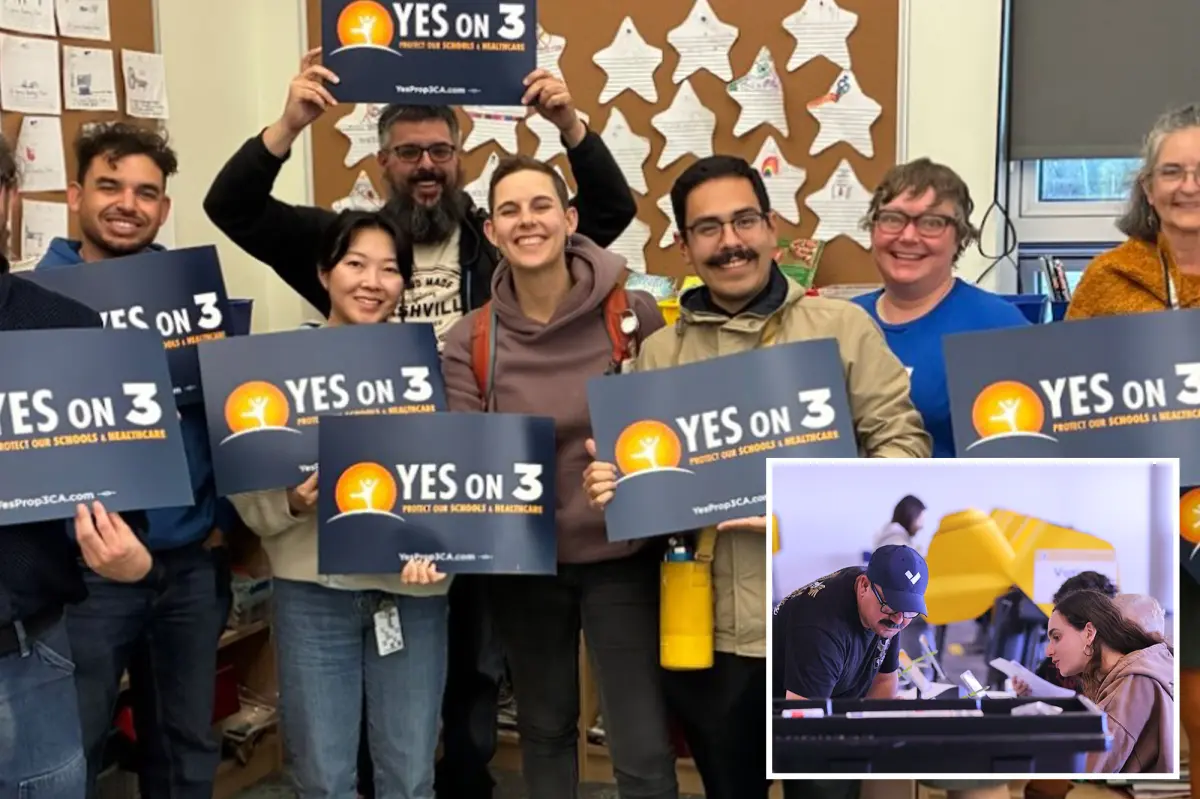
When California voters walked into polling places on Tuesday, they were asked to settle a question that has hovered over public education for more than a decade: Should the state’s wealthiest residents keep paying a little extra to fund schools and community colleges? The answer, by a decisive margin, was yes. Proposition 3, which makes permanent the income tax surcharge on high earners that California first adopted as a temporary emergency measure in 2012, cruised to victory with 58.7 percent approval, or about 4.4 million votes, compared with 41.3 percent opposition, or about 3.1 million votes, according to the Associated Press. This was not a new tax, and it did not ask anyone to dig deeper than they already do. Instead, it locked in rates that were already built into California’s tax code, preserving a stream of funding that has become a lifeline for classrooms, school nurses, counselors, and community college programs. For supporters, the outcome was a moment of relief and validation. For opponents, it was a disappointment and a broken promise. But for millions of California families with children in public schools, the practical meaning is simple: the money will keep flowing, at least for the foreseeable future, into teacher salaries, instructional materials, campus support staff, and the small but essential services that make a school feel like a place where children are cared for, not just counted.
The mechanics of Proposition 3 are easy to explain but surprisingly easy to misunderstand. The measure does not create any new tax liability for anyone. Rather, it makes permanent the higher income tax rates that California has charged its top earners since 2012, when the Legislature and voters approved them to help schools recover from the devastation of the Great Recession. Those rates range from 10.3 percent to 12.3 percent on the portion of income above a threshold that is adjusted each year for inflation. In practical terms, the surcharge applies to individual income above roughly $371,000, a figure that changes annually, so taxpayers below that line are not affected. The revenue generated by this small slice of the tax code is enormous: the state’s nonpartisan Legislative Analyst’s Office estimates it brings in somewhere between $5 billion and $15 billion every year, depending on how the economy is performing and how much income the wealthiest Californians report in a given year. That money has a clearly defined destination. Under the terms of the measure, 89 percent of the education dollars go to K-12 schools and 11 percent go to community colleges. In years when revenues exceed a certain cap, the extra money is directed to health care for low-income children and families, a detail that broadens the measure’s appeal beyond parents and teachers. In flush years, the revenue accounts for roughly 15 percent of the state’s entire K-12 budget, a staggering share that helps explain why school districts across California have been watching this election so closely. It is not an exaggeration to say that for many districts, especially those serving large numbers of low-income students, this money is the difference between offering art classes and eliminating them, between keeping counselors on campus and asking teachers to double as social workers, between maintaining small class sizes and letting crowded rooms grow even more crowded.
To understand why Tuesday’s vote feels so significant, it helps to remember how we got here. The surcharge was born in 2012 as Proposition 30, a temporary tax pitched by then-Gov. Jerry Brown as a bridge out of the recession. Schools were reeling from years of layoffs, furloughs, and budget cuts, and Brown traveled the state warning that without the measure, the classroom experience would become unrecognizable. Voters reluctantly agreed, treating it as a limited sacrifice for a pressing emergency. But temporary taxes in California have a way of becoming permanent, especially when schools have grown accustomed to the money. In 2016, voters were asked to extend the tax through 2030, and they did so with Proposition 55, again with the understanding that this was not forever. Proposition 3, by contrast, was a fundamentally different kind of request: it asked voters to give up the expiration date entirely and make the tax a permanent part of California’s constitutional landscape. That is a much bigger ask, and it reflects a broader shift in how Californians think about taxes and public services. The state’s highest earners already pay a 13.3 percent top marginal rate when the separate 1 percent surcharge for mental health services is included, making California’s top income tax rate the highest in the nation. Humanizing what that means: a family earning several million dollars a year pays a significantly larger share of its income in state taxes than a teacher earning seventy thousand dollars, and that money is redistributed across the state to fund schools in neighborhoods that range from the wealthiest enclaves of Los Angeles to the most isolated rural communities in the Central Valley. For many voters, this is not an abstract debate about tax policy, but a direct reflection of their values and their priorities.
The campaign behind Proposition 3 was a powerful demonstration of what organized money and institutional muscle can do in California politics. The California Teachers Association placed the measure on the ballot and poured roughly $30 million into the effort, making it one of the best-funded education ballot campaigns in recent memory. The coalition included the California State PTA, the California School Nurses Organization, the California School Employees Association, the California Medical Association, and the California Democratic Party. These are not fringe groups; they represent teachers, parents, school support staff, and health care providers who see the impact of funding shortages in their daily work. Their argument was straightforward and emotionally resonant: losing this revenue would mean layoffs, larger classes, fewer counselors, and deep cuts to programs that students rely on, especially at a moment when federal funding cuts are already squeezing schools from other directions. The CTA framed the choice for voters in stark terms: vote yes to continue supporting public schools, or vote no to hand a tax cut to the wealthiest Californians. That framing clearly worked. It gave voters a simple way to understand a complicated tax measure and connected it to the universal desire to give children a fair shot. Teachers across the state sent mailers, texted their neighbors, and stood outside supermarkets with signs, turning the campaign into a grassroots effort that felt personal even though it was backed by a well-oiled political machine.
Opponents were no less passionate, but they faced an uphill battle from the start. The campaign against Proposition 3 was led by the California Taxpayers Association, the Family Business Association of California, and the California Hispanic Chambers of Commerce, groups that argued the tax had been sold to voters as a temporary measure, not a permanent fixture. Their message was rooted in a powerful critique: Californians already pay some of the highest income, sales, and gas taxes in the country, and the state has a spending problem that cannot be solved by simply asking the wealthy to pay more. They urged voters to reject the measure and demand that Sacramento “fix spending first,” pointing to the state’s budget volatility and the difficulty of predicting how much money will flow into public services in any given year. That argument has historical resonance in California, where voters have long been suspicious of political promises and eager to limit the growth of government. But despite those concerns, the polls never really showed a contested race. A Public Policy Institute of California survey released in late October found 58 percent support and 41 percent opposition, almost identical to the results in September, and that pattern held all the way to Election Day. The numbers were starkly divided along familiar political lines: Democrats, independents, younger voters, and renters supported the measure, while Republicans and older voters were more likely to oppose it. The split reflects a broader truth about California’s electorate, which has become increasingly willing to tax itself for public goods as long as the burden falls on someone else. Asked directly whether they wanted to preserve school funding or reduce taxes for the rich, a clear majority chose schools.
Finally, it is worth placing Proposition 3 in the broader context of the election and the state’s ongoing conversation about wealth and opportunity. It shared the ballot with Proposition 40, a separate and much more ambitious proposal to impose a one-time 5 percent wealth tax on California’s roughly 200 billionaires. That measure lost majority support in the final weeks of the campaign, and its defeat was driven in large part by hundreds of millions of dollars in opposition spending from technology leaders who cast it as an attack on innovation and entrepreneurial success. The contrast between the two measures is telling. Voters were willing to make permanent an income tax on high earners, but they were not willing to go further and impose a new tax on accumulated wealth. Proposition 3 also became an issue in the race for state superintendent of public instruction, where California Teachers Association-backed candidate Richard Barrera campaigned as a champion of the measure. His opponent, whose name appeared on the ballot alongside the school superintendent race, did his best to distance himself from the tax debate, focusing instead on accountability and choice. In the end, the success of Proposition 3 sends a clear signal to Sacramento and to the rest of the country: Californians may be tired of high living costs, may grumble about traffic and housing prices, may even complain about the state’s tax burden in casual conversation, but when they are asked to protect the institutions that educate their children, enough of them will say yes. The measure’s passage means that for as long as California exists as a state, its wealthiest residents will help support its public schools. It is a permanent commitment, a constitutional promise, and a powerful reminder that the debate over taxes and education is never really about numbers on a spreadsheet. It is about who we want to be and how we want to take care of one another when the future feels uncertain. That is the human story behind Proposition 3, and on Tuesday, voters told that story in their own way: by keeping the promises they had made to their children, their teachers, and themselves.