






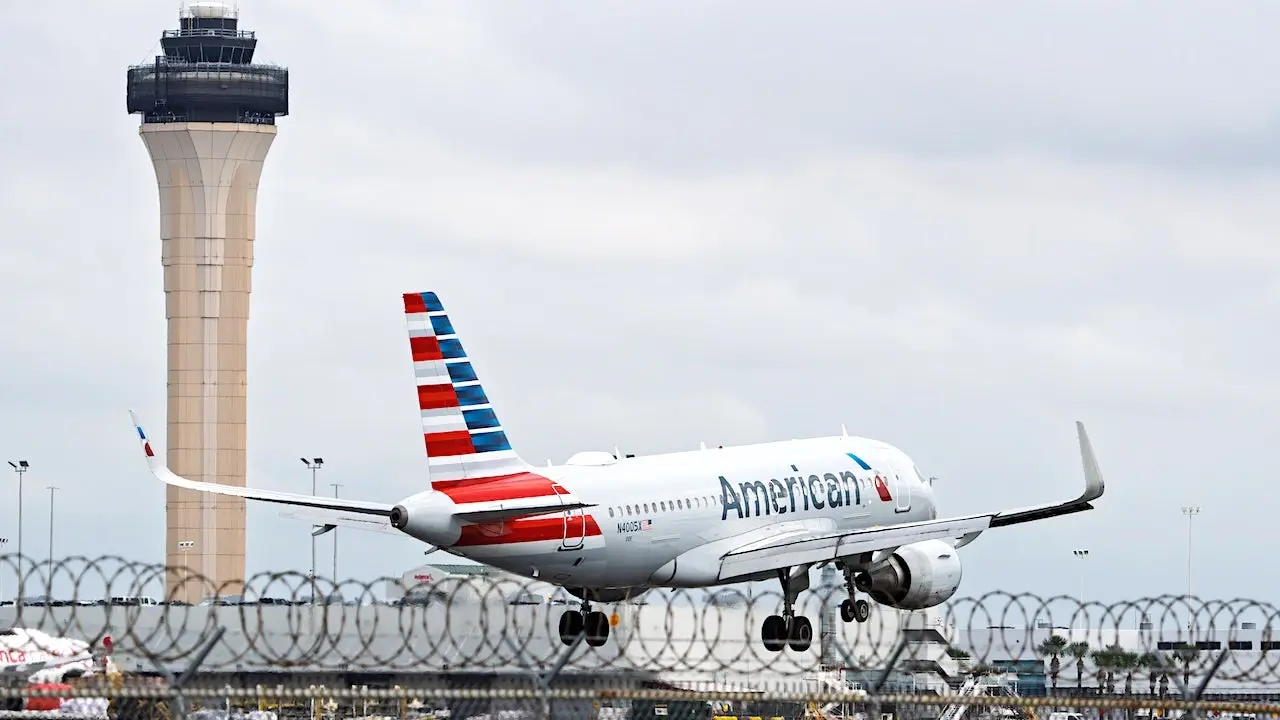
On a balmy Friday night in early September, the steady hum of an Airbus A319 cruising south from Baltimore toward Miami should have been the soundtrack to a routine journey—a few hours of quiet, interrupted only by the clink of drink service and the low glow of seatback screens. But for passengers and crew aboard American Airlines Flight 1779, that familiar rhythm dissolved into something far more unsettling as the aircraft pushed through the night sky. The flight, which had departed Baltimore/Washington International Thurgood Marshall Airport just after 9 p.m. EDT, was already running nearly two hours behind schedule, a small frustration that would soon pale in comparison to the scene unfolding in row 9. According to public flight-tracking data, the plane was somewhere over the eastern seaboard when flight attendants, trained to notice the smallest signs of trouble, began receiving reports of a female passenger behaving erratically. By the time the plane touched down at Miami International Airport at approximately 11:23 p.m., the cabin had been transformed into a strange theater of improvised crisis management, with the alleged behavior of one traveler casting a long shadow over an otherwise ordinary Friday evening flight.
The specific details of the disturbance, later pieced together from aviation records and crew communications, painted a startling picture. The passenger in question, seated in 9D, had reportedly begun to undress completely and then engaged in indecent acts in full view of the people seated nearby. It was the kind of behavior that leaves fellow passengers unsure whether to gasp, look away, or summon help, and it prompted the lead flight attendant to take immediate action. Through the Aircraft Communications Addressing and Reporting System, or ACARS, a datalink network used by flight crews to communicate with ground operations, the attendant sent a message to American Airlines’ Integrated Operations Center. The note was stark in its professionalism: a passenger in row 9 had stripped off her clothing and was behaving indecently, and the crew requested that law enforcement be notified and on hand upon arrival. The ACARS log, published by the aviation website AirLive, did not detail every reaction inside the cabin, but it is not difficult to imagine the awkwardness and alarm rippling through the rows as passengers averted their eyes, whispered to one another, or tried to discreetly alert the flight crew. The flight attendants, tasked with maintaining order while also caring for the safety and comfort of everyone on board, were suddenly confronted with a situation that no training manual can fully prepare a person for—a fellow human being in a state of profound vulnerability or volatility, exposing not only their body but their distress to a planeload of strangers.
What makes this incident so striking is that the flight did not divert. The crew, after assessing the situation, made the decision to continue to Miami rather than land early at some intermediate airport. This was no small choice. Diverting a flight is expensive, disruptive, and sometimes necessary when a passenger becomes a genuine threat to safety, but here the disturbance, while alarming and deeply inappropriate, was apparently contained enough that the pilots and cabin crew felt they could manage it for the remaining duration of the journey. The Airbus A319 pressed on through the night, carrying with it a cabin full of travelers who had unwittingly become witnesses to something profoundly awkward, perhaps even frightening. There is a strange intimacy to being trapped in a metal tube at 30,000 feet; there is no escaping, no stepping outside for air, no easy way to remove yourself from a situation that has gone wrong. For the passengers seated near row 9, the rest of the flight must have felt interminable, each minute stretching into a careful negotiation of where to look and how to react. For the crew, the challenge was to maintain a sense of normalcy while also dealing with a situation that required both firmness and compassion. And for the woman in seat 9D, whatever led her to that moment—whether a medical emergency, a mental health crisis, or the influence of alcohol or drugs—her life was about to change in a way she likely never anticipated when she boarded the plane in Baltimore.
The landing itself was as orderly as the flight had been chaotic. Flight 1779 arrived at Miami International Airport just before half past eleven, pulling into Gate D2 in Terminal N, where law enforcement officers were waiting. According to the flight tracking service Flightera, the reception was immediate and controlled: officers met the aircraft and took the passenger into custody as the other travelers began to disembark, stepping past the quiet spectacle of official procedure. The Miami-Dade Sheriff’s Office, American Airlines, and Miami International Airport have all been contacted for comment, but as of now, the details of what happened after the arrest remain unclear. There is no word on what charges might be filed, whether the woman was examined by medical personnel, or what her condition was when she was led off the plane. What is known is that a flight that began with a delay and ended with a police presence had, in the span of a few hours, become part of a larger and troubling pattern. Unruly passenger incidents have become a growing concern for airlines in recent years, with the Federal Aviation Administration tracking thousands of reports annually. The vast majority are minor, but a significant number involve alcohol, altercations, and behavior that endangers the safety of everyone on board. Lawmakers have even proposed measures that would ban unruly passengers for life from multiple airlines, a response to the growing sense that too many people are treating the shared space of an airplane as a private arena for their own grievances or impulses.
In the aftermath of this particular incident, there is a natural tendency to focus on the bizarre and shocking surface details: a woman stripping naked, performing indecent acts, causing a scene at 30,000 feet. But to humanize the story is to ask a deeper question: what happened to this woman that night? Was she suffering from a seizure, a psychiatric episode, a severe reaction to medication, or the disorienting effects of alcohol consumed in the pressurized cabin environment? Did she remember any of it the next morning, or did she wake up in custody with the hazy, horrifying realization that she had done something that would be reported on news outlets around the world? The public record rarely captures these nuances. We know only what the ACARS message said, what the flight attendants observed, and what law enforcement did when the plane landed. We do not know whether any passenger tried to help her, whether a flight attendant draped a blanket over her shoulders, whether anyone on board recognized the signs of distress behind the indecency. We do not know if the crew spoke to her gently, trying to reach the person beneath the unraveling, or if they were forced to physically restrain her for the safety of the flight. The absence of these details leaves a hole in the narrative, and it is in that hole that empathy must live. It is easy to mock, to click, to share, to judge. It is harder to sit with the discomfort of not knowing, to acknowledge that everyone on that plane—including the woman at the center of it—was having a terrible night.
Perhaps the most human lesson to be drawn from this strange episode is the reminder that air travel, for all its routine and regulation, remains an environment where the unexpected can happen at any moment. Passengers are told to secure their own oxygen masks before helping others, to keep their seatbelts fastened when seated, to stow their trays for takeoff and landing. But no announcement prepares you for the moment when a fellow traveler begins to unravel, when the carefully constructed social contract of polite distance and quiet tolerance suddenly frays. In those moments, the flight attendants become more than service workers; they become first responders, therapists, and guardians of the cabin’s fragile peace. And the passengers become something more than anonymous seatmates; they become witnesses to the full range of human experience, from the mundane to the alarming to the profoundly sad. The woman in seat 9D will likely face legal consequences, and the airline will follow its procedures, and the story will fade into the endless stream of news cycles. But for the people who were actually there, sitting in the dark of the cabin, feeling the plane descend into Miami while police officers waited on the jet bridge, this was not just a headline. It was a shared encounter with the unpredictable, a reminder that we are all just a few bad decisions, a medical emergency, or a fragile mental state away from being the person in seat 9D. As the story continues to unfold, and as the authorities work to determine what happened and why, the best response may be a mixture of accountability and compassion: accountability for behavior that disrupted a plane full of people, and compassion for a human being who, at least for one night, lost control of herself in the most public and vulnerable way possible.