






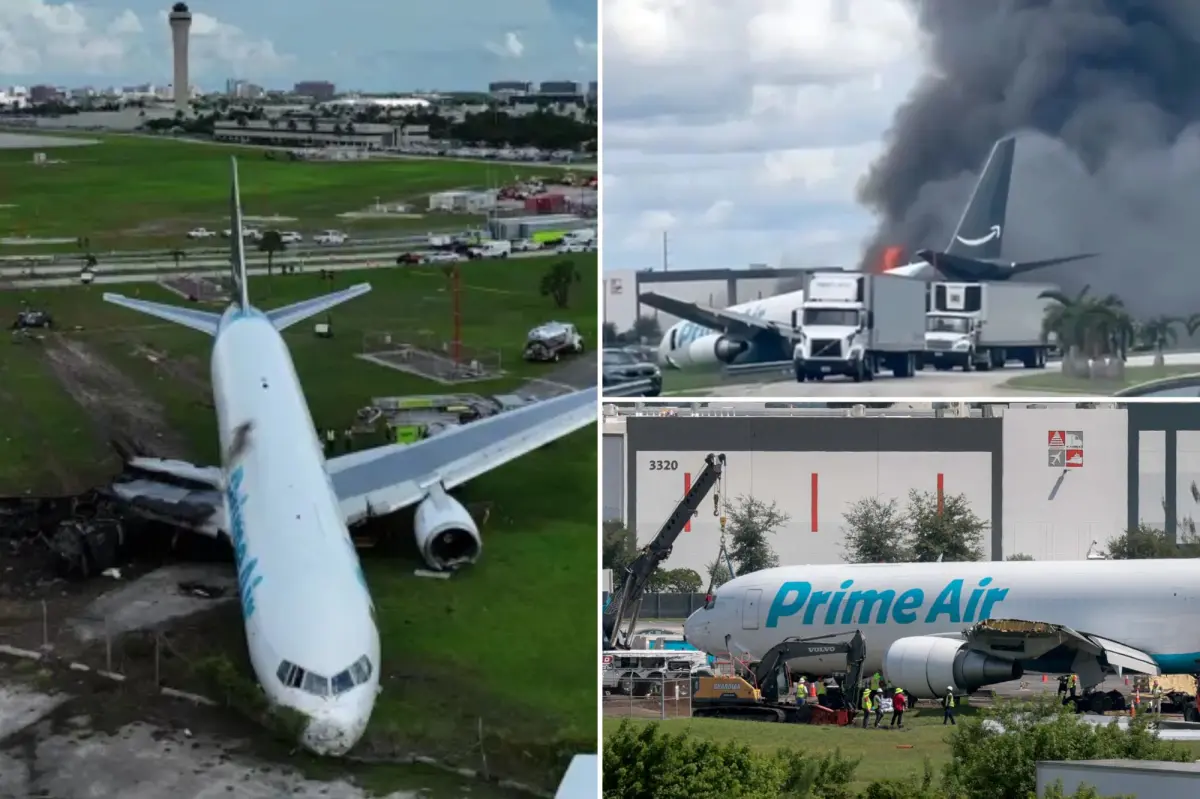
On September 6, a Boeing 767 cargo plane was making its way from Puerto Rico to Miami International Airport, loaded with packages of contact lenses for Amazon. It was a routine flight, one of thousands that keep the modern world humming, and the five people on the ground near the runway had no reason to expect anything out of the ordinary. They were airplane cleaners, workers for a company that services aircraft, riding in a van as they prepared for their next assignment. Within seconds, their lives would be violently extinguished. The plane came in too fast, careened off the runway, barreled roughly 1,200 feet past the end of the pavement, and smashed into the van. Five people in the van died, two others were seriously injured, and the driver of a car on a nearby public road was also hurt. The two pilots walked away with minor injuries. According to a preliminary report released Thursday by the National Transportation Safety Board, the tragedy was preceded by a critical failure of communication. Just four minutes before clearing the plane to land, an air traffic controller had provided a wind advisory to a different flight, noting gusts of up to 25 mph from the south. But the controller did not issue information about the wind to the pilots of the Amazon cargo plane. Federal regulations require that both wind direction and velocity be stated when authorizing the use of a runway if a tailwind component exists. The report did not list a cause, and the investigation could take more than a year to complete. But already, the outline of a disaster is visible: a routine flight, a missed warning, and a van full of workers who never had a chance.
The final moments inside the cockpit were chaotic and haunting. The NTSB’s summary of cockpit voice recordings revealed that one pilot repeatedly warned the other that the plane was going too fast, both during the approach and after touchdown. The other pilot never gave a consistent verbal response. The two men had flown together for the first time earlier that day, a fact that may prove significant as investigators examine crew coordination and cockpit communication. The aircraft’s automated systems also sounded warnings about the plane’s rate of descent and the rapidly approaching terrain, mechanical voices adding to the rising tension. The numbers tell the rest of the story. When the 767 touched down, it was traveling at 184 miles per hour and was already about three-quarters of a mile past the start of the runway. The pilots may have tried too late to abort the landing. Data show the wheel brakes were applied, then released as the engines throttled to “go-around” thrust values—a maneuver that would have lifted the plane back into the air for another attempt. But the go-around came too late. The brakes were applied again with only about 415 feet of runway remaining. The plane ran off the pavement while still traveling at 130 miles per hour, struck airport equipment and the cleaning crew’s van, crashed through a perimeter fence, hit a car on a public road, and came to rest with its nose in a parking lot fence. The entire disaster unfolded in a matter of seconds, but the echoes will last a lifetime.
To understand how this could happen, it helps to understand the weather. A tailwind blows from behind the aircraft, increasing its ground speed and making it much harder to stop. During landing, pilots prefer to face into the wind, because a headwind slows the plane and provides lift. A tailwind, especially a gusting one, can push a plane past its intended touchdown point and eat up the runway needed for braking. Experts said the weather appeared to play at least some role in the accident. Tony Mello, a former Federal Aviation Administration official who oversaw air traffic control services in the central United States, said that when winds are like that, it is the controller’s responsibility to issue that information to a pilot, especially on landing and especially when gusts are present. John Goglia, a former NTSB member, said landing with a gusting tailwind requires more concentration on the part of the pilot but is not impossible. He described the failure to share the wind conditions as a significant omission, but he was careful not to assign blame for the entire crash to that one mistake. “Every crash is a chain of events,” he said. “That’s just one event.” His words are a reminder that aviation accidents are rarely caused by a single error. The missing wind advisory was one link. The unanswered cockpit warnings were another. The late go-around was still another. Together, they formed a chain that ended in catastrophe.
The people who died in the van were not statistics. They were workers, part of a crew employed by a company that cleans airplanes. Their job was to board planes after flights, wipe down tray tables, collect trash, vacuum floors, and prepare cabins for the next passengers. It is essential work, but it is often invisible to the flying public. On September 6, they were in a van near the runway, perhaps waiting for their next assignment, when a 767 weighing hundreds of thousands of pounds came crashing into them. There was no warning, no time to run. Five of them died. Two others were seriously injured, and the driver of a car on a public road was also hurt—a person who simply happened to be driving past the airport at the wrong moment. The cargo on the plane was contact lenses, a product so ordinary and mundane that it seems almost absurd in contrast to the destruction. But that is often how tragedy works: it arrives in the middle of ordinary moments, turning routines into memorials. The families of the five workers are now left with empty chairs, unanswered phone numbers, and the unbearable weight of sudden, violent loss. The two pilots survived with minor injuries, but survival does not mean they are unscathed. They will carry the memory of those final seconds, the alarms, the warnings, the sound of impact. They, too, are victims, though they walked away.
In the aftermath, the corporate response was swift, at least in business terms. Amazon suspended its partnership with 21 Air, the North Carolina-based operator of the doomed plane. 21 Air had been flying packages for Amazon since 2024, part of the vast logistics network that powers online shopping. In a written statement, 21 Air said safety is “a core focus” of its organization, and that it is reviewing the information in the NTSB preliminary report closely, alongside its own internal safety and operational protocols. The company promised to take all appropriate action to improve safety based on the facts as they are established. Those are the words that corporations always offer after a tragedy, and they will mean little to the families of the victims unless they are followed by real change. The aircraft itself was a 32-year-old Boeing 767, originally built to carry passengers and converted to a cargo plane in June 2016. Age and conversion are not necessarily causes of the crash, but they are part of the context of a cargo industry that often relies on older aircraft flying long hours. The Miami crash also came less than a year after a UPS cargo plane crashed at Louisville’s Muhammad Ali International Airport after losing its engine while accelerating down the runway. That crash killed all three pilots and 12 people on the ground, and injured 23 more. These two tragedies, so close in time, have cast a spotlight on the safety of cargo aviation—a world of night flights, heavy loads, and tight schedules, where the pressure to deliver goods can sometimes overshadow the need to be careful.
The NTSB’s preliminary report is not the final word. It is a snapshot of a disaster that investigators will spend more than a year trying to understand. But it already contains a lesson that should trouble anyone who flies, or who works near an airport, or who believes in the power of human communication. Aviation safety is not a single invention or a single rule; it is a culture, built on the willingness of people to speak up and to listen. When an air traffic controller notices a strong tailwind and mentions it to one pilot but not to another, that is a failure of culture. When one pilot warns that the plane is going too fast and the other does not respond, that is another failure. When the automated systems are screaming and the humans on the flight deck are not on the same page, the system has already begun to break. And when a van full of airplane cleaners is parked near a runway, relying on the hope that everyone else is paying attention, the consequences of that breakdown become fatal. The five workers who died on September 6 did not have a chance to tell their own stories. They were doing a job that most of us never see, and they were killed by a chain of errors that should have been broken at any number of points. The investigation will continue, and it may lead to new regulations, better training, improved cockpit communication, and more rigorous enforcement of existing rules. That is the only fitting tribute to their memory. We cannot bring them back, but we can make sure that the wind is always reported, the warnings are always heard, and the silence that killed them is never allowed to take root again.