





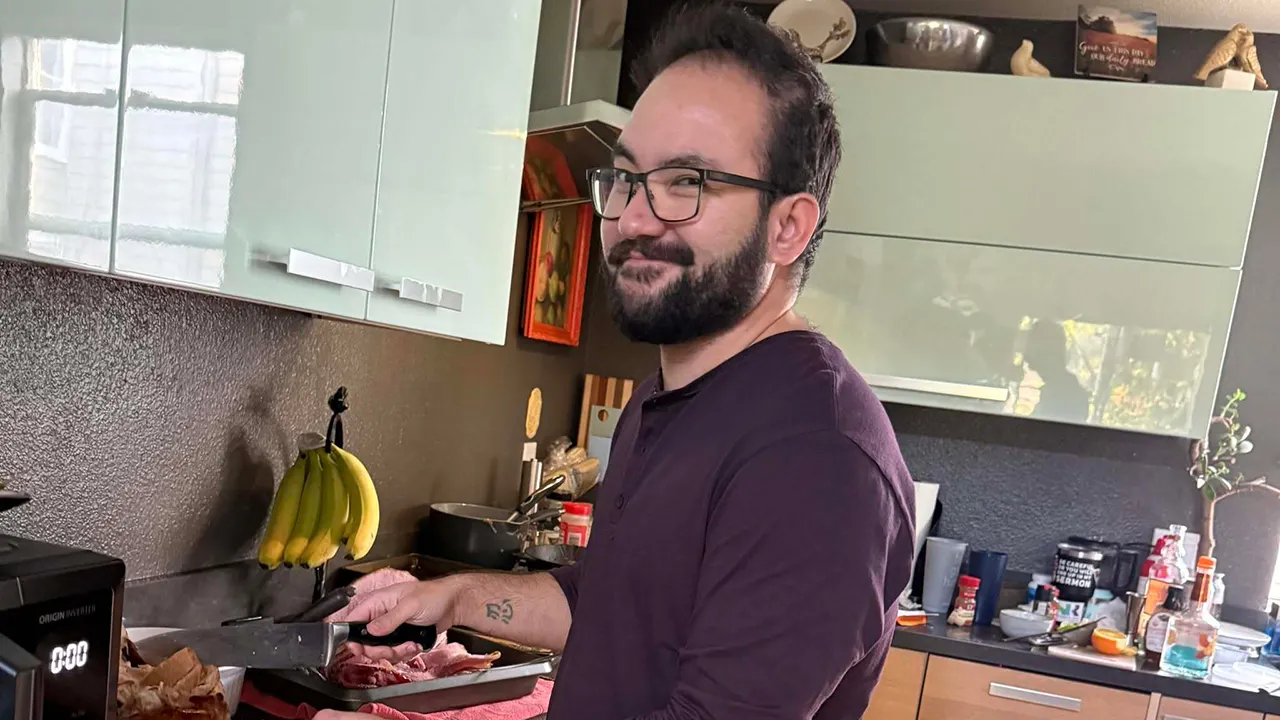
In the quiet, ordinary language of a parent’s love, William Finney II reached out to his son with a message that now carries a devastating weight. On September 7, beneath a smiling photo Jonathan McKinsey had shared on Facebook, Finney wrote, “Jon, hope everything is going well. Hope you can visit us when you have some free time. Mom and Dad love you so much and miss you. Hope everything goes well with you and Candice and the kids.” It was the kind of message any parent might send—hopeful, warm, a gentle nudge toward family and connection. But less than three weeks later, that same son, a 40-year-old New York Times executive, was shot to death in a California park parking lot. The image of a father typing those words, unaware of the storm gathering around his child’s life, is heartbreaking in hindsight. It reminds us that behind every headline about crime and court battles, there are real people with families who love them, who pray for them, and who never imagine that a routine Facebook comment could become part of a tragedy. That message now stands as a haunting artifact of a family’s hope, a last written plea for togetherness before violence tore everything apart. The father’s words also humanize McKinsey in a way that court documents cannot—he was someone’s child, someone’s partner, someone’s parent, and someone who was deeply missed even before he was gone.
The violence that ended McKinsey’s life unfolded in the parking lot of the Dublin Sports Grounds, a public space where families gather for games and children run around. According to the Alameda County District Attorney’s Office, McKinsey’s in-laws, 77-year-old Shouyong Zhang and 77-year-old Shili Chen, carried out a planned ambush, killing him in a hail of gunfire. Prosecutors charged the elderly couple with murder, alleging they acted by “lying in wait.” Several 911 callers reported gunfire, and when a Dublin Police Services sergeant arrived, he found McKinsey suffering from multiple gunshot wounds. Witnesses pointed officers toward a black Honda Civic leaving the parking lot, and police quickly conducted a high-risk traffic stop nearby. Chen was allegedly driving, with Zhang in the passenger seat. Three witnesses identified both as the shooters, and surveillance video allegedly captured the couple opening fire “in concert” on McKinsey. The attack happened in a crowded parking lot, with children nearby, and authorities described a “blatant disregard for public safety.” During an interview with investigators, Zhang reportedly admitted to shooting McKinsey, and police recovered a second gun he allegedly used. The cold, calculated nature of the alleged crime—two elderly grandparents accused of lying in wait and executing their son-in-law—is almost impossible to reconcile with the image of a father’s Facebook message. It speaks to a family conflict so deep and so poisoned that it ended in the most extreme violence imaginable. The public nature of the killing, in a place meant for recreation and joy, only adds to the sense of shock and sorrow.
To understand how a family could fracture so completely, one has to look at the bitter legal war that surrounded McKinsey and his estranged wife, Candice Jang. The couple had been married for 14 years and were living apart, with Jang holding sole legal and physical custody of their three children. McKinsey had filed for divorce in December, and the months ahead were filled with court dates: a family law status conference scheduled for October 2 and a three-day domestic violence restraining order hearing set for December. Court records show competing allegations of abuse, each side painting a dark picture of the other. This was not a simple, amicable separation; it was a battlefield of accusations, fear, and mistrust. The children were at the center of it all, and both parents seemed desperate to protect them in their own ways. McKinsey’s death came just as these legal battles were intensifying, leaving the case unresolved and the children without a father. The tragedy is compounded by the fact that the alleged killers were not strangers or hitmen, but the children’s own grandparents—people who might have been expected to shield the family from harm, not to become the instruments of its destruction. The divorce and custody proceedings were already a painful chapter, but no one could have predicted they would end in a parking lot ambush. The legal system, with its hearings and restraining orders, was supposed to be the arena where these conflicts were resolved. Instead, the conflict spilled out into the real world with deadly consequences.
McKinsey’s own court filings reveal a man who felt trapped and terrified. He alleged that Jang physically and emotionally abused him on a weekly basis and mistreated their children. In a declaration reviewed by KTVU, he wrote, “I truly believe that she would hurt or even kill them if she believed there was any possibility of me having the children in my custody and care.” Those are chilling words, especially now that he is gone. McKinsey, who was a transgender man, also detailed painful conflicts with his in-laws. He accused his mother-in-law, Chen, of directing anti-LGBTQ slurs at his son and at him when he intervened. He claimed that Zhang struck him in the chest while he was recovering from double mastectomy surgery in 2010. Even more disturbing, McKinsey alleged that Jang forced him to eat a dead cockroach and once struck him with a frying pan. These are the kinds of allegations that, if true, paint a picture of a household filled with cruelty and control. Whether or not every detail was accurate, they show a man who believed he was fighting for his life and the lives of his children. His fear of his in-laws, in particular, now seems tragically prophetic. He saw them as a threat, and in the end, they were the ones accused of pulling the trigger. His vulnerability as a transgender man, recovering from surgery, and facing a powerful opposition, adds another layer of sadness. He was not just fighting for custody; he was fighting to be heard, to be believed, and to protect his children from what he saw as a dangerous environment.
But Jang told a very different story. In her own protection order request, she alleged that McKinsey physically and emotionally abused her, their children, and her parents. She asked the court to keep him away from all of them, writing, “He can be vindictive, and I worry he will retaliate against me and the people listed above.” She also wrote that she slept with a pair of scissors near her bed for protection in 2021. Prosecutors separately charged McKinsey in October with two misdemeanor counts alleging he struck his 6-year-old son and left his 2-year-old child home alone while shopping, according to KTVU. McKinsey denied intentionally leaving the toddler behind, arguing that Jang had orchestrated the situation to frame him. The competing narratives are dizzying—two parents, each accusing the other of terrible things, each claiming to be the protector of the children. In the middle of this he-said-she-said, there were three young lives, caught in a storm of adult rage and fear. Despite the ongoing legal battles, a judge later approved unsupervised public visits with the couple’s children, suggesting that at least some part of the system believed McKinsey could safely see his kids. Then, on Tuesday night, police served a search warrant at Jang’s home. Authorities have not disclosed what they were seeking. The investigation is ongoing, and it is not clear whether Zhang or Chen have retained attorneys. The legal aftermath of McKinsey’s death is still unfolding, but the family drama that led to this point remains murky and painful. What is clear is that both sides were suffering, both sides felt threatened, and both sides believed they were fighting for something sacred.
In the end, this story is not just about a shooting, a divorce, or a custody battle. It is about the tragic unraveling of a family, and the way love can curdle into something unrecognizable. A father’s Facebook message, so full of hope, now sits as a silent memorial to a son who never made it home. The children at the center of this case have lost their father in the most violent way imaginable, and their grandparents are accused of being the ones who took him from them. Whatever the truth of the allegations between McKinsey and Jang, no one emerges from this story unscathed. The grandparents, if convicted, will spend their final years in prison. The mother must somehow explain to her children why their father is gone and why their grandparents are not there. The father of the victim must live with the memory of a message that went unanswered in the worst possible way. This tragedy also serves as a reminder of how deeply family court battles can wound people, and how the system, for all its intentions, sometimes cannot contain the rage that builds between estranged partners and their extended families. It is a story about the fragility of human relationships, the danger of unresolved anger, and the way that even the most ordinary moments—a photo on Facebook, a comment from a parent—can become part of a much darker narrative. As the investigation continues and the legal process moves forward, we are left with more questions than answers. But we are also left with a profound sense of loss, not just for Jonathan McKinsey, but for everyone who loved him, and for the children who will grow up without him. In the end, the father’s plea—“Mom and Dad love you so much and miss you”—was answered, but not in the way anyone could have hoped.