



Paragraph 1: The Serene Sky Shatters Near Rimrock Lake
The air above Rimrock Lake hangs thick with the scent of pine, cool alpine moisture, and the uncomplicated quiet of a late spring afternoon in Washington’s Cascade Mountains. For the hikers, weekend campers, and local anglers scattered along the shoreline, June 13th felt like any other idyllic day—a time for casting lines, snapping photographs of snow-capped peaks, and soaking in the deep green of the national forest. The peaceful rhythm was abruptly torn apart by a sound that does not belong in that wilderness: the low, howling roar of a tactical jet aircraft, flying far lower and slower than anyone on the ground expected a fighter jet to fly. The F-18 Hornet, a machine designed for speed and lethality, was in obvious distress, its engines sputtering and coughing like a wounded animal. Pedestrians froze, their eyes tracking the grey silhouette as it banked precariously over the lake, its wings wobbling. Then, the sky split open with a violent explosion as the jet impacted the steep tree-covered mountainside, sending a massive fireball, plumes of thick black smoke, and shards of burning metal cascading down the slope. Panic rippled through the lakeside crowd. A woman began to sob uncontrollably as she frantically dialed 911, her shaky voice collapsing into incoherent sobs, while other witnesses shouted conflicting details to dispatchers. Within seconds, the Yakima County emergency communications system lit up with a flurry of calls, demanding helicopters, fire trucks, and paramedics. The first frantic report caught the dispatchers’ attention: “JET CRASH,” followed by a secondary, almost miraculous detail: “PILOT PARACHUTED OUT.” The initial shock began to mix with cautious hope—the pilot was still alive, floating somewhere down out of that terrifying chaos.
Paragraph 2: The Pilot’s Violent Departure and Bizarre Ascent into Survival
Major Simon, a seasoned Marine Corps aviator assigned to Marine Aircraft Group 11, 3rd Marine Aircraft Wing, had been conducting routine low-level training maneuvers over the rugged terrain, flying a standard circuit pattern some 55 miles southeast of Seattle. The routine turned catastrophic in a heartbeat. The sudden, violent failure of the aircraft’s systems gave him no warning, no manual for the split-second decision that followed. As the ejection seat fired beneath him, the rocket blast threw him violently upward through the canopy, the explosive shockwave shattering the acrylic glass and sending fragments whipping against his unprotected face, slicing through his soft tissue and splitting his forehead and cheeks. The windblast at those speeds tore at his torso, ripping at his flight suit, while the brutal deceleration of the parachute deploying snapped his spine like a whip, momentarily blinding him. He descended in a surreal silence, watching the horror unfold below as his multi-million-dollar Hornet plowed into the mountain, erupting into a billowing inferno of burning jet fuel and twisted aluminum. The tree line rushed up to meet him far too quickly. He crashed through the dense network of Douglas firs and ponderosa pines, the parachute lines snagging on branches and limbs, yanking him to a jarring, awkward halt. Dangling there, suspended between earth and canopy, he felt the warmth of blood trickling down his face and pooling in his eyes. Disoriented but trained to a razor’s edge, Major Simon unclipped his harness, dropped several feet to the ground, and landed hard on the uneven forest floor. With adrenaline flooding his system, he quickly gathered his survival gear—his helmet, his knife, his signaling devices—before pulling out his personal cellphone. Remarkably calm, he punched in the number for his unit’s command post, as if calling in a weather report, to inform them of his status and location while standing ankle-deep in pine needles, a hundred yards from the roaring fire consuming his aircraft.
Paragraph 3: The Deputy’s Search and the Bizarre Encounter
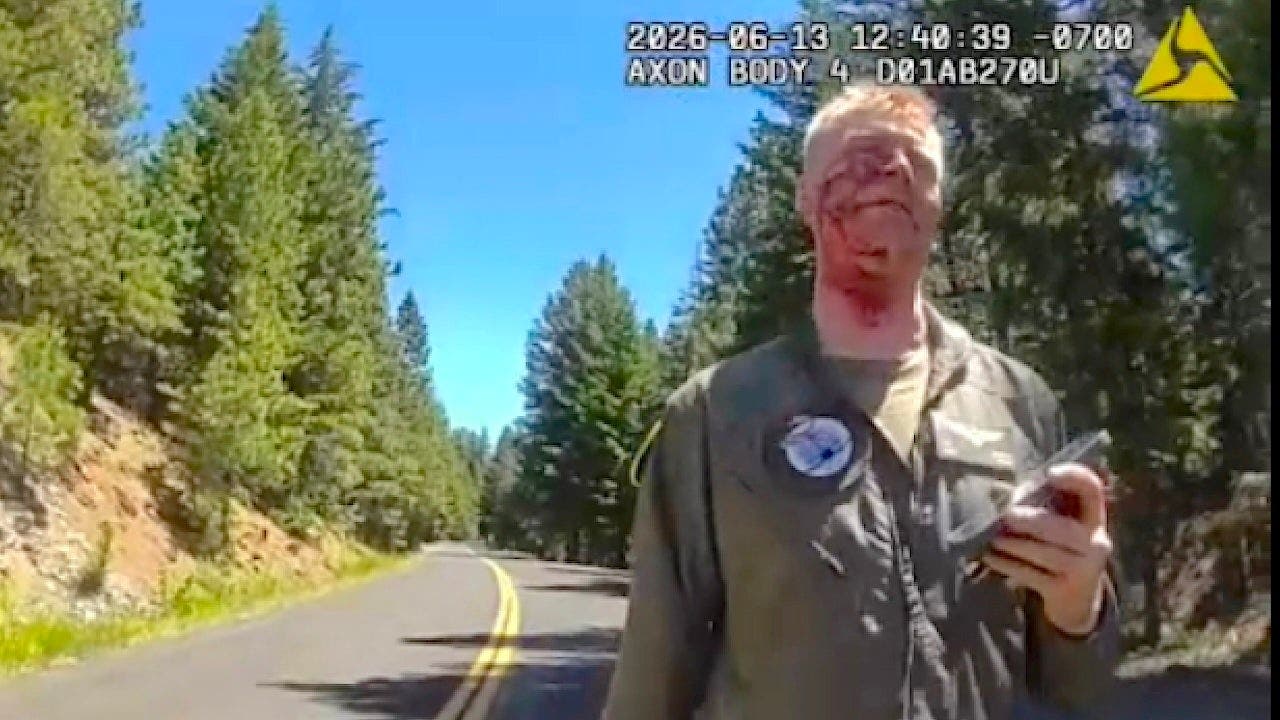
On the ground, the first responder to reach the crash site was a Yakima County Sheriff’s Deputy, a career law enforcement officer accustomed to the mundane realities of rural policing—dealing with livestock on the road, bar fights at the local tavern, or the occasional lost hunter. But this call, relayed over his radio with the frantic urgency of a mass casualty event, was something entirely different. Racing his patrol unit up the winding mountain access roads, the deputy watched the tall column of black smoke rising like a sinister beacon over the treeline, guiding him to the epicenter. He parked his cruiser, grabbed his med kit, and began a hard hike through the underbrush, his breath ragged, his mind racing with the possibility of finding a severely injured aviator, or worse, nothing but scattered remains. Then, through a break in the trees, he saw him: a man in a full olive-drab flight suit, his face covered in livid red blood, walking casually along the edge of a forest service road as if returning from a morning jog. The deputy’s heart slammed against his ribs as he approached, his hand instinctively hovering over his sidearm before realizing the figure posed no threat. The pilot spotted him and offered a tired, lopsided grin, blood still oozing from his split lip. The deputy moved in, immediately assuming the role of medical first responder. He began the practical, physical examination—a “buddy check” as military personnel call it—running his hands along the pilot’s neck and spine, checking for hidden fractures or spinal injuries, ignoring the pilot’s protests that he was fine. The surreal nature of the moment struck the deputy like a freight train: here was a man who had just been rocketed out of a jet that had exploded into a mountain, standing placidly amongst the wreckage, requesting a bottle of water and asking if anyone had seen his sunglasses.
Paragraph 4: The Calm Under Pressure Captured in Dialogue
The interaction between the deputy and Major Simon, captured on the deputy’s body camera, offered the world a glimpse into the astonishing psychological armor of a military test pilot. As the deputy asked the inevitable, obvious question, Simon started to respond, cutting himself off mid-sentence. “Well, that was–” he began, before trailing off, as if the experience was too mundane to warrant a complete sentence. When the deputy pressed him for details on what had induced the ejection, Simon tried to piece together the chaotic final moments. “We were doing some circles over the lake,” he explained, his voice flat and pragmatic. “I tucked in, and I’m not sure exactly what happened. Honestly, I’m a little frazzled.” The word “frazzled” was a masterclass in understatement; his flesh was torn, his body bruised, and his aircraft was hunka burning steel behind him. The deputy, noticing the significant blood flow, asked if his facial lacerations were painful. Simon gently touched his cheek, looked at the crimson staining his glove, and dismissed it as a minor inconvenience. When the deputy gestured toward the smoking wreckage and the dense trees separating them from it, Simon matter-of-factly confirmed his trajectory: “I went through the trees.” His hands were trembling, a physiological response he couldn’t suppress despite his mental focus, and he readily admitted it when asked. “I have some adrenaline going,” he said, his voice carrying a hint of embarrassed amusement. The moment reached its peak of surrealism when Simon flipped open his phone again, dialed a number, and spoke to someone on the other end with the casual tone of a neighbor asking to borrow a lawnmower. “Hey, buddy, this is Major Simon, I just crashed.” As he pocketed the phone, he turned to the deputy, summed up the entire harrowing ordeal, and delivered a line that would define the story: “Without exaggeration: That’s about as close as you come.”
Paragraph 5: The Cold Bureaucratic Aftermath and the Long Investigation
Back in Southern California, the switchboards at Marine Corps Air Station Miramar buzzed with the grim music of an incident report. The initial communications transformed the chaotic wilderness scene into precise military jargon: an F-18 Hornet, assigned to Marine Aircraft Group 11, 3rd Marine Aircraft Wing, had been lost in a “non-fatal aviation mishap” during routine training approximately 55 miles southeast of Seattle. The destroyed airframe, a piece of hardware valued at nearly $67 million, was now nothing more than a smoldering scar on the mountainside, a financial black hole that contractors and government auditors would spend months reconciling. The official public statements were quick to confirm the pilot’s recovery and stable condition, thanking the Yakima County Sheriff’s Office and local first responders for their rapid response, but offering no cause for the catastrophe. Behind closed doors, the intricate web of a military accident investigation began to spin. Crash investigators would be dispatched to the rugged site, tasked with painstakingly sifting through the charred debris, retrieving the flight data recorder and cockpit voice recorder from the wreckage, and interviewing the still-shaken Major Simon in exhaustive detail. They would scrutinize maintenance logs going back years, review satellite weather data, and analyze every radio transmission. Military officials, speaking to reporters, emphasized that these investigations are notoriously complex and thorough, often taking upwards of several months to complete. While the pilot’s survival was the headline, the deeper questions remained unanswered: Was it a mechanical failure, a bird strike, or a momentary lapse in judgment? Without definitive answers, the Hornet fleet’s training syllabus would face temporary holds, and a cloud of speculation would hang over the Pacific Northwest until the official report surfaced.
Paragraph 6: The Walk Away—A Testament to Training and Resilience
As the afternoon sun lowered over the Cascade Range, casting long shadows across the scorched earth, the spectacle of the crash site began to transition into a somber postscript. Major Simon, now carefully examined, was eventually loaded into a medical evacuation helicopter, presumably bound for a hospital to receive sutures for his facial lacerations and undergo a full battery of X-rays and neurological tests. He left the scene under his own power, declining a stretcher, his head held high despite the gauze taped to his brow. The tragedy of the lost aircraft was real—$67 million of taxpayer money gone in an instant—but the miracle of the pilot’s survival overshadowed the destruction. For the deputy, watching the helicopter lift off, the encounter would remain a career-defining moment, a stark reminder that even in the most terrifying of human events, composure can coexist with catastrophe. For the community of Rimrock Lake, the smoke would dissipate, but the memory of the jet screaming overhead would linger for years. And for Major Simon, the debriefing was only beginning. Yet, as he stared out the helicopter window at the ragged tear in the forest canopy, he likely felt an immense, overwhelming gratitude. He had walked away from a fireball, survived a descent through a murderous forest, and held a casual conversation with a policeman while bleeding from his face. His performance under unimaginable duress was not luck; it was the culmination of years of brutal training, muscle memory, and the unshakeable mental fortitude demanded of a Marine aviator. The investigation would drone on for months, the headlines would fade, and the insurance forms would be filed, but for one man, June 13th was simply the day he looked death in the eye, shrugged, and said, “I’m a little frazzled.”