


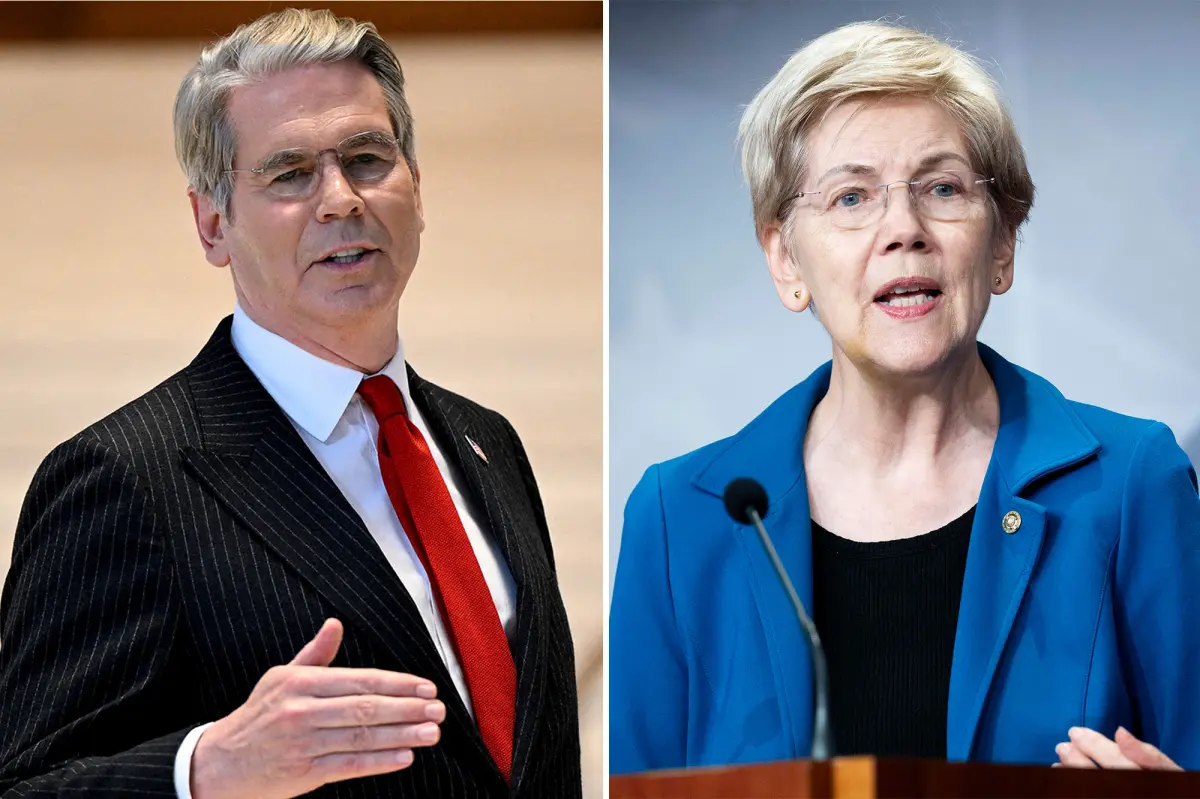
In the often-sterile world of high finance and government bureaucracy, a handwritten note can feel like a relic of a bygone era. But when Treasury Secretary Scott Bessent picked up his pen to write to Senator Elizabeth Warren, it wasn’t an act of old-fashioned courtesy—it was a deliberate, sharp-edged provocation. Bessent, a former hedge fund manager now steering the nation’s economic policy, addressed his note to the Massachusetts Democrat with a sarcastic holiday greeting: “Happy Indigenous Peoples’ Day in advance to you and your family.” The words, reported by Fox Business Network, were not a warm gesture but a pointed callback to one of the most contentious and personal controversies of Warren’s political career: her past claims of Native American ancestry, which were met with widespread skepticism, genetic testing, and eventually the unforgettable nickname “Pocahontas” from President Donald Trump. By invoking that history, Bessent wasn’t just exchanging pleasantries—he was throwing down the gauntlet in a bitter, personal war of words between two powerful figures who represent opposing visions of America’s economic future.
The note was also, by design, a jab at Warren’s legendary appetite for correspondence. Since the start of the second Trump administration, Warren has sent more than 100 letters to Bessent alone, according to his team, each one demanding answers, data, or policy changes from the Treasury Department. Warren’s latest missive, dated October 10, asked pointed questions about what the Treasury was doing to lower borrowing costs for ordinary Americans, citing a surge in yields that she described as “self-inflicted.” For Bessent, this barrage of paper is less a genuine inquiry than a political performance. “Senator Warren loves to write letters,” he told Fox and Friends on Sunday, his voice dripping with exasperation. “More than writing the letters, she loves to leak them to the press. That I read about the letter on Bloomberg and Politico before we receive it, and a lot of these letters are embarrassing.” It’s a telling complaint: Bessent isn’t just annoyed by the volume of Warren’s inquiries; he’s insulted by their content, which he believes betrays a profound misunderstanding of how markets and monetary policy actually function. In his view, Warren is not a diligent oversight official but a headline-hungry grandstander using the Treasury as a prop.
What makes this feud so human—and so fascinating—is that it’s not really about the mechanics of bond markets or the arcane distinctions between financial instruments. It’s about identity, respect, and the deep chasm between two ways of understanding power. Bessent’s public dismissal of Warren as “economically illiterate” is a brutal personal attack on a woman who built her political brand on being a former Harvard Law professor and a fierce consumer advocate. He went further, citing specific examples of what he sees as her incompetence: confusing a currency swap with a currency intervention, and accusing the Treasury of a bond market intervention that he insists has been underway since 2024. For a layperson, these terms might sound like technical jargon, but for Bessent, they are proof that Warren, the ranking member of the Senate Banking Committee and a member of the Senate Finance Committee, lacks the fundamental knowledge required for her job. “The shocking thing here,” he said, “is that she is the ranking member on the Senate Banking Committee, and she is on Senate Finance.” The implication is clear: Warren is not just wrong—she is dangerously unqualified, and her position of influence only magnifies the danger.
To understand why Bessent would resort to such a personal barb, you have to revisit the long and painful saga of Warren’s Native American ancestry. For decades, Warren’s claims of indigenous heritage were a source of professional and political advantage, or so her critics argued. In 1984, she authored a Native American cookbook and identified as Cherokee. Two years later, she marked herself as “Native American” in a State Bar of Texas survey. Between 1995 and 2004, Harvard Law School, where she taught, described her as Native American on federal paperwork—a designation that would have made her a valuable asset in an era of affirmative action. When she ran for Senate in 2012, her Republican opponent, Scott Brown, seized on these claims, calling them a career move rather than a matter of heritage. The controversy exploded again in 2018 when President Trump, never one to let a rival’s vulnerability go unexploited, dubbed her “Pocahontas” and offered to donate $1 million to a charity of her choice if she took a DNA test to prove her ancestry. Warren accepted, submitting to genetic analysis by Stanford professor Carlos Bustamante. The results were, at best, ambiguous: she possessed a Native American ancestor “in the range of 6-10 generations ago,” with her heritage estimated between 1/64th and 1/1,024th, while her genome was about 95% European. Some geneticists argued that the analysis was flawed due to the lack of Native American reference data, but the damage was done. The Cherokee Nation condemned the way she used the test, and Warren issued a formal apology in early 2019, admitting she had made mistakes in how she described her background. Yet the nickname stuck, and the wound never fully healed. For Bessent to resurrect this episode—even with a sly holiday greeting—was a deliberate and cruel escalation, one that shifted the fight from policy to personal integrity.
The economic substance of their dispute, however, is no less urgent. Warren’s October 10 letter to Bessent arrived at a moment of genuine financial anxiety. The 30-year Treasury yield, the rate of return investors expect for holding long-term federal debt, had just jumped to its highest level since 2004, a signal that markets were losing confidence in the government’s fiscal path. Warren blamed the surge on the Federal Reserve’s decision to raise the federal funds rate by a quarter of a percentage point, driven by concerns about inflation, and she argued that the Treasury’s policies were making things worse for everyday Americans who borrow money for mortgages, car loans, and business expansion. Bessent, however, rejected her premise with contempt. “It is difficult to treat your concern as sincere,” he wrote, before turning the tables on Warren’s own record. “As the federal funds rate climbed from near zero to its highest level in 22 years, with inflation hitting a 40-year high, you were a cheerleader for the Biden Administration’s reckless spending.” In Bessent’s telling, Warren is not a critic of fiscal irresponsibility but an enabler of it—someone who cheered on the very policies that fueled inflation and are now causing yields to spike. This is not just a disagreement over numbers; it is a fundamental clash over who is responsible for the economic pain Americans are feeling at the grocery store, at the gas pump, and in their monthly mortgage statements. Warren sees herself as a watchdog for working families; Bessent sees her as a hypocrite who helped create the mess she now purports to fix.
The tone of Bessent’s response was, by his own admission, “sassy,” and it culminated in an offer that was less a helpful gesture than a sarcastic insult. “If you receive a passing grade to the Yale metric, not the Harvard curve, I would be happy to also include a Fixed Income for Dummies,” he wrote, cheekily offering Warren a “Foreign Exchange for Dummies” tutorial. The Yale reference is a nod to his own alma mater, while the Harvard curve is a dig at Warren’s old employer, which has a reputation for generous grading. It was a schoolyard taunt dressed up in the language of an Ivy League rivalry. Warren’s office, notably, did not respond to a request for comment, perhaps recognizing that any reply would only feed the spectacle. But the episode reveals something important about the state of American governance in the 2020s. Policy debates have become deeply personal, and the people who are supposed to oversee the nation’s finances are spending their time exchanging insults that sound more like late-night cable news segments than serious discussions about the future. Bessent’s handwritten note, with its mocking holiday greeting, and Warren’s relentless letter-writing campaign, with its inevitable leaks to the press, are both performances designed for an audience far beyond the walls of the Treasury and the Senate. They are playing to their bases, raising money, and building political narratives. In the process, the actual work of governing—ensuring stable markets, fair taxation, and sound fiscal policy—risks being buried under an avalanche of snark and self-righteousness.
And yet, for all the nastiness, there is something undeniably human about this feud. Bessent, a man who spent his career in the rarefied air of hedge funds, seems genuinely baffled and offended that a senator would dare to challenge his expertise with letters he considers foolish. Warren, a woman who has spent her life fighting for consumer protections and financial reform, seems genuinely convinced that she is exposing the arrogance and recklessness of Wall Street elites like Bessent. Each believes the other is not only wrong but dangerous, and their contempt is a natural extension of a political culture that rewards conflict over cooperation. But the deeper tragedy is that their fight is not merely personal. The questions Warren raises—about who benefits from Treasury policy, about whether the government is doing enough to lower borrowing costs, about the long-term sustainability of federal debt—are real and urgent. And Bessent’s responses, however snarky, contain a kernel of valid criticism: the political class did overspend, and inflation did ravage American households. Neither side has a monopoly on wisdom, and neither side seems capable of listening to the other. In that sense, the handwritten note and the hundred letters are symbols of a broken dialogue, a national conversation that has devolved into a shouting match. Perhaps the only honest conclusion is that the American people, struggling to make ends meet, deserve better than a Treasury secretary who calls his counterpart “economically illiterate” and a senator who uses the press to score points. They deserve leaders who can disagree without disdain, who can debate policy without questioning each other’s intelligence or ancestry, and who can remember that the real enemy is not the person across the aisle but the economic insecurity that haunts so many families. Until that changes, the battle between Bessent and Warren will remain a cautionary tale—a vivid, human reminder of how far our public discourse has fallen.