

President Trump has never been shy about putting his name on things, and this weekend he made it clear that he is no longer satisfied with buildings, hotels, or even entire countries’ worth of attention. At a rally in Clarksville, Tennessee, the president mused aloud about renaming either the Atlantic or Pacific Ocean after himself, saying, “We’ve got the Gulf, we’ve got a beautiful lake, and now someone said ‘you need a river,’ so, I don’t wanna change the name of the Hudson River. Henry Hudson, he did a good job sailing up that sucker a long time ago.” He then pivoted to the grandest of geographic gestures: “So, we need a river; we need an ocean. So, I was thinking of either the Atlantic or the Pacific. We call it Trump Ocean or Ocean of the Americans, something like that.” He paused to reassure the crowd that the Mississippi River is safe, because he loves that state and won it by a lot. But the message was unmistakable: President Trump doesn’t just want to make waves; he wants to own the waves.
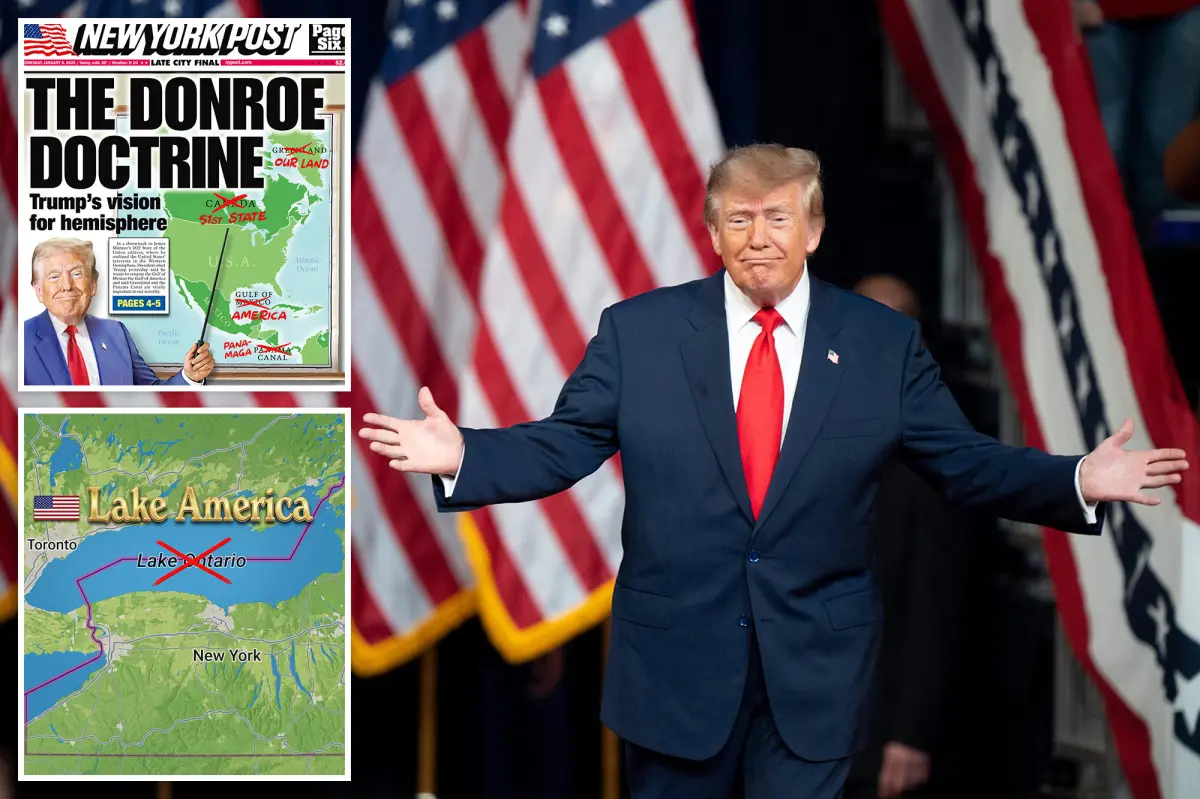
This is not a sudden impulse. For decades, Trump has been famous for slapping his name on everything from skyscrapers to steaks, and now that he is back in the White House, the entire map of the United States has become his latest canvas. Already, he has signed executive orders to rename the Gulf of Mexico as the “Gulf of America” and Lake Ontario as “Lake America,” the latter coming as part of his ongoing trade war with Canada. Some of these proposals started as offhand jokes at rallies, but with Trump, jokes have a way of becoming policy. He has also floated renaming the state of New Mexico as “New America” and the Strait of Hormuz as the “Trump Strait,” though so far neither of those has moved beyond the idea stage. What makes this so remarkable is not just the sheer scale of the ambition, but the way Trump speaks about it as if geography is a matter of personal branding. He doesn’t talk about oceans as natural wonders or shared heritage; he talks about them as titles, trophies, and real estate opportunities. In his mind, a name is a claim, and a claim is a form of ownership.
The same instinct has driven him to rename institutions and landmarks. Last year, his administration renamed the headquarters of the U.S. Institute of Peace as the “Donald J. Trump Institute of Peace,” a move that came during one of his most public and relentless campaigns to be awarded the Nobel Peace Prize. Trump has long been obsessed with the prize, and he has repeatedly framed his foreign policy interventions—whether brokering deals, threatening adversaries, or ordering the capture of Venezuelan strongman Nicolas Maduro—as proof that he deserves the world’s highest honor. When María Corina Machado, a prominent Venezuelan opposition figure and Nobel laureate, gave Trump the prize she had been awarded, he effectively became the owner of a Nobel Peace Prize, even if it wasn’t officially his. Yet that hasn’t stopped him from expressing frustration with the Norwegian Nobel Committee. In a Truth Social post, he complained about recent winner Navi Pillay, writing, “This is the woman who received the Nobel Peace Prize over the Great United States of America, whose Representative, ME, settled eight Wars, and many other things. I know nothing about this woman, and neither does anyone else!” For Trump, the Nobel isn’t just an honor; it’s a validation he feels the world has unfairly denied him. Naming an institute after himself is his way of giving himself the recognition he believes he deserves, regardless of what the committee in Oslo decides.
The Kennedy Center has become another battleground in this campaign for self-commemoration. Trump attempted to rename the iconic Washington cultural center after himself, but a federal judge blocked the move. In response, his administration ordered a tarp to be placed over the center’s name, a visual symbol of the standoff. Trump was later seen reviewing demolition plans for the facility, and while the courts have ordered his administration to give 30 days’ notice before making major changes, the president has suggested that the building may need to be torn down because of storm damage. To his critics, the Kennedy Center is a beloved cultural institution, a place where the arts and politics meet, and a monument to a fallen president. To Trump, it is simply another property that should bear his name, another stage for his ego, another obstacle to be bulldozed if it refuses to cooperate. The tarp over the Kennedy Center is a perfect metaphor for the broader battle: even when the law stops him from putting his name on something, he will still try to cover up the old name, obscure the history, and make the world look at him.
This pattern is both uniquely Trumpian and uncomfortably familiar. Throughout history, rulers have renamed cities, mountains, and oceans after themselves, from Alexandria to Stalingrad to countless other examples. But in a modern democracy, renaming a country’s most recognizable natural landmarks feels different—more like a performance than a decree. Trump’s supporters see it as a kind of audacious patriotism, a way of putting America first by putting Trump first. His critics see it as an attempt to erase shared history and replace it with a single, all-consuming personality. Either way, the effect is the same: every map, every news cycle, every conversation about the Gulf or the ocean now includes his name. Even if the Atlantic and Pacific never officially become “Trump Ocean,” the very fact that he said it out loud, in front of a cheering crowd, is enough to keep the idea alive. Trump understands that in the age of media, the naming of a thing is less important than the conversation about it. He doesn’t need the ocean to change its name; he just needs people to imagine it.
In the end, the question of whether Trump will actually rename an ocean may be beside the point. What matters is what his obsession with names reveals about him. He is a man who has spent his entire life trying to make sure he will not be forgotten. He built towers with his name in gold letters, sold products with his name on the label, and now, as president, he wants to carve his name into the very geography of the nation. There is something almost human about that desire—the wish to leave a mark, to be remembered, to know that you mattered. But there is also something deeply lonely about it, because no ocean, no mountain, and no building can ever give a person the recognition they crave from the world. For all his power, Trump seems driven by a need that no amount of naming can satisfy. So he keeps going, from the Gulf of America to the Institute of Peace to the Kennedy Center to, now, the Atlantic and Pacific. The waves may not carry his name, but they will always carry his voice, and that, perhaps, is the only ocean he truly wants to control.