


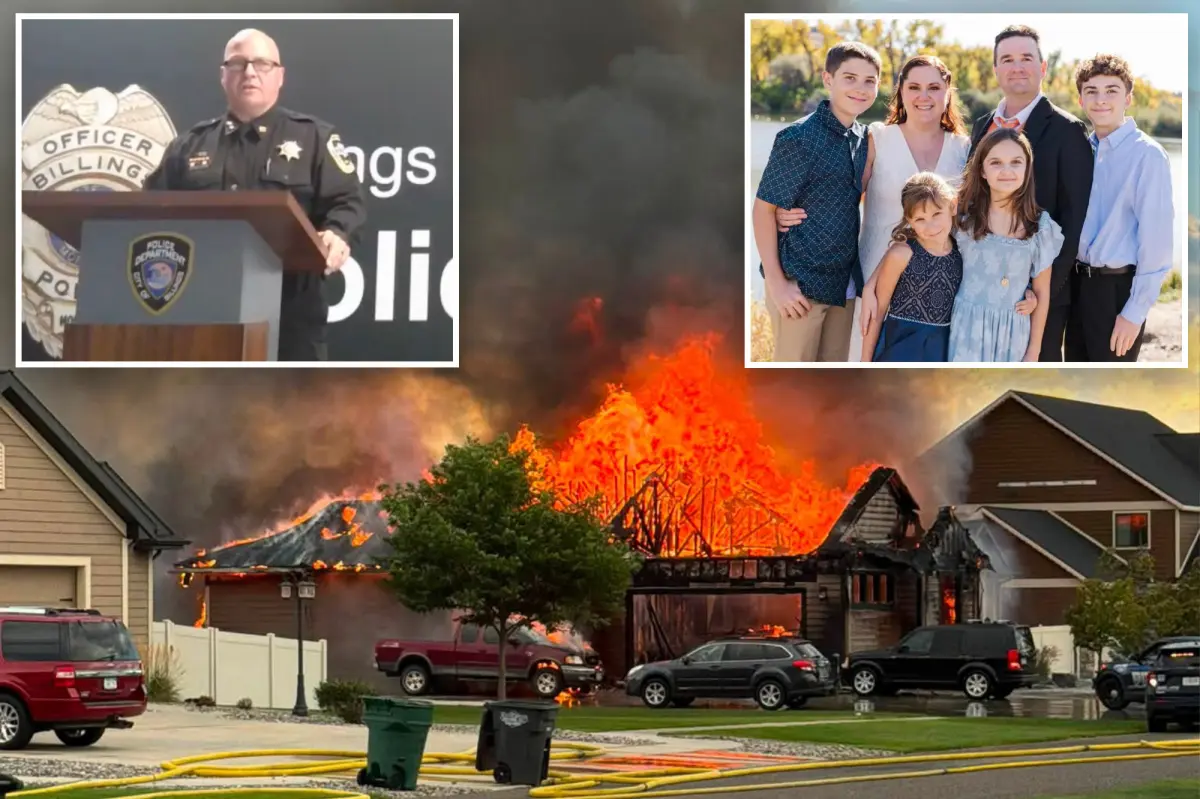
In the quiet, rural outskirts of Billings, Montana, the air was thick with the smell of smoke and the lingering breath of tragedy. The scene that greeted Yellowstone County Sheriff Kent O’Donnell was one of absolute devastation—a family home reduced to a skeletal frame of scorched timber and crumbling walls, its contents fused into unrecognizable piles of ash and debris. It was in this desolate landscape that a deputy, tasked with the grim work of combing through the ruins for evidence, stumbled upon a miracle. Half-buried beneath a collapsed shelf and a layer of sodden, blackened wreckage, lay a photo album and a Bible. The album’s cover was warped and singed, but its pages, damp and frayed, still held the captured smiles of decades past. The Bible, its leather binding scarred but intact, fluttered with pages that had miraculously escaped the furnace of the fire. For a hardened lawman, a man accustomed to witnessing the worst humanity could offer, the sight stopped him cold. He called the sheriff over, and together they knelt amongst the ashes, holding the remnants of a family’s life. The improbability of these two specific items surviving the inferno—the physical record of memory and the spiritual guidebook of faith—seemed to reach beyond mere coincidence. As O’Donnell stood, his eyes reflecting the smoldering ruins, he would later confess to the press that finding them made him think that something higher was undeniably involved in the midst of such utter loss.
To truly grasp the magnitude of this catastrophe, one must imagine the ordinary beauty of the hour that preceded it. The Smith family home, nestled on a quiet stretch of land just outside Billings, was not an architectural marvel, but a cozy, lived-in sanctuary that exuded the warmth of decades of shared history. That evening, Barbara Smith, 72, and her husband Dana, 73, were hosting a dinner for their blended family—a living testament to their resilience and capacity for love, having merged children from previous relationships into a single, intertwined unit. The dining table, adorned with a well-worn tablecloth and mismatched chairs, was likely laden with casseroles, fresh bread, and the comforting aromas of a home-cooked meal. Laughter probably drifted through the rooms as family members exchanged stories, the clinking of silverware providing a rhythmic backdrop to lively conversation. At that moment, the most pressing concerns were the temperature of the side dishes or the timing of everyone’s departure. This was a place where grandchildren had learned to walk, where birthdays had been celebrated with homemade cakes, and where Barbara and Dana had built a fortress of stability against the challenges of life. They were not wealthy in a material sense, but they were rich with each other’s presence, secure in the knowledge that their home represented a haven—a place where arguments were settled, wounds were bandaged, and love was the unspoken law. The hour of 5:50 PM marked the very pinnacle of this tranquility, the sacred golden hour of home life, where the outside world and its troubles were kept at bay, completely unaware that a devastating storm was about to break upon their peaceful shore.
That storm had a name: Alan Smith, 44, their son. The weeks leading up to that fateful evening had been tense, fraught with an escalating friction that culminated in a difficult, gut-wrenching decision by his parents. Alan had been asked to leave the family property. Whether the reason was a disagreement gone too far, a struggle with personal demons, mental health issues, or simply the inability to conform to the household’s expectations, the eviction had lit a fuse of deep-seated rage within him. For a man possibly wrestling with self-worth, resentment, and a sense of profound betrayal, being cast out by his own parents represented the ultimate rejection. The anger that festered in his mind festered into a dark, lethal resolve. At approximately 5:50 PM, as his family gathered around the dinner table in a cherished ritual of togetherness, Alan arrived at the property. The sound of his vehicle pulling into the drive may have momentarily interrupted a sentence, a brief pause in conversation that was quickly forgotten. But the weight of his presence was far heavier than anyone could have imagined. Deputies believe he began shooting almost immediately, transforming the sanctuary of the dining room into a scene of unimaginable horror. The first deafening reports shattered the quiet hum of the evening, replacing laughter with screams and turning a family meal into a desperate scramble for cover. The choice of the dinner hour was no accident; it was a deliberate strike at the very heart of familial unity, an attempt to annihilate the source of his perceived humiliation. In that cruel, chaotic moment, Barbara and Dana—defenders of their home—found themselves facing the unthinkable: their own child, the boy they had raised and loved, becoming the instrument of their family’s destruction.
The outside world first learned of the terror through confused and fragmented reports. Neighbors, perhaps sitting down to their own suppers or relaxing in their living rooms, heard a rapid succession of loud pops crack through the evening air. Initially, many dismissed the sounds as “fireworks”—a common and comforting explanation for sudden gunfire in a rural community, especially at twilight. But as the popping grew more frantic and sustained, a creeping dread replaced their initial confusion. Ten minutes after Alan’s arrival, at around 6:00 PM, the last of the gunfire echoed across the landscape. At precisely 6:01 PM, a frantic female voice connected with the Yellowstone County Sheriff’s Office dispatch. The call was a harrowing cacophony of panic, punctuated by distant screams and the terrifyingly close sound of gunshots still ringing out in the background. She shouted that people were hurt, that someone was shooting, and that they needed help immediately. The dispatcher, trained to remain calm, could hear the sheer primal terror in the woman’s voice as she fought to be heard over the chaos. The timeline is brutally compressed: 5:50 PM arrival, 6:00 PM the sounds of weaponry, 6:01 PM the desperate plea for help. In that fleeting window, an entire family’s world was incinerated. When the first deputies arrived, they were met with a gruesome tableau—the wail of sirens merging with the lingering echo of gunfire, but also the secondary catastrophe of a fire that had broken out, engulfing the structure in flames. The emergency response became a frantic race against time, but the bullets and the blaze had already exacted their unforgiving toll. The scene that greeted law enforcement was one of absolute, overwhelming chaos—a horrific amalgamation of smoke, steel, and sorrow.
It was in the grim aftermath of this carnage that Sheriff Kent O’Donnell faced the media, his voice heavy with the undeniable weight of what he had witnessed. Standing before the cameras, with the smoke still curling into the Montana sky behind him, he grimly relayed the facts of the “tragic massacre.” But it was his mention of the surviving objects that struck an unexpectedly profound chord with the nation. He recounted how his deputy, sifting through the ashes, had discovered the photo album and the Bible. “If that doesn’t make you think something higher is involved,” he said, his voice trailing off into a reflective silence, leaving the statement hanging in the air as a testament to his own awe. For a man who spent decades dealing with the harshest realities of human nature, whose belief in the sacred might have been dulled by endless exposure to cruelty, the survival of these two items was a deeply moving paradox. The photo album is a vault of human memory—it holds the births, the Christmases, the graduations, the small, overlooked moments that collectively stitch a life together. The Bible is a vault of spiritual truth—a roadmap for navigating unimaginable valleys, a promise of redemption, and a physical connection to a higher power. That these two artifacts, representing the temporal and the eternal, were spared from the inferno felt less like luck and more like a gentle whisper from the divine amidst a cacophony of screams. The sheriff’s reflection offered a fragile anchor of hope for a shattered community, suggesting that while the physical bodies of the Smith family had been tragically taken, their essence—their memories and their enduring faith—had been preserved, protected by something far greater than the flames that sought to consume them.
As the sun set over the charred remains of the Smith family home, the community beyond Billings was enveloped in a profound, suffocating grief. The tragedy was a brutal intrusion of violence into the serene pastoral landscape of Montana, a stark reminder that bloodshed knows no geographic boundaries. Neighbors who had heard the “fireworks” were tormented by the guilt of not having realized the danger sooner. The surviving family members—those not present at the dinner table that night—awakened to a horrifying new reality: the loss of a father, a mother, siblings, and the knowledge that the perpetrator was their own brother. Questions churned endlessly without clear answers. What drives a son to such extremes? Could a disagreement over a roof, over a place to live, truly have ignited such catastrophic rage? The investigation would continue, but the psychological autopsy of Alan Smith’s mind would likely never yield a simple, satisfying explanation. The yellow police tape would eventually be rolled up, but the scars would remain etched into the landscape and the hearts of all who loved the Smiths. In the days to follow, the community would gather for vigils, laying flowers and handwritten notes near the site, seeking solace in each other’s embrace. And somewhere, safe in an evidence bag, soon to be returned to a grieving relative, lay the photo album and the Bible. They are no longer mere artifacts; they are a lifeline. The album will allow grandchildren to gaze upon the faces of their grandparents again, to touch the tangible ghost of their past. The Bible will be opened in search of strength during the darkest hours. It is a brutal, heartbreaking truth that a dinner table filled with love was shattered by the rage of a child. Yet, in the ashes, the pages of memory and faith survived unblemished. In that stark dichotomy lies the most human of truths: even in the face of irredeemable darkness, the human spirit—bound by history, hope, and the unwavering belief that something greater guides our steps—refuses to be completely extinguished. The sheriff’s quiet wonder at those two objects reflects a universal need to find meaning in horror, to cling to the idea that a family’s legacy is far too precious to be erased by a single, tragic act of violence.