

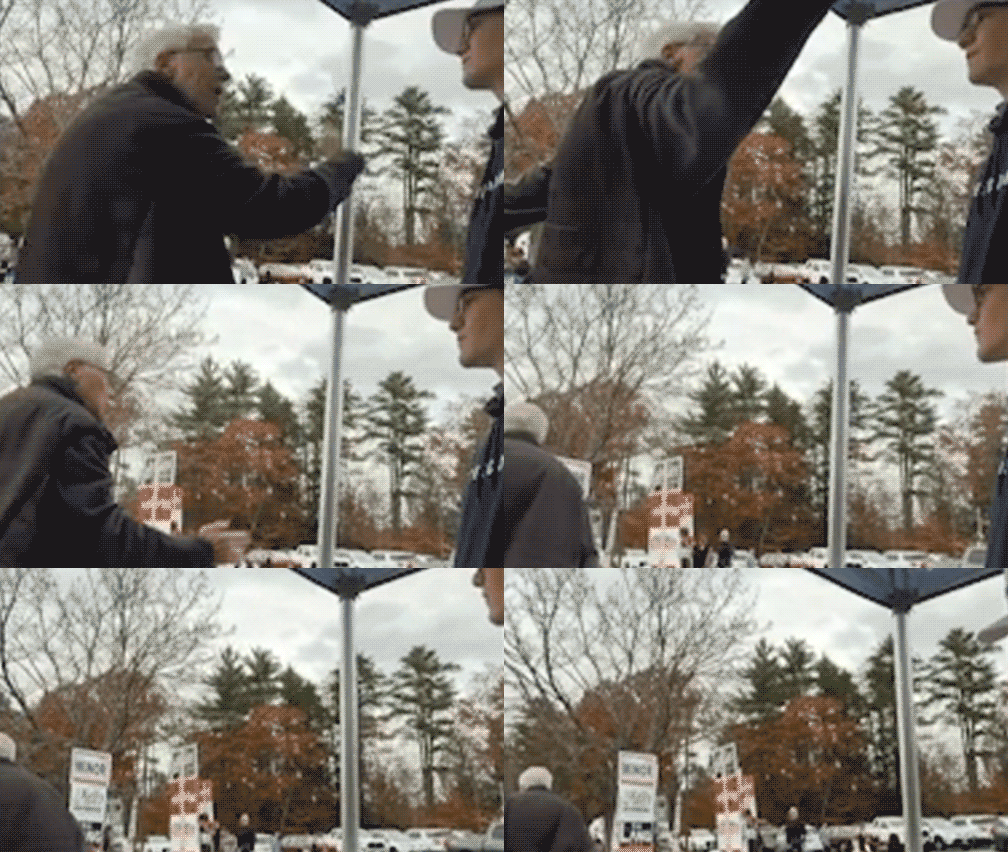
On a crisp November morning in Laconia, New Hampshire, the quiet rituals of democracy were unfolding outside a local elementary school. Voters were making their way to the polls, casting ballots in an election that would shape their communities, when a confrontation erupted that no one expected. At the center of it was Stephen Redic, a 70-year-old poet, and an 18-year-old member of Turning Point Action, a conservative youth organization. What began as an attempt to share poetry—Redic reportedly approached the group’s tent and said he wanted to read a poem about rich people—rapidly devolved into shouting, profanity, and ultimately a physical slap that was captured on video. By 8 a.m., Laconia police had arrested Redic, charging him with simple assault, a misdemeanor, and disorderly conduct, a violation. For a town that had never seen him before, according to Police Chief Matthew Canfield, the incident was both startling and strangely symbolic: a man of letters, armed with words, reduced to using his hands. The elementary school setting, meant to symbolize civic participation and the nurturing of the next generation, became the backdrop for a moment that felt less like democracy and more like a barroom brawl.
The video of the incident is jarring in its immediacy. Redic, visibly agitated, stands before the young activist and raises his voice, his face growing red, his gestures increasingly aggressive. The crowd around him shifts uncomfortably, unsure whether to intervene or step away. At one point, he jabs his finger at the young man and shouts, “You sit there and dare to look me in the face and say I don’t know anything?” His voice is hoarse, frayed with emotion, as if he has been carrying this argument for decades and finally found an outlet. The young man, calm and seemingly trying to engage in debate, doesn’t strike back. Redic continues, his rage building, until he gives the activist the middle finger and delivers a backhanded slap across the face. “That’s what I know,” he says, as if the violence itself were an exclamation point to a lifetime of feeling unheard. Then, as quickly as it began, he storms away, muttering, “F— that s—,” while onlookers gasp and someone off-camera talks about calling the police. It is a scene that plays out in slow motion in the mind afterward: not because it was physically devastating, but because it captures something deeply unsettling about the state of public discourse. A man who presumably saw himself as a truth-teller, a poet, chose to speak with his hand instead of his verse. The poem about rich people was never read. The debate never happened. All that remains is the slap.
Stephen Redic is not the typical image of a political agitator. At 70, he belongs to a generation that came of age in a very different America, one where arguments were often resolved over coffee, not captured on smartphones and uploaded to the internet. His 2023 poetry collection, “Tying My Shoes,” suggests a reflective soul, someone who has lived long enough to see presidents come and go. In fact, Redic boasted of meeting every U.S. president since Dwight D. Eisenhower—a claim that paints a portrait of a man who has been a lifelong observer of power, a witness to history, someone who might have believed that his perspective was valuable, even essential, to a conversation about politics and privilege. But on that Wednesday morning, none of that history surfaced in the interaction. The man who had supposedly stood in the presence of presidents could not stand five feet away from a teenager with a different opinion. Police Chief Canfield said Laconia police had no prior contacts with Redic, emphasizing that this was an isolated incident, not the behavior of a known troublemaker. That detail makes the story even more poignant. A 70-year-old poet, with no criminal history, finding himself handcuffed outside an elementary school, is a cautionary tale about how even the most unexpected people can be swept up in the tempest of modern political aggression. The poem he wanted to share was about rich people, but in the end, the only wealth on display was the poverty of a dialogue that ended before it began.
The legal aftermath now takes center stage. Redic is due in court on December 10 for an arraignment, and as of Wednesday afternoon, it was unclear whether he had hired a lawyer. He did not respond to requests for comment. The charges—simple assault and disorderly conduct—are relatively minor in the grand scale of criminal law, but they carry weight far beyond a courtroom. For the 18-year-old victim, the morning at the polling place likely became something he will not soon forget: a first taste of political activism that turned physical, a reminder that words can sometimes carry a punch. For the Laconia community, it becomes a story people will tell for years, a weird footnote in local election history. But for the country, it is another data point in a troubling trend. This incident comes just fourteen months after Charlie Kirk, the founder of Turning Point USA and Turning Point Action, was assassinated at Utah Valley University, under a similar tent, while attending a campus event. His accused killer, Tyler Robinson, has pleaded not guilty, and a hearing is scheduled for Monday that could set a trial date. The shadow of that tragedy hangs over every tent, every table, every public gathering where activists sit down to talk to their fellow citizens. The slap in Laconia was not a bullet; no one was seriously injured. But it resonates with the same grim frequency: a civic space, a political difference, and someone deciding that the right response is violence.
What makes this incident so human, and so sad, is how ordinary it all seems. There was no elaborate plan, no ideology beyond the rawest instinct. Redic wanted to read a poem. The young man was at his table, presumably ready to engage with passersby, to argue, to persuade, to make a point. In another world, the two might have had a fascinating conversation: a 70-year-old poet who has met every president since Eisenhower, and a teenaged activist who has inherited a political landscape far more fractured than anything his elders experienced. The poet might have shared verses about wealth and inequality, and the activist might have responded with arguments about freedom and opportunity. Instead, they gave each other something far more familiar: fuel for the endless cycle of outrage. The video will be shared, dissected, and weaponized. People will take sides. Some will see a frustrated elder being disrespected by a young conservative; others will see an old man losing control and assaulting a kid. The nuance will be lost, as it almost always is. And that, perhaps, is the most human element of all—the way a single moment, full of complexity and emotion, gets flattened into a headline, a clip, a cautionary tale.
In the end, the story of Stephen Redic and the 18-year-old activist is not really about politics in the traditional sense. It is about the strange, fragile nature of human connection. A poet is someone who works with words, who believes in the power of language to convey meaning, to move hearts, to change minds. To watch one resort to a slap is to watch someone give up on language entirely. Perhaps Redic felt invisible, ignored, patronized by a teenager who seemed to think he knew everything. Perhaps the young man, in his zeal, said something that struck a nerve. We may never know the full story, because the video does not show the beginning, and the poem was never read. But we do know that at that moment, in front of an elementary school, a man who had spent his life tying his shoes and meeting presidents threw all of that away for a few seconds of violent release. The arraignment in December will be a formality, a legal box to be checked. The charges may be dropped, or a fine may be paid, or some compromise may be reached. But the image of an old poet slapping a young activist outside a voting booth will linger, because it asks us something uncomfortable: How did we get here, and what do any of us really know? The poet said he knew something when he struck out, but in truth, he had forgotten the one thing his life should have taught him—that words, however imperfect, are the only bridge we have left. And every time we choose to tear that bridge down, whether with a slap or a shout, we all lose something irreplaceable.