





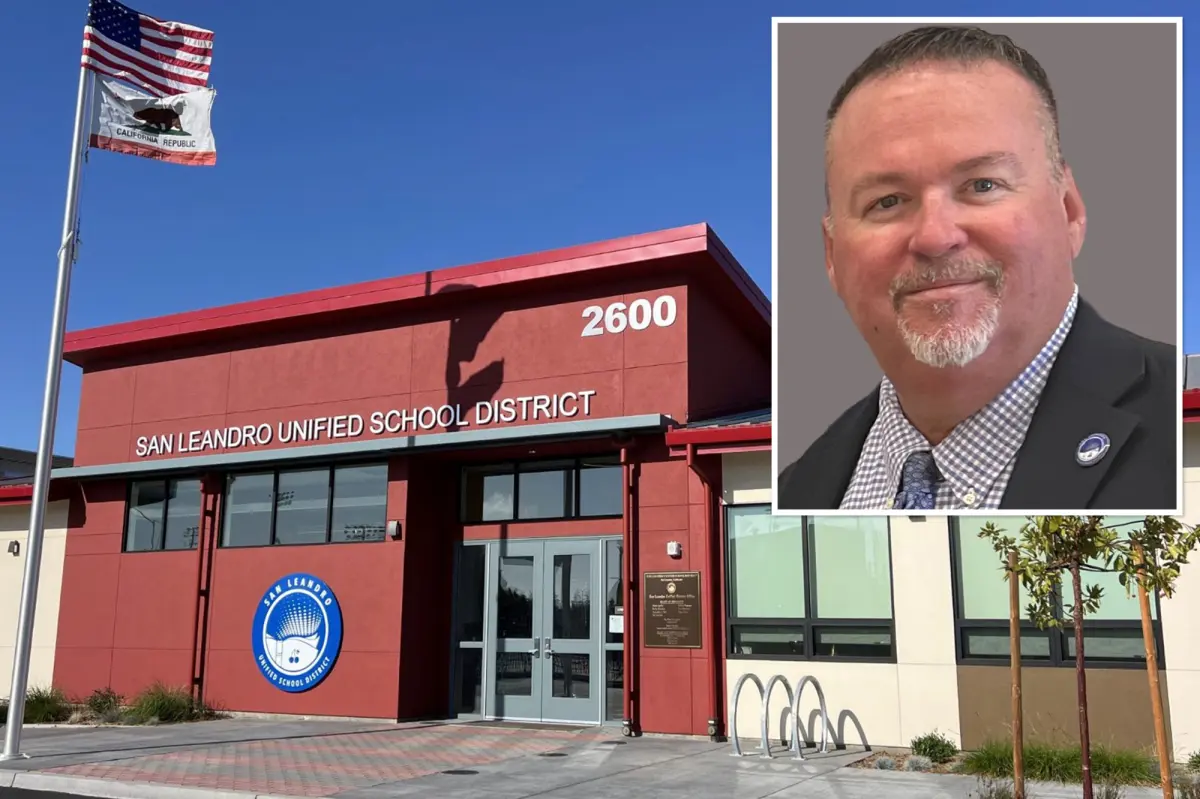
In the heart of the East Bay, where the steady hum of commuter trains and the scent of eucalyptus trees define the morning routine, the San Leandro Unified School District has long been regarded as a bastion of stability and community trust. For over a decade, the figurehead of that stability has been Superintendent Mike McLaughlin, a man whose name has become synonymous with the district’s leadership, its budget approvals, its school board meetings, and its forward-looking educational initiatives. He was the steady hand guiding the district through budget crises, shifts in curriculum, and the unprecedented challenges of a global pandemic. So when the terse, sterile email arrived in the inboxes of staff and board members late last week, announcing that McLaughlin had been immediately placed on administrative leave, the shock was visceral, rippling through administrative offices and teacher lounges alike. The announcement, stripped of any explanatory detail, left a vacuum that was immediately filled by hushed whispers, speculative gossip, and a palpable sense of unease. The man who had served as the public face of San Leandro’s educational system for over a decade had vanished from the helm, replaced by a temporary placeholder, leaving the comfortable, predictable rhythm of the school year fractured. Parents dropping off their children at elementary schools had no idea of the turmoil brewing downtown, but within the district’s central offices, the atmosphere was thick with anxiety, a collective holding of breath as employees waited to understand the gravitational shift that had just occurred beneath their feet.
The catalyst for this sudden leadership vacuum was not a financial scandal or a public political misstep, but rather a deeply personal and troubling allegation stemming from an employees’ gathering—an outing meant to foster camaraderie and teamwork among the district’s top-tier leadership. According to sources with direct knowledge of the situation, the gathering involved alcohol, a common lubricant for easing the formality of professional events, yet one that often blurs the boundaries of acceptable behavior. During the course of this event, it is alleged that McLaughlin, who has occupied the superintendent’s chair since 2013, physically touched a female manager in a manner that she perceived as unwanted and inappropriate. This was not a fleeting, accidental brush; sources indicate it was a deliberate, unwelcome advance that immediately crossed a line of professional decency and personal safety. The female official, whose identity remains shielded for her protection Diagnostically, she has become the fulcrum of a high-stakes institutional crisis. In the days following the incident, the burden of that moment weighed heavily on her, transforming a quiet professional into an unintentional activist, thrust into a spotlight she never sought. She was not alone, however; her bravery in reporting the incident emboldened other employees who had perhaps witnessed the behavior or had harbored their own quiet concerns, leading to multiple employees coming forward to attest to the uncomfortable dynamics of the event Scottsdale. Their collective voices transformed a private grievance into a formal, undeniable allegation that the district’s Board of Education could no longer ignore.
Responding to the mounting pressure and the courage of those who spoke up, the district’s leadership swiftly mobilized a formal response, prioritizing the need for institutional integrity over the loyalty owed to a long-standing administrator. The San Leandro Unified School District Board of Education, which had once trusted McLaughlin with unprecedented authority, issued a terse but significant statement acknowledging the situation. They confirmed that the administrative leave was the “immediate result of allegations made by district employees regarding inappropriate conduct in violation of board policies and the district’s rules of conduct.” The language is sterile, bureaucratic, and carefully measured, but the weight behind it is colossal. In a move designed to ensure objectivity and avoid any appearance of a cover-up, the district has retained an independent investigator to conduct a thorough, impartial probe into the claims. This external investigator will meticulously interview witnesses, review any available footage or communications, and weigh the credibility of the accounts given by the employees who stepped forward. The Board of Education, while remaining legally bound to avoid prejudgment, has explicitly acknowledged that if the allegations are substantiated, the actions constitute a fundamental violation of the adopted board policies and the comprehensive rules of conduct that every employee—from the newest custodian to the highest-ranking administrator—is expected to follow.
The investigation hangs over the district like a dark cloud, and the initial silence from the accused has been deafening. McLaughlin has not responded to multiple attempts by various news outlets to reach him, retreating behind a wall of silence that could be interpreted either as the careful counsel of legal advisors preparing a defense, or a man grappling with the abrupt end of a long public career. The details of the district’s formal statement, which affirmed that the action was “the immediate result of allegations made by district employees regarding inappropriate conduct in violation of Board policies and the district’s rules of conduct,” read like bureaucratic legalese, yet they carry the weight of a death knell for the superintendent’s reputation. The district has moved swiftly to retain an independent investigator, a critical step to ensure objectivity in a case where loyalty and hierarchy could easily be compromised. This outside scrutiny is essential, as the allegations represent a fundamental breach of the trust that is the bedrock of the district’s culture. The board’s cautious, carefully worded statement—phrased around the conditional “if the allegations are true”—reflects the legal necessity of remaining neutral during a pending investigation, yet it does little to quell the rampant speculation that now threatens to poison the district’s internal morale. The independent investigator will now have to sift through witness testimony, reconstruct the timeline of the evening, and assess the toxicology of power, alcohol, and perception that defines such he said-she said scenarios.
For a man whose professional biography reads like a temple to meritocratic achievement, the fall from grace is precipitous. Before ascending to the top role in San Leandro, McLaughlin had already built a formidable reputation as an educational administrator, having previously steered superintendencies in three other school districts, honing a leadership style that balanced academic rigor with fiscal responsibility. His credentials were impeccable; a Doctor of Education from the prestigious University of Southern California gilded his resume, lending an aura of academic elitism to his practical, grounded approach to school administration. He was not merely a paper pusher; he was a visible presence at school ribbon-cuttings, a staunch advocate for teacher retention, and a figure who commanded respect from principals and custodians alike. Yet, the authority that had been earned through decades of hard-won experience is now precariously balanced against the severe weight of these new allegations. As of this writing, McLaughlin has not responded to multiple requests for comment, remaining in a stoic silence that is as deafening as the accusations themselves. That silence is likely the product of legal counsel, a strategic retreat while his attorneys assess the landscape mercilessly. Yet, in the public eye, that silence reads as something else—perhaps defiance, perhaps shame, or perhaps the stunned confusion of a man whose life’s work is unraveling in a matter of days. His career, which includes serving as superintendent of three other school districts before San Leandro secret, and culminating in a doctorate from the University of Southern California, now hangs in a precarious balance. The compensation package, a reported base salary of $390,352, with total compensation reaching $523,128, now stands in stark contrast to the precarious nature of his personal and professional standing, a reminder that even the most elevated positions are ultimately fragile against the crucible of personal conduct.
As the district scrambles to stabilize its leadership, the mechanics of the interim government have been set into motion finds its new anchor in Donal Patel, the Assistant Superintendent of Educational Services, who will step in as acting superintendent during this uncertain period. Patel now faces the Herculean task of steering a district that is simultaneously mourning the perceived fall of its leader and grappling with the administrative and emotional fallout. His sudden elevation to the top seat is not a celebration of ambition but a somber necessity. He must maintain educational continuity, reassuring parents that classrooms are unaffected, while simultaneously managing a tarnished executive office. Meanwhile, the district has made it clear that more details will remain confidential until the independent investigation concludes, a legally cautious approach that leaves the public in a purgatory of uncertainty. For the female manager and the other employees who courageously voiced their concerns, the immediate response is a validation of their truth, a signal that the institution they serve takes their safety seriously. However, the investigation is also a grueling process, requiring them to relive the trauma of the event multiple times, facing cross-examination and scrutiny of their own conduct at the outingque. The district has charged Assistant Superintendent of Educational Services, Donal Patel, with the unenviable task of stepping into the breech as the acting superintendent. Patel now carries the weight of an entire school system on his shoulders, forced to navigate the daily operations of schools, manage the anxieties of the public, and uphold the educational mission, all while the specter of his predecessor’s potential misconduct looms over every decision.
Examining the human element of this scandal reveals a tragic narrative of a titan felled not by a single blow, but by a slow bleed of compromised judgment. Mike McLaughlin’s biography reads like a textbook case of the American success story in public administration. He possesses a Doctorate in Education from the prestigious University of Southern California, a credential that speaks to intellectual rigor and ambition. Before his tenure in San Leandro, he held the superintendent position in three other districts, building a reputation as a competent, if occasionally stern, leader who could navigate complex budgetary landscapes and board politics. His remuneration—a base salary of over $390,000, ballooning to over $523,000 with benefits—places him among the elite of California’s educational leaders, a figure that underscores the immense trust and financial investment that the community placed in his hands. Now, that trust lies shattered. As he sits in his home, likely conferring with legal counsel, he is separated from the daily buzz of the district he helped shape. The silence on his end is strategic, but it also hints at the profound isolation of leadership. He is likely reliving the moments of that evening, wondering how a casual social gathering turned into the catalyst for his potential professional ruin. While this does not absolve him of responsibility if the allegations are true, it paints a picture of a human being—flawed, perhaps arrogant, but still human—watching a lifetime of professional achievements evaporate in the harsh light of a single accusation. Meanwhile, the woman at the center of the story must navigate her own complex reality. She is a “manager” within the district, a position of relative authority, yet one that pales in comparison to the superintendent’s dominance. She has become a reluctant symbol of the #MeToo era, her personal discomfort now a matter of public record, debated by board members and discussed in the hallways of every school she enters Meet the temporary replacement, Dr. Donal Patel, the Assistant Superintendent of Educational Services. His promotion to acting superintendent is a sudden, unceremonious thrust into the spotlighthe did not ask for and likely does not desire. He must now navigate the treacherous waters of a district in crisis, ensuring that the educational needs of thousands of students are met, while simultaneously managing the adult drama that has hijacked the district’s agenda. He inherits a fractured leadership team, a staff that is both scared and angry, and a community demanding answers that cannot yet be provided. The administrative machinery of the district will not stop; the buses will still run, the classrooms will still open, and the curriculum will be delivered. But the spiritual and moral compass of the district is spinning. Patel’s task is not merely to maintain the status quo, but to provide a stabilizing presence, assuring everyone that despite the chaos, the institution’s commitment to its core values—integrity, respect, and safety—remains unwaveringaising the question of whether power can ever be wielded without inviting abuse.
In the broader context, this incident transcends the confines of a single school district in the East Bay. It serves as a stark reminder of the fragile nature of power and the perpetual vulnerability of those lower on the organizational chart. The core allegation—an unwanted advance condoned by alcohol—is a timeless, yet still devastating, violation of workplace protocol. The financial disparity between McLaughlin’s $523,128 total compensation and the salary of a district manager is immense, highlighting the inherent power imbalance that often allows such behavior to go unchallenged for years. It often takes a courageous individual to break the silence, and the fact that multiple employees came forward suggests that the toxic behavior may have festered beneath the surface for some time, waiting for a crack in the armor of authority. The district’s commitment to an independent investigation is a step toward healing, but the road ahead is long and fraught with legal complexities. The board cannot discuss details publicly, bound by confidentiality agreements and respect for the investigative process stolen. For the community, this situation is a sobering reminder that educational leadership is not just about test scores and budgets, but about the moral character of those who set the tone. As the investigation unfolds, the district must confront uncomfortable questions about the informal power dynamics that exist between top administrators and lower-ranking employees, the role of alcohol in professional events, and the systemic pressures that often compel victims to remain silent. The outcome of this investigation will not only determine the fate of Mike McLaughlin’s distinguished career, but it will also define the cultural legacy of the San Leandro Unified School District for years to come, serving as a testament to whether institutions truly uphold the values of respect and integrity they preach to their students. For now, the office that once belonged to the superintendent sits darkly cold, awaiting a verdict that will ripple far beyond the walls of the central administration building.